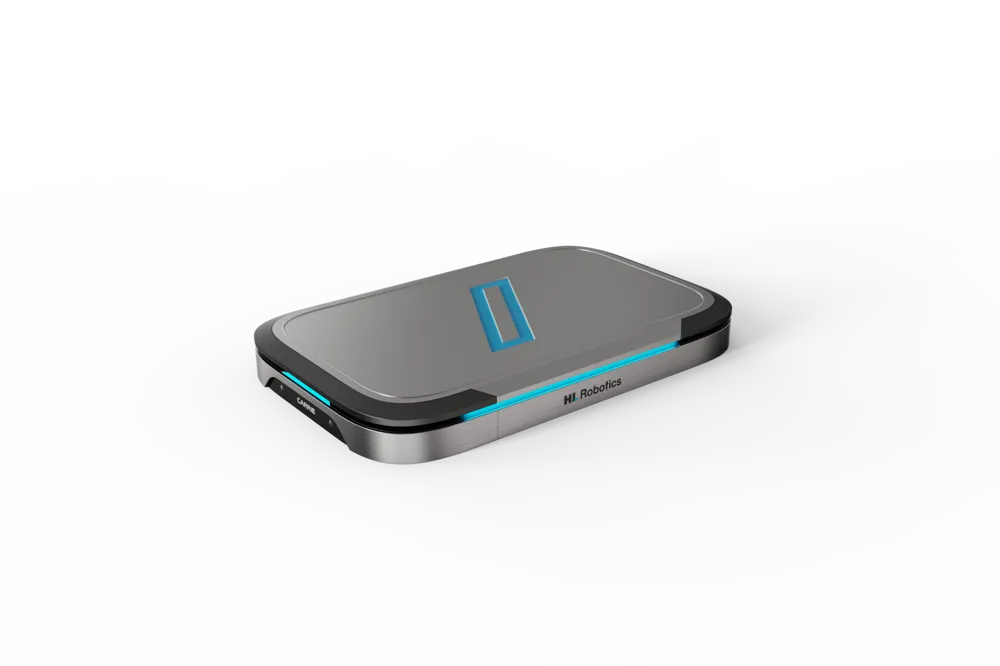
The world's lowest height (15cm)Autonomous mobile robot capable of transporting up to 2-ton cargo – An ultra-slim, heavy-duty AGV (Automated Guided Vehicle) that maximizes safety and efficiency in complex industrial sites by measuring and collaborating on load in real-time with intelligent weight sensors.
HonoreekoConstruction & Industrial Tech로보틱스자율 주행안전 기술지속 가능성모빌리티 솔루션차량 제어
캐리(CARRIE)
11
0
HL Robotics
One-Line Product Definition
Problem Definition
In factories or warehouses, when moving pallets or large cargo,forklifts or large AGVs (Automated Guided Vehicles)had to be used, but these are bulky and make it difficult to share space with people, which greatly restricts work flow. In addition, handling heavy objects requires cumbersome management, such as a separate weight measurement system or manual loading considering the load.
Among existing logistics robots, the thinnest can only carry up to several hundred kg, and robots that can lift several tons are too tall, reducing space utilization. For example, the robot cannot fit under low shelves, creating idle space.
Meanwhile, for multiple robots to collaborate, a separate upper-level system had to calculate load distribution, etc. In short,"There is no robot that can intelligently move heavy loads without taking up much space."This was a pain point in the industrial field.
Key Differentiators
CARRIE is the "world's thinnest" autonomous mobile robot at 15cm tall, and it breaks the existing trade-off by being able to carry up to 2 tons with a single unit. Thanks to its slim design, the robot can penetrate low gaps under pallets or racks to lift loads, and it can move without wasting inter-floor space even in multi-story warehouses.
In addition, by mounting an integrated weight sensor on the robot itself, it immediately measures the weight when a load is placed and determines whether it is within its loading limit. If it is too heavy for one unit, it automatically cooperates with other CARRIE robots nearby to perform collaborative transport by lifting multiple units simultaneously. For this purpose, a swarm control AI is applied between the robots to automatically distribute the load without separate central management.
As a result, load measurement + transport + multi-collaboration are possible with just the robot, without the need for a separate forklift, scale, or collaboration system. Moreover, not only is it low in height, but the vehicle's footprint is only about the size of a delivery cart (88cm wide, 145cm long), allowing it to pass through narrow passages.Omnidirectional driving wheels (Mecanum wheels)are installed to maximize space utilization with 360-degree rotation in place and lateral movement, and HL's ultra-thin power module integrates all motors, batteries, and sensors within a height of 15cm from the ground.
In conclusion, CARRIE is a unique logistics robot that is "low, so it utilizes space well, smart, so it measures weight, and collaborates autonomously."
Key Adopters
Large logistics centers, manufacturing plants, and smart factories are the main entities that need this robot the most. For example, it will be introduced to move parts pallets weighing several tons in narrow spaces in automobile parts factories, or to move product pallets between racks with low floor heights in logistics hub warehouses.
These customers are likely to contract with HL Robotics in the form of B2B industrial robot purchases to deploy multiple CARRIE robots at once. It can also be used to transport materials at construction sites, and to transport heavy containers/luggage at ports or airports (however, additional weather resistance options are required for outdoor environments).
In terms of smart city management, CARRIE can become the basic unit of indoor and outdoor smart logistics networks, so the government or local governments (B2G) may introduce it on a trial basis. However, most realistically, industrial B2B purchases, where the company's logistics/production departments calculate ROI and decide to purchase, will be the mainstay.
Scalability
CARRIE is related to industrial safety standards rather than specific national regulations, so it can be launched globally once it obtains autonomous mobile robot safety certifications in each country. The HL Group has already showcased it overseas through CES, and the global logistics robot market is growing, attracting attention from factories in Asia, North America, and Europe.
In particular, it has secured a patent for its ultra-slim design, making it difficult for competitors to follow immediately, increasing the possibility of preempting the overseas market. However, field application requires local AS networks and integration with existing facilities, so initially it may be limited to Korean and some overseas customers with existing HL Group networks.
However, conceptually, it can be used anywhere there is a warehouse or factory, so the market size is very broad. Furthermore, by modifying this technology, it can be commercialized into other fields such as ultra-slim parking robots (already based on HL's PARKIE robot technology) or hospital logistics robots.
In fact, HL previously developed and commercialized the parking robot Parkie, and CARRIE came out as an extension of that, so in the future,it plans to expand into various industry-specific robot series (All-Care Platform).In summary, it is a solution that can be expanded to various industries because the technology and market timing are right.
Judges' Evaluation
At CES 2026, CARRIE received rave reviews from the judges, winning Innovation Awards in three categories (Industrial Technology, Robotics, and Smart Cities). Professional magazines such as Electronics360 introduced it as *"the thinnest but most powerful robot in the world"*, marveling at the fact that it lifts 2 tons with a thickness of 15cm.
In particular, it is highly regarded and reliable because it is an advancement of the parking robot PARKIE, which won the CES Best of Innovation Award in 2024. Industrial robot experts acknowledged the technology, saying, *"Reducing the thickness of the robot raises concerns about safety and rigidity, but HL has solved this well,"* and the fact that *"the integration of weight sensors simplifies the logistics process"* was also well received.
From a market perspective, it was highly regarded for its potential to connect with actual industry demand, saying that the HL Group is from an automobile parts company and accurately reflects the needs of the manufacturing site. However, some have made realistic criticisms, saying, "The battery capacity will be limited because it is too slim, but is the operating time sufficient?", *"There are limitations such as slopes to completely replace forklifts."
Overall,due to *"high level of technological completeness close to commercialization and clear on-site use cases"*there are only positive reviews without criticism of overestimation, and the HL Group itself is already a company with mass production capabilities, so market launch is also viewed optimistically.
Analyst Insights
🔥 High Marketability / Feasibility of Business Connection – CARRIE is a product that meets the immediate needs of smart logistics and manufacturing sites, and is highly likely to be commercialized soon and generate profits through the HL Group's production/sales network. It can be applied to a wide range of industries, not just a specific niche, so it has great growth potential and is likely to be a successful example of showing *"the potential of Korean robots."*
The award list data is based on the official CES 2026 website, and detailed analysis content is produced by USLab.ai. For content modification requests or inquiries, please contact contact@uslab.ai. Free to use with source attribution (USLab.ai) (CC BY)
댓글 (0)
댓글을 불러오는 중...