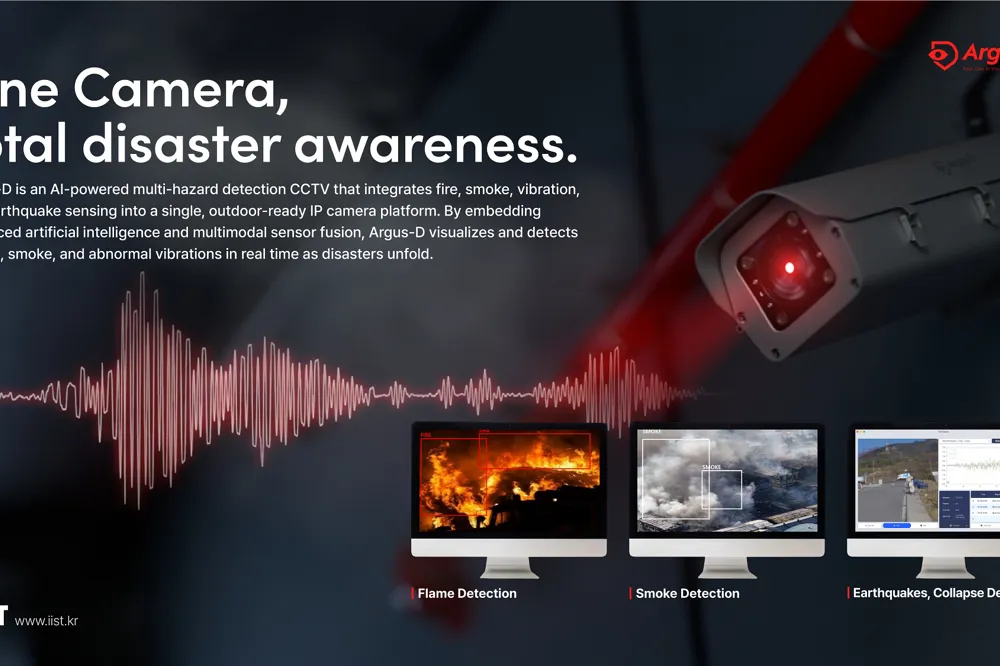
A multi-sensor + AI-powered CCTV system that provides early warnings by real-time detection of various risk factors such as fire smoke, earthquake vibrations, and intrusions; a smart camera for infrastructure [28][29].
##
IIST Co., Ltd
A multi-sensor + AI-powered CCTV system that provides early warnings by real-time detection of various risk factors such as fire smoke, earthquake vibrations, and intrusions; a smart camera for infrastructure [28][29].
##
Existing CCTV networks rely on manual monitoring, resulting in delayed responses to anomalies [28]. Fires and disasters are only identified when a person recognizes smoke on the screen or an alarm sensor is activated, and the golden time is missed, leading to greater damage.
In addition, general security cameras only record intrusions and lack real-time suppression or warning functions.
##
Argus-D combines various sensors such as video (flame and smoke), vibration (earthquake), and sound in a single camera, and performs active early warning by making immediate judgments on-site with edge AI [30][29]. Without cloud transmission, it detects abnormal patterns with deep learning in the camera itself, sounding an alarm within seconds and activating related response systems.
In particular, sensor fusion AI, such as smoke visual detection + vibration sensor cross-validation, significantly reduces false alarms, and captures risk signals in advance at a stage before people recognize smoke or building shaking [29].
As a result, it provides a new safety infrastructure where distributed cameras, like "eyes of the entire city", form a real-time risk monitoring network [31].
Local governments promoting smart cities, large factories or plant operators, and facility managers of campuses and airports are the target adopters. Since the purpose is to build a public infrastructure safety net, it has a strong B2G and B2B nature, and collaboration models with urban security companies or telecommunications companies are also possible.
##
Disaster response such as fire and earthquake is a universal task and can be expanded to cities around the world.
When linked to a platform, API interworking with insurance companies and fire/disaster headquarters systems is also possible (e.g., insurance risk management, automatic fire dispatch), expanding the service ecosystem [32].
However, the speed of distribution is expected to vary by region, depending on video surveillance regulations and infrastructure budgets in each country.
##
It was noted as a "camera that plays the role of a guardian beyond surveillance" [31]. It was considered one of the most dramatic AI use cases at CES, and was evaluated as presenting the direction of urban infrastructure AI [29][33].
On the other hand, in the actual field, there are remaining challenges to be solved, such as installation costs and management issues, and sensor life. However, the market is accepting it positively due to the great need for safety, and pilot discussions are being held with several local governments.
🔥 High marketability / Potential for business connection (Demand is certain as an essential technology for urban and industrial safety, and early adoption cases are expected)
The award list data is based on the official CES 2026 website, and detailed analysis content is produced by USLab.ai. For content modification requests or inquiries, please contact [email protected]. Free to use with source attribution (USLab.ai) (CC BY)