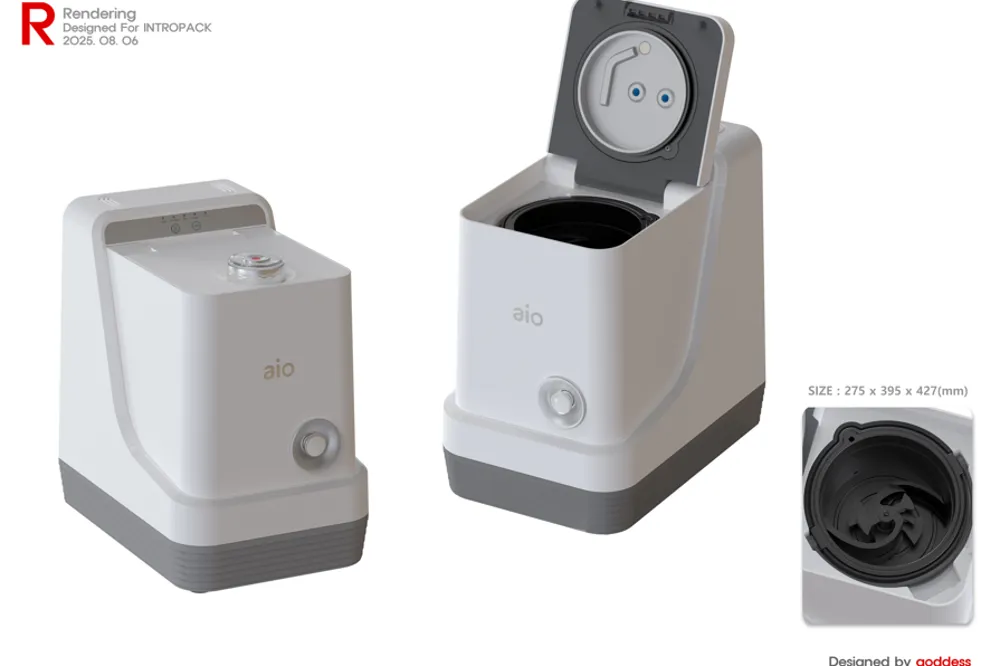
An innovative food waste disposal unit that completely blocks odors and water vapor without a filter, solving the problem of food waste disposal in homes and small businesses.
HonoreekoFood Tech음식물 처리자원 재활용지속가능성친환경 기술스마트 퇴비화AI 제어
aio 음식물 쓰레기 처리기
64
0
INTROPACK/Hanseo University
One-Line Product Definition
Problem Definition
Background Problem: Food waste generated in the kitchen is a nuisance due to odors and bacteria caused by decay, increased disposal costs, and environmental pollution. Existing food waste disposers mostly use deodorizing filters, but the filters are easily damaged by food heat and water vapor, causing odors and vapor to leak and pollute indoor air. This causes discomfort to users and incurs periodic filter replacement costs.
Limitations of Existing Methods: Existing disposal methods, such as disposal in designated waste bags or the use of filter-based food waste dryers/grinders, have limitations in odor leakage and hygiene management. In particular, additional costs and hassles arise for filter replacement or odor removal, and there is a risk of secondary contamination such as leachate leakage during the food waste collection process.
Key Differentiators
Filterless Complete Sealing Technology: The aio food waste disposal unit completely blocks odors and water vapor without a separate filter through high-pressure sealing storage and condensation technology. As a result, no odor or vapor leaks into the room during operation, maintaining a pleasant kitchen environment.
Resource Recycling through Composting: It is designed to not only dry and reduce food waste, but also to compost it for recycling as a resource. This is a differentiator that reduces waste itself and allows the resulting product to be used in an environmentally friendly way.
Ease of Use: It minimizes user intervention by allowing households or small restaurants to easily put in food waste and process it automatically. It is more practical than existing products in that it can be operated indoors without burden because there is no odor and the treatment process is clean.
Key Adopters
Purchasing and Usage Entities: The main targets are general households and small restaurants with high food waste generation. Housewives and self-employed restaurant owners who are highly interested in food waste disposers due to odor problems are the core customer base.
B2C/B2B/B2G Classification: It has a strong B2C product character. It can be seen as a kitchen appliance for general consumers, and can also be linked to support projects at the local government (public) level to reduce food waste disposal costs if necessary (e.g., pilot introduction in apartment complexes, public facilities, etc.).
Scalability
Environmental and Regulatory Aspects: Food waste composting is an environmentally friendly treatment method that complies with environmental regulations, and is an area that can receive policy support. However, since the product is tailored to the domestic kitchen environment, market access strategies may vary depending on the food waste disposal system in each country.
Industry and Market Expansion: Since the food waste problem is a global universal task, this technology can be applied to overseas kitchen appliance markets. In particular, demand can be expected in urban areas with a lot of food waste and countries with developed food industries. In addition, if the scale is expanded and applied to large-scale food waste treatment facilities or systems for apartment complexes, there is room for expansion into the B2B/B2G market.
Judges' Evaluation
CES Award Context: This product was selected as a 2026 CES Innovation Award Honoree in the Food Tech category, and its technology and ideas have been recognized internationally. It seems that it received high scores for its practical innovation in solving odor problems, along with the evaluation that it is a solution that accurately addresses existing problems.
Technological Completeness: It appears to be a commercial-level implementation rather than a prototype, and gives the impression that core functions such as filterless sealing technology have been clearly proven. It is said that the research base is solid as it was developed in cooperation with Hanseo University.
Market Expectations: Food waste disposers are in high demand in Asian markets, including Korea, so the marketability is also evaluated as bright. In line with the eco-friendly and sustainability trends, there are positive expectations for future commercialization connections in local government food waste treatment policies or the eco-friendly kitchen appliance market.
Over/Underestimation Factors: However, consumer response may vary depending on the actual processing capacity, speed, and maintenance costs. Performance sustainability and safety due to non-use of filters, etc., will require further evaluation after actual use, but so far, it has been purely well-received without any overestimation concerns compared to its innovation.
Analyst Insights
🔥 High marketability / Business connection possible (A product that solves a clear pain point in real life, and has a high potential for success in both policy and commercial demand)
The award list data is based on the official CES 2026 website, and detailed analysis content is produced by USLab.ai. For content modification requests or inquiries, please contact [email protected]. Free to use with source attribution (USLab.ai) (CC BY)
댓글 (0)
댓글을 불러오는 중...