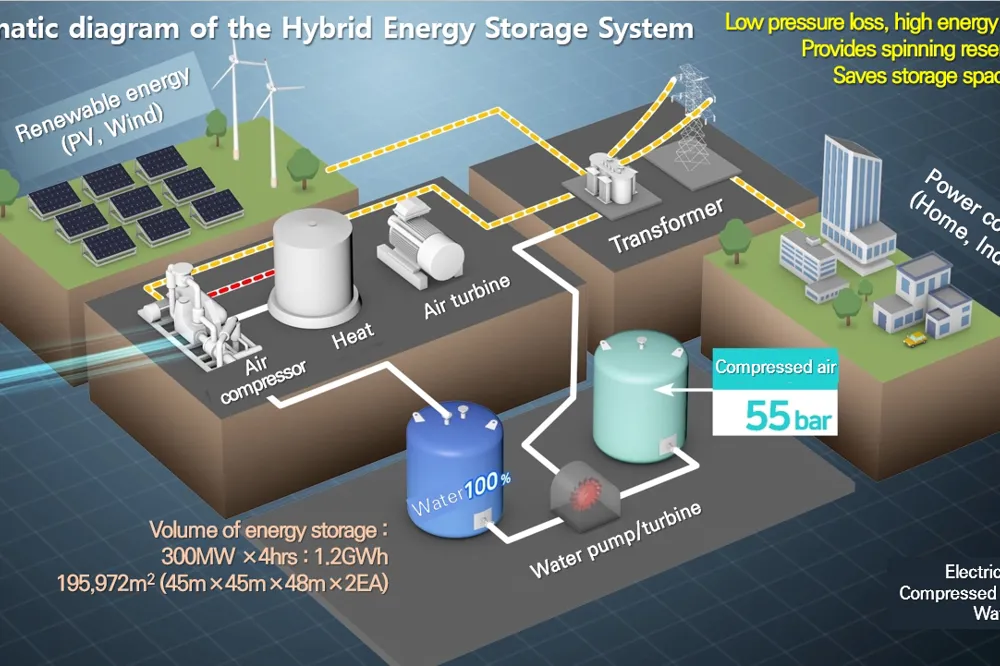
Compressed air + hydraulic hybrid large-capacity energy storage device. This is a new concept grid energy storage system that can store more than 1,000 MWh of power for more than 8 hours by combining the space efficiency of compressed air and the efficiency of hydraulic power, without the need for a huge reservoir required by existing pumped hydro storage.
HonoreekoSustainability & Energy Transition하이브리드 에너지 저장풍력 발전수력 발전에너지 효율스마트 그리드전력 안정화
HESS(Hybrid Energy Storage System) - Aero & Hydro 융합
3
0
Korea Electric Power Corporation (KEPCO)
One-Line Product Definition
Problem Definition
Renewable energy sources such as solar and wind power have fluctuating outputs, making large-scale power storage essential. The two main existing large-capacity storage methods are ▲Compressed Air Energy Storage (CAES) and ▲Pumped Storage Hydropower (PSH), but each has significant drawbacks.
CAES has a low round trip efficiency (RTE)of 50-70% due to heat loss during the compression, storage, and release of air. On the other hand, pumped hydro storage is efficient but requires huge reservoirs at the top and bottom of mountains, which poses challenges in terms of terrain limitations and securing sites. In addition, environmental impacts make new construction difficult.
In short, the lack of cheap and large batteries, which are essential for expanding renewable energy, has been pointed out as a problem for grid stabilization.
Key Differentiators
HESS combines only the advantages of compressed air (Aero) and hydraulic power (Hydro) to offset the disadvantages of both technologies. Compressed air has a high storage density, requiring only 1/10 of the facility area of pumped hydro, but its efficiency is low. The key is that the fusion of hydraulic power principles has increased energy efficiency to approximately 80%. This is approximately 10-30%p higher than existing CAES and close to the 86% of lithium-ion batteries.
At the same time, it is designed as a modular facility that is less dependent on geological conditions so that it does not require huge underground caverns or reservoirs. For example, it can be installed by combining above-ground tanks and hydraulic cylinders, greatly reducing site restrictions.
With this innovation, large-scale storage with high efficiency like pumped hydro storage, but with 1/10 of the installation area and low investment cost per 1MWh, has been realized. As a result, it is a utility-grade device that mitigates grid variability by storing excess power from renewable energy all day and releasing it when needed.
Key Benefits
The main customers for this solution are power companies and power infrastructure investors. Since Korea Electric Power Corporation itself is the developer, KEPCO and its power generation subsidiaries will install it on the domestic power grid first.
For future overseas exports, foreign public power corporations, private power companies, and energy infrastructure companies may adopt it. For example, power grid operators in the Middle East or Australia with a high proportion of renewable energy may purchase it for long-term storage, or island region governments building microgrids may be interested.
Among general companies, data center operators or businesses with large-scale renewable energy complexes may adopt it for ESS purposes. However, since it is basically a hundreds of MW to GW-class facility, it will be sold/built in the form of B2G/B2B large-scale projects.
Scalability
HESS is considered the most advantageous concept for infinitely expanding capacity among existing commercial ESSs. Since there are few geographical restrictions, it can be built anywhere, such as on flat land or along the coast, making it advantageous for global distribution. In particular, it can be spotlighted as a renewable energy storage solution in flat areas or desert areas where pumped hydro storage is difficult.
In terms of technology expansion, various applications are possible in addition to storing excess power, such as *power quality adjustment (frequency adjustment)* and linkage with green hydrogen production.
However, since it is a very large infrastructure, the construction cost is high and the project lead time is long. Rather than increasing explosively in the private market, it is expected to be gradually built, focusing on national projects. In addition, as it is a new combination of technologies, performance verification must be preceded in the initial commercial plant. Growth will be determined by each country's policy support and eco-friendly trend.
In terms of regulations, it must go through a process similar to power plant construction permits and pass safety and environmental impact assessments.
Judges' Evaluation
The CES award is a rare case of technology in the power infrastructure field being selected. This is interpreted as meaning that the judges placed great importance on the impact on a sustainable future. The innovation point was pointed out as "solving the grid storage challenge in a way other than batteries," and the level of technical completeness was also evaluated as reliable due to KEPCO's long research results.
There are high expectations that this technology can significantly lower the cost of renewable energy storage if it is commercialized in the market. However, there are also voices of caution against overestimation, as it still appears to be in the proof-of-concept/pilot stage.
Power industry experts say, "HESS, which can be called pumped hydro storage on land, will be a game changer if it is put to practical use, but there is still no demonstration plant data," and mention that performance verification is needed for the next 5 years. There is also a positive view that winning the CES Innovation Award can rather be a good opportunity to promote it to those outside the power industry and attract investment and cooperation.
Overall, the technical potential is highly evaluated, but the market's expectations are cautiously observed.
Analyst Insights
🧪 R&D and concept verification stage (Noted as an innovative concept for power grid stabilization, but still requires time and verification for practical use as it is in the research and development stage that requires demonstration)
The award list data is based on the official CES 2026 website, and detailed analysis content is produced by USLab.ai. For content modification requests or inquiries, please contact contact@uslab.ai. Free to use with source attribution (USLab.ai) (CC BY)
댓글 (0)
댓글을 불러오는 중...