An intelligent facility diagnosis platform that prevents accidents by predicting signs of failure in ultra-high voltage substation equipment in real time using AI (a system that detects equipment abnormalities early with on-site sensors + AI).
Best of InnovationkoEnterprise Tech변전 설비 진단실시간 데이터 분석설비 예지보전전력 설비 관리자동화 시스템고장 예측
SEDA(Substation Equipment Diagnostic & Analysis System)
6
0
Korea Electric Power Corporation (KEPCO)
One-Line Product Definition
Problem Definition
Failures in ultra-high voltage equipment at power substations lead to large-scale blackouts and significant losses. However, existing diagnostic methods rely on periodic inspections, making it difficult to detect abnormalities early. In the past, visual inspections were performed weekly, and internal disassembly inspections were performed every 2-3 years, often missing subtle defects or signs of aging that occurred between inspections.
In particular, deterioration or partial discharge inside transformers or switchgear is difficult to detect in real time during operation. Abnormal signs are often identified only after the equipment damage has progressed significantly. Furthermore, visual and manual inspections are costly and time-consuming, and diagnostic variations occur depending on the skill level of the personnel. These diagnostic gaps and limitations have led to reduced efficiency in preventive maintenance of power facilities and the risk of unexpected power outages.
Key Differentiators
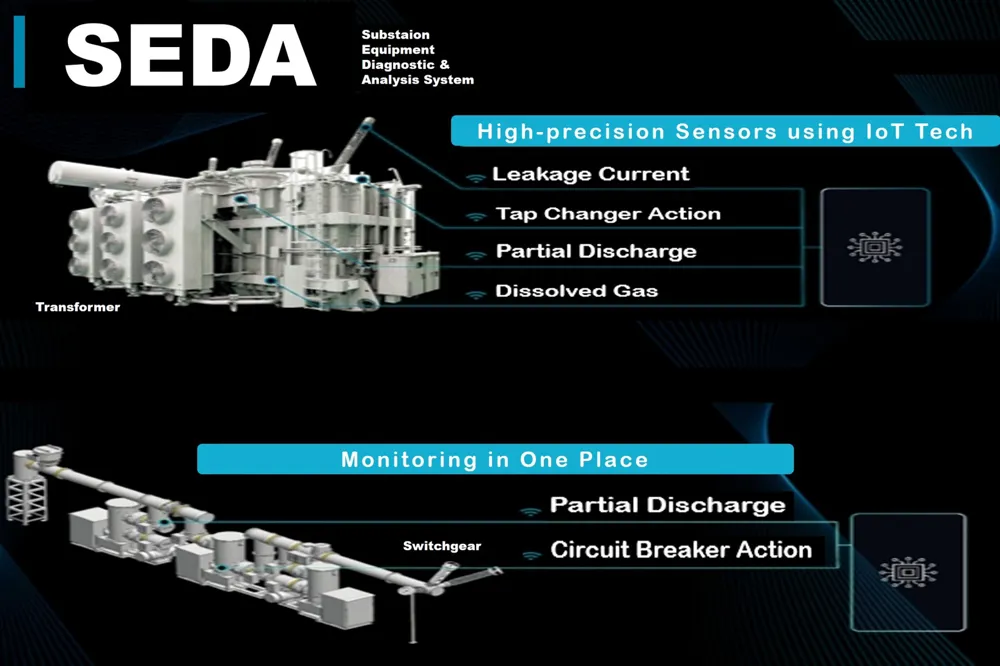
The biggest differentiator of SEDA is that it goes beyond existing manual and intermittent inspections by introducing continuous monitoring and AI predictive diagnostics. Specifically, six types of sensors (temperature, vibration, partial discharge, gas, etc.) are attached to transformers and switchgear to collect real-time status data, which is integrated with a database of past inspection history data. Then, an AI algorithm automatically analyzes for signs of defects. This allows immediate identification of subtle abnormal patterns that humans may miss, enabling preemptive action within the "golden time" for potential failures.
For example, in field applications in the first half of 2025, SEDA prevented 10 ultra-high voltage equipment failures in advance, preventing damage worth $24 million and achieving '0' power outages. AI-based time-series prediction reduces the search area to 1/25 of the past, quickly identifying problem areas. Intelligent unmanned diagnostics reduce reliance on manpower and operate with 95% or higher reliability even at night or in bad weather, which are excellent advantages compared to similar systems.
In short, SEDA is a data+AI convergence solution that shifts the paradigm of substation asset management from "reactive response" to "proactive prediction."
Key Adopters
Key Adopters: The main entities that will adopt this solution are power facility operators and public power institutions. For example,Power companies (power plant and transmission/distribution network operators)is a model for applying SEDA to its substations and transmission infrastructure. Since Korea Electric Power Corporation (KEPCO) developed it in-house, it will first be adopted within KEPCO and its affiliates, and in the future, it will be exported and supplied to overseas power public corporations or private power grid operators in a B2G/B2B format. In addition, large industrial complexes or institutions with their own substations, such as railways and airports, may also be targets for purchase.
In summary, it is mainly B2B/B2G (power infrastructure companies, government power authorities) and not for general consumers.
B2C/B2B/B2G classification: B2G and B2B (for power public corporations and private power companies)
Scalability
Environmental/Regulatory Constraints: Since it is a system applied to power facilities, power grid standards and safety certifications of each country are required. The power grid sector tends to be conservative, making large-scale adoption difficult without proven reliability. SEDA has already built reliability by completing pilot verification in the KEPCO operating environment. In terms of regulations, there may be requirements for power IT system security or AI decision-making explanations, but these are not expected to be major constraints.
Industry/Market Scalability: The market potential of SEDA is significant due to the increasing demand for upgrading aging power infrastructure worldwide. KEPCO showed its willingness to enter overseas markets such as North America through the CES exhibition, and is likely to use SEDA as an export solution in connection with its smart grid/digital twin strategy.
Also, SEDA'score technology (AI predictive diagnosis platform)can be extended and applied to other industrial asset management such as power generation facility, transmission line monitoring, and factory plant facility management in addition to substations. However, the power facility market hasa small number of customers at the national level (mainly B2G)Therefore, project-based adoption targeting major power companies in each country is expected to be the focus rather than comprehensive spread. Nevertheless, the economic benefits of preventive maintenance (savings from preventing power outages) are clear, so it is highly likely to become a key element in the digitalization of the power industry in the long term.
Judges' Evaluation
At the CES 2026 Innovation Awards, SEDA was selected as an honoree in the Enterprise Tech category, drawing attention as a successful digital transformation case for a traditional power public corporation. Technology media outlets praised the fact that "AI acts as a gatekeeper for substations, preventing major power outages," andactual prevention results (prevention of 10 accidents)The data that proved this was regarded as a technology with completeness and effectiveness. Market experts at KEPCO"presented a future power grid management paradigm"and is receiving positive responses as a case that proves the value of AI utilization even in traditional industries.
The level of technology maturity is considered stable as it has already entered the diffusion stage after effectiveness verification in the pilot project, and there is a high level of interest from overseas power officials at the CES exhibition site, soit will be a "catalyst for global expansion"However, some say thatwe need to see "how much the solution optimized for the Korean power grid environment can be customized overseas."presented a cautious view. Overall, it is evaluated as an innovation that meets market expectations, and there are not many overestimation factors, but rather more potential.
Analyst Insights
🔥 High Marketability / Business Connection Possible (The proven AI predictive maintenance effect solves a major pain point in the power industry, and the prospect of commercialization is bright in line with the digital transformation needs of global power companies.)
The award list data is based on the official CES 2026 website, and detailed analysis content is produced by USLab.ai. For content modification requests or inquiries, please contact contact@uslab.ai. Free to use with source attribution (USLab.ai) (CC BY)
댓글 (0)
댓글을 불러오는 중...