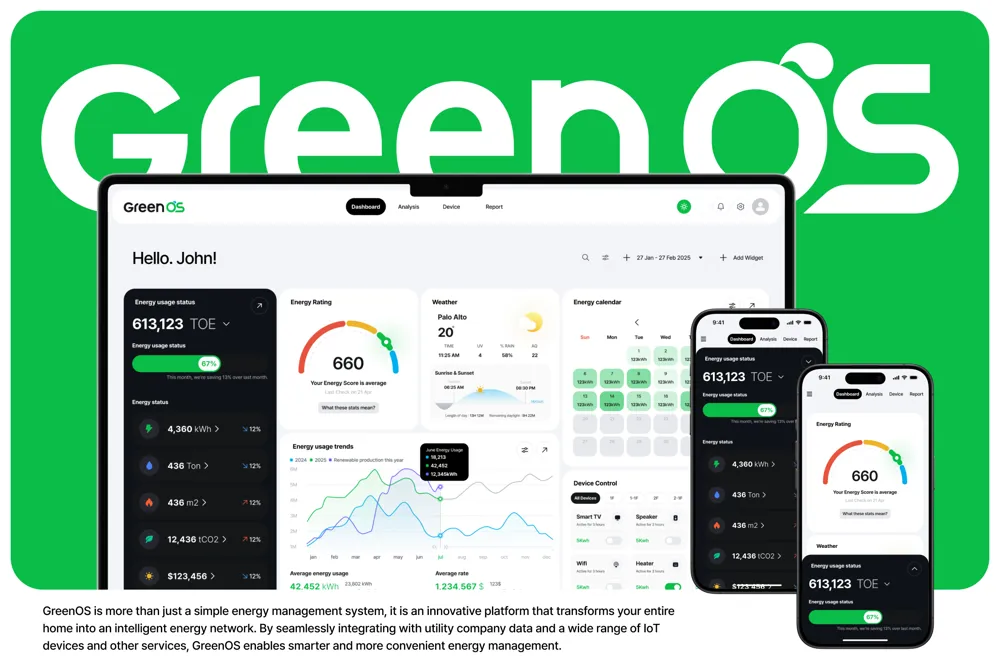
Sensor-Free AI Energy Management Platform. A SaaS solution that uses AI to analyze building power usage data without separate hardware sensors, helping to optimize real-time energy consumption and manage carbon emissions. (A platform that allows building managers to easily perform difficult energy-saving tasks with chatbots and automated reports)
HonoreekoEnterprise TechAI 에너지 관리센서리스 모니터링BEMSNILMESG 보고탄소 배출량 감소
GreenOS: 에너지 및 탄소 관리를 위한 센서리스 AI 플랫폼
4
0
Korea Greendata
One-Line Product Definition
Problem Definition
Existing Building Energy Management Systems (BEMS) require significant cost and expertise for installation and operation, making them impractical for small and medium-sized buildings or existing buildings. The need to install dozens of sensor devices and have specialized personnel to handle them has created a high barrier to entry.
As a result, even when implemented, most are only used for monitoring due to the complexity of the system, and are not actively used for energy optimization. In addition, energy waste is difficult to address with uniform operation because each building has different environments and usage patterns.
In summary, high costs and complexity have been hindering energy saving efforts.
Key Differentiators
The core innovation of GreenOS is the complete elimination of hardware sensors. It has a deep learning algorithm that accurately separates the consumption of individual facilities using only main power data through NILM (Non-Intrusive Load Monitoring) technology. This allows it to identify energy usage and anomalies for each piece of equipment without additional metering equipment.
It also provides a GPT-based chatbot interface (Greeny), allowing users to obtain information such as "What were the problems with the heating and cooling equipment yesterday?" in a conversational manner through questions instead of complex dashboards. In addition, it is equipped with features that compensate for the lack of expertise of managers, such as automatically generating ESG reports and presenting energy saving scenarios through AI simulation.
The biggest differentiator from similar energy management platforms is that it replaces expensive sensor networks with software and maximizes operational convenience.
Key Adopters
The main customers are all entities that operate buildings or facilities. For example, office buildings, university campuses, hospitals, factories, and government offices are likely to adopt it for the purpose of reducing energy costs and managing carbon emissions.
Building owners, facility management companies, and energy service companies (ESCOs) can purchase and apply it to each site. In addition, local governments may adopt it in bulk to reduce energy consumption in public buildings under their jurisdiction, or large corporations may distribute it to multiple business sites.
In terms of business model, it will be a B2B/B2G SaaS, supplying one platform to multiple buildings in the form of a license. It is a particularly attractive solution for companies with greenhouse gas reduction obligations.
Scalability
Because this platform is cloud-based software, it can be expanded without national or industrial boundaries. It has already been thoroughly verified in Korea and has won awards from government agencies, and it is expected to be applicable to cities around the world with similar building management methods.
However, initial tuning may be necessary due to differences in power grid data formats and energy rate structures in each country. Since big data and AI algorithms are at its core, its functions can be expanded to other fields such as factory equipment optimization and smart energy for home use once data is secured.
For example, it can be developed into power optimization for each facility in industrial factories or smart home energy assistants. In terms of regulations, the barrier to entry is relatively low because only data privacy and security issues need to be managed and no separate equipment certification is required.
Overall, it is considered a solution with high scalability.
Judges' Evaluation
In the CES review, the point of *"breaking through hardware barriers with software"* was well received. It was recognized for both innovation and practicality in that it accurately classifies energy without sensors, leading to the award.
In terms of technical completeness, the fact that it has already won awards from the Korean Ministry of Land, Infrastructure and Transport and secured 10 intellectual property (IP) rights has added to its credibility. Market expectations are also high, and demand for solutions such as GreenOS is expected to increase in a situation where companies have strong ESG requirements and cost reduction pressures.
However, some point out that the conservative perception in the field regarding *"AI-based energy management"* is a variable. In other words, the actual rate of adoption will depend on how quickly traditional facility teams accept these AI tools.
Overall, the prevailing opinion is that it has brought innovation to the undervalued field of building energy.
Analyst Insights
🔥 High Marketability / Business Connection Possible (As a practical solution that removes the installation cost barrier, widespread commercialization is expected in the building management market where there is a great need for energy savings)
The award list data is based on the official CES 2026 website, and detailed analysis content is produced by USLab.ai. For content modification requests or inquiries, please contact contact@uslab.ai. Free to use with source attribution (USLab.ai) (CC BY)
댓글 (0)
댓글을 불러오는 중...