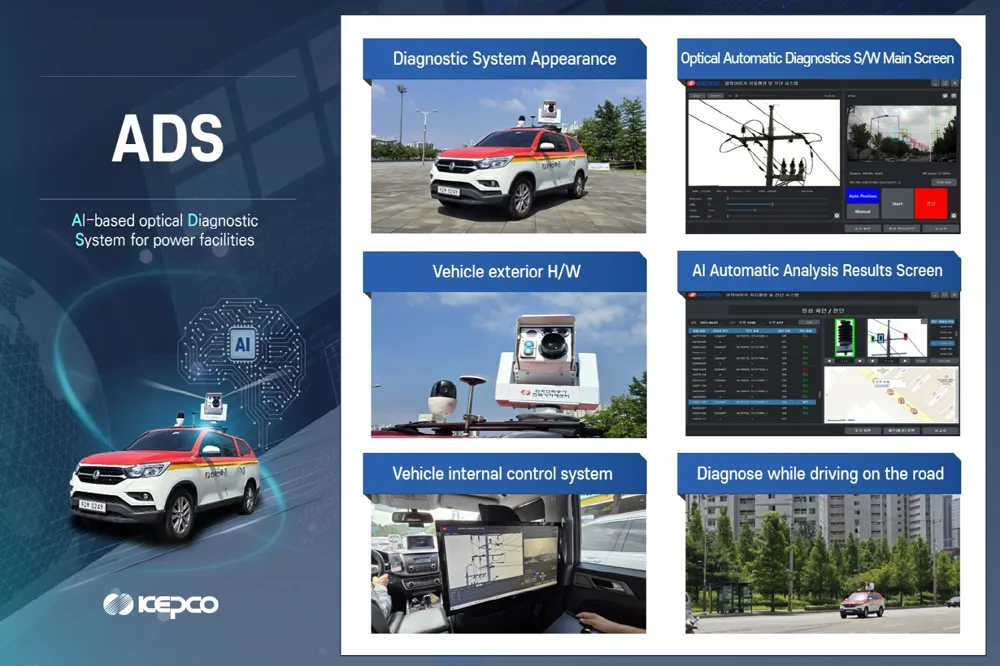
ADS(AI 기반 전력 설비 광학 진단 시스템)
Korea Electric Power Corporation (KEPCO)
ADS Optical Diagnostic System (AI-based optical diagnosis of power facilities, KEPCO)
Basic Information
Company Name: Korea Electric Power Corporation (KEPCO)
Company Website:https://home.kepco.co.kr/kepco/EN/main.do
Korean Company: Global (DB: is_korean_company = false, but actually a Korean public enterprise)
Original Link:https://www.ces.tech/ces-innovation-awards/2026/ads-ai-based-optical-diagnostic-system-for-power-facilities/
One-Line Product Definition: ADS (AI-based optical diagnostic system for power facilities)
Problem Definition
Difficulty in managing extensive power grids: Manually inspecting tens of thousands of kilometers of transmission and distribution lines, transformers, switches, and other equipment requires enormous manpower and time. Existing manual diagnostics could only inspect 119 facilities per person per day, resulting in management gaps. Furthermore, visual inspection could miss subtle signs of degradation or vary depending on the skill level of the personnel.
Risk of frequent power outages and accidents: If failures that were not addressed in advance due to inspection gaps and inadequate diagnosis accumulate, they can lead to major accidents such as transformer explosions or power outages. In addition, the increasing failure rate due to aging equipment has limited the ability to prevent safety accidents and improve reliability with existing methods.
High Costs: Korea Electric Power Corporation was investing approximately $8.7 million annually in the existing manual inspection method. Nevertheless, efficiency was low, resulting in a poor cost-effectiveness.
Key Differentiators
Overwhelming Inspection Efficiency: The ADS system is mounted on a special vehicle and inspects facilities with cameras and AI while driving at 30 km/h. This allows for the inspection of up to 2,400 facilities per day, achieving more than 20 times the efficiency compared to manpower. In other words, it performs work that used to take 20 days in just one day.
Real-time AI Defect Analysis: While driving, the camera recognizes utility poles or transformers with 93.9% accuracy, automatically identifies and tracks them, acquires high-definition images, and AI immediately analyzes whether there are defects. The analysis accuracy ranges from 74.4% to 96.9%, and it identifies various defects such as current leakage and insulation damage in real time on-site and immediately saves the results to the cloud. This real-time capability is on a different level from the existing method of having people return to the office to analyze photos.
Continuous Learning Improvement: The system continuously learns the AI model by accumulating detected defect data. As time passes, the accuracy and detection range improve, and new types of failure patterns can also be learned. In the end, it is a continuously evolving platform, not a one-time tool, in that it is a self-diagnosis system that becomes smarter over time.
Improved Safety through Preventive Maintenance: This early warning system enables proactive repairs at the small sign stage, greatly contributing to power outage prevention and safety accident prevention. The big differentiator is that it has shifted from responding to accidents after they occur to AI predictive maintenance.
Key Adopters
B2G / Public Power Company: Korea Electric Power Corporation (KEPCO) is the developer and primary user. In the future, overseas power companies may adopt this system. Public/private companies that manage extensive facilities, such as PG&E in the United States or European power companies, are key customers.
Large-Scale Facility Management Companies: In addition to electricity, companies with extensive infrastructure such as railway lines, transmission towers, and control camera networks can also adopt modified versions. For example, railway corporations can use it to inspect railway lines, or oil pipeline operators can use cameras to inspect pipelines, which is expected to expand to B2B infrastructure management companies.
Scalability
International Power Grid Market: With the global upgrade of aging power grids and the move towards smart grids, the demand for solutions like ADS is high. Korea Electric Power Corporation has already promoted globally with CES participation, and the possibility of pilot discussions with power authorities in the United States and the Middle East is mentioned. It can be applied to any country with just multilingual AI models and localization.
Application to Other Industries: The core technology is high-speed mobile-based image recognition + AI defect determination, which can be applied to road pothole inspection, oil pipeline leak detection drones, etc. In other words, ADS can be expanded into a smart maintenance platform and licensed to various industries such as bridge and tunnel inspection and building facade diagnosis.
Regulations and Restrictions: This system may replace existing manpower inspections, which may lead to manpower reallocation issues, but it is not expected to cause major social backlash because the focus is on increasing efficiency rather than reducing manpower in terms of power safety. Technically, a response process (human verification procedure) is required in the event of AI false detections, but this is already built-in. There is no special regulatory resistance as long as data storage/transmission security is observed.
Judges' Evaluation
Game Changer in the Power Industry: The CES judges evaluated ADS as a **"paradigm shift in industrial infrastructure management"**, and it was recognized as the best innovation in the construction and industrial technology field. In particular, it was noted that a public enterprise achieved CES Best of Innovation-level results with the developed technology. BusinessWire reported that KEPCO unveiled nine future power technologies at CES 2026, declaring its aim for the global market, and introduced ADS as a core export technology.
Technological Completeness: Tens of thousands of image learning data obtained from actual operating sites (Jincheon testbed, etc.) are mentioned as the secret to AI accuracy. Achieving a 90% recognition rate with only optics without additional sensors such as LiDAR is evaluated as AI model excellence. However, industry experts commented that performance in bad weather or night environments and detection of new defects that AI has not yet learned need to be verified in the future.
Market Expectations: The power industry expects it to be a solution that can achieve both operating cost reduction and reliability improvement. The existing labor cost problem of $8.7 million per year can be greatly reduced by introducing AI, and above all, ROI is very high because it can prevent large-scale power outages and prevent hundreds of millions of dollars in losses. On the other hand, internal resistance is pointed out as a challenge for retraining and acceptance of technical personnel as AI enters a field that has traditionally been labor-dependent.
Analyst Insights
🔥 High Marketability: As a solution that realizes efficiency and smartization, which have emerged as essential tasks for the infrastructure industry such as electricity, a rush of adoption by global power companies is expected. It is highly likely to quickly dominate the market in terms of technological maturity and immediate economic feasibility and become an industry standard in the future.
The award list data is based on the official CES 2026 website, and detailed analysis content is produced by USLab.ai. For content modification requests or inquiries, please contact contact@uslab.ai. Free to use with source attribution (USLab.ai) (CC BY)