An AI-based music copyright protection system that detects copyright infringement by identifying AI-generated and plagiarized music at the song structure level.
HonoreeEnterprise TechAI음악 저작권 보호IP 보호인공지능저작권 관리음원 분석
MIPPIA - AI Music IP Protection System
32
0
Mippia Inc.
One-Line Product Definition
Problem Definition
In the music industry, plagiarism issues involving AI-generated content and similar melodies/rhythms are rapidly increasing. Existing sound source comparison technologies (waveform or simple sound pattern matching) cannot distinguish between complex music structures or AI synthesis differences.
Consequently, composers, record labels, and streaming platforms struggle to identify the boundaries between AI tracks and original songs. Additionally, the lack of global real-time new song monitoring makes it difficult to immediately detect illegal remixes or plagiarism.
Key Differentiators
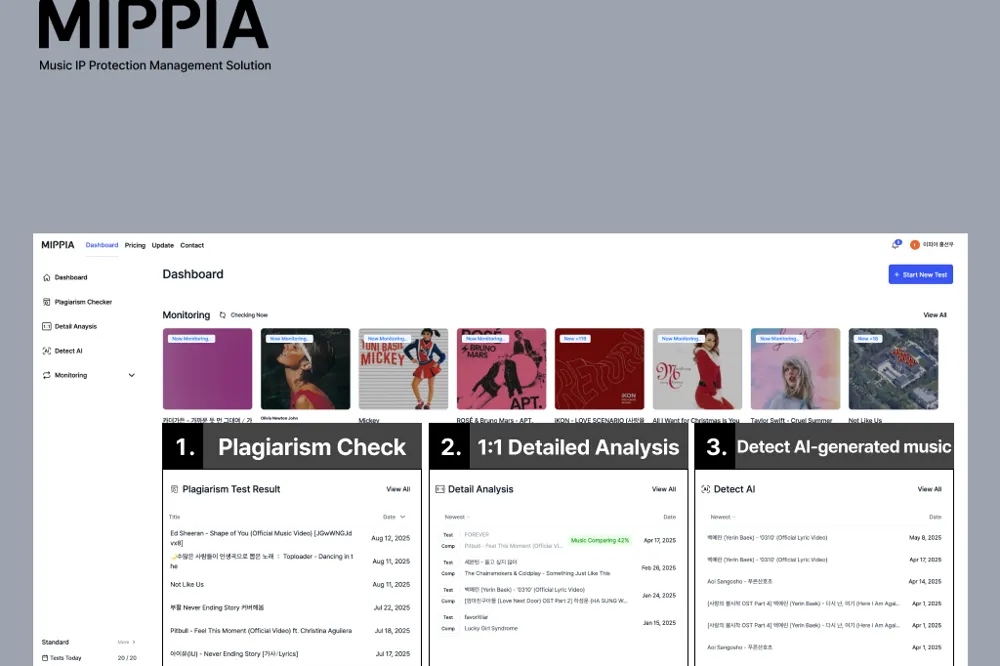
MIPPIA uses a four-stage AI engine that analyzes a song's structure, melody, and rhythm down to the sheet music level. Unlike existing waveform comparison-based tools, it evaluates quantitative similarity in 4-bar units through sound source separation (stereo -> individual instruments), feature extraction, and rhythm/structure analysis.
In particular, the piano roll-based visualization interface allows even non-experts to intuitively understand the similarity. It also includes a model that can determine whether music is AI-generated with 98% accuracy.
Another differentiator is that it provides real-time plagiarism monitoring through global sound source data monitoring and API integration.
Key Adopters
The music industry, including music production companies, labels, and streaming platforms, are the main customers. It targets companies (B2B) that want copyright management and legal dispute resolution, and public institutions (copyright organizations) can also be potential customers.
It is provided as a business-to-business (B2B) service rather than being used directly by individual creators.
Scalability
Music copyright is a global issue, so global scalability is high. As an API-based solution, it can be applied to other languages and markets.
However, due to differences in copyright legal systems and data access methods (sound source DB) in each country, localization is necessary even though the technology itself is global. The monitoring system can be directly linked to media platforms (YouTube, TikTok, etc.) and can be expanded to video and multimedia content discrimination.
Judges' Evaluation
It has been recognized for its technological innovation by winning the CES Annual Award. Mippia is being verified by K-pop production companies and is also receiving support from the Korean SBA, and is evaluated as a startup's achievement.
The industry has high expectations, saying that it is "a solution to solve the copyright plagiarism problem in the AI era." However, there are technical and legal obstacles such as real-time large-capacity processing and securing copyright data, so there are concerns about initial overestimation.
Currently, it is attracting attention as a practical tool that can meet the demand for global copyright response.
Analyst Insights
🔥 High marketability. In an era where AI music is rampant, the demand for copyright protection is rapidly increasing, so there is great potential for B2B-centered growth.
If accuracy and scalability are proven, it is expected to become a standard technology.
Product demo video: (Official demo video related to the product is not released) – See CES presentation and report video: Mippia presentation
The award list data is based on the official CES 2026 website, and detailed analysis content is produced by USLab.ai. For content modification requests or inquiries, please contact [email protected]. Free to use with source attribution (USLab.ai) (CC BY)
댓글 (0)
댓글을 불러오는 중...