An AI companion panda doll for lonely seniors – a robot that provides emotional support and helps manage dementia in the elderly through emotional connection with the appearance and movements of a real baby panda.
HonoreeArtificial Intelligence생체 모방감성 AI정서적 교감인공지능홈 어플라이언스로보틱스
생체 모방 감성 AI 판다
17
0
Mind with Heart Robotics Co. Ltd.
One-Line Product Definition
Problem Definition
The increasing number of elderly people living alone and the growing mental health issues such as dementia are becoming serious problems worldwide, but there are few adequate solutions to alleviate them. Many seniors suffer from emotional isolation, depression, and loneliness, but human care resources are limited, and pet therapy has practical limitations such as care burden and allergies.
Existing healing robots such as the Japanese PARO robot seal have been available, but they are very expensive and have limited functions, so they have not become widespread. Mind with Heart Robotics aims to solve these problems by developing AI robots that are as natural as real animals and providing continuous emotional support at a low price, thereby alleviating the isolation and cognitive decline problems of the elderly.
Key Differentiators
The biggest strength of this AI panda, called 'An'An', is that it precisely reproduces the touch and movements of a real panda cub using biomimetic technology. Made of premium wool and lambskin, it provides a warm and soft texture when hugged, and it moves naturally in response to human stroking motions with more than 10 touch sensors throughout its body.
In addition, it has a long-term memory learning function that learns user voice patterns, touch, and interaction habits through emotional AI algorithms to show personalized responses over time. Unlike simple toys, this robot is differentiated by being designed to provide 24-hour "stigma-free" emotional support while continuing conversation and emotional exchange.
Furthermore, the healthcare version provides clinical-grade functions that can monitor the cognitive and emotional state of the elderly by collecting objective interaction data (contact patterns, vocalization changes, etc.) and sharing it with caregivers or medical staff. It is designed to be about 1/5 the price of competing products, which greatly improves the accessibility issues of existing therapeutic robots.
Key Adopters
This robot panda is expected to have both B2C and B2B demand. First,General Consumers (B2C)The main buyers can be lonely seniors themselves or their families. For example, adults living far away may purchase it for the emotional stability of their parents, or seniors living alone may bring in companion robots themselves.
In addition, in the B2B field, elderly care facilities such as nursing homes, senior centers, and dementia relief centers can purchase multiple units and use them in healing programs. At this time, it can also have a B2G nature in which institutions pay the cost or it is introduced with local government subsidies.
Furthermore, institutions for other age groups that need emotional support, such as autism treatment centers, may consider introducing it, so the target is both B2B in the medical/welfare field and B2C for individual consumers.
Scalability
This product has a high potential for expansion into the global market without being greatly restricted by specific national regulations if only the language is localized. In fact, after winning the CES Innovation Award, people in the nursing field in Asia, including China and Korea, as well as North America and Europe, are showing interest.
However, since it has not received medical device approval, it may be necessary to obtain additional medical device approval in each country to be used for formal treatment. Basically, it is expected to be sold as a toy/companion robot category to bypass regulations.
Also, the panda character is familiar to the Chinese cultural sphere, but preferences may differ in other cultural spheres, so in the future,Other animal forms (e.g., dog, cat robots)It is also possible to consider a strategy to increase the lineup to respond to various emotional preferences. The AI platform itself can be expanded for various emotional support purposes such as depression patients in addition to specific age groups, so there is potential for expansion into the overall mental health robot market in the future.
Judges' Evaluation
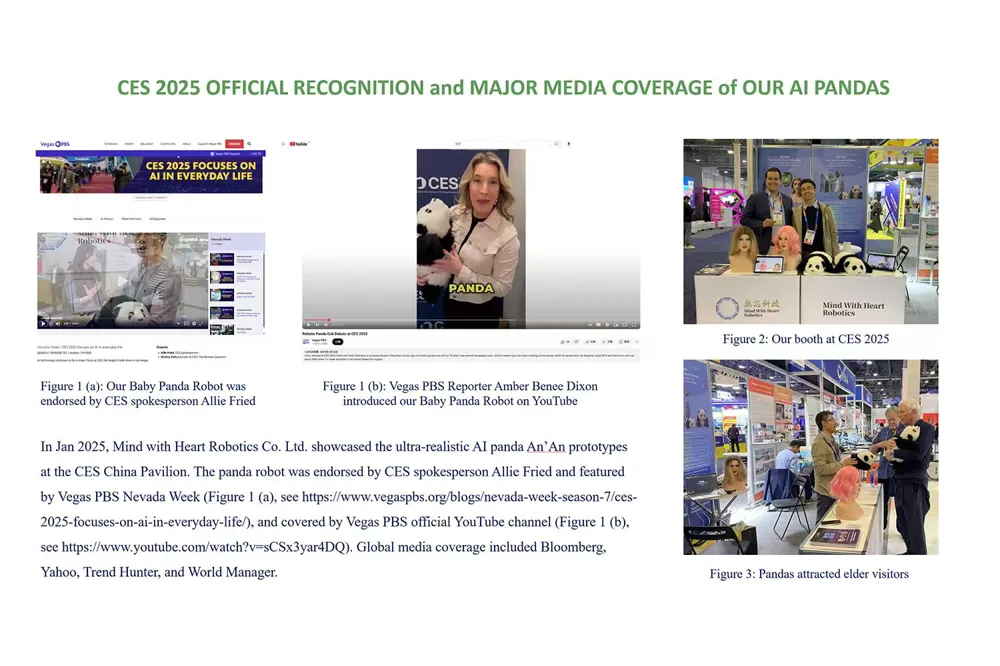
At the CES site, this baby panda robot attracted the attention of many visitors thanks to its cute appearance, and TechCrunch cited it as "one of the weirdest technologies we found at CES 2026," while positively highlighting its purpose. The TechCrunch article introduced An'An as *"a 24-hour emotional support partner that responds naturally to human touch and gradually becomes personalized over time"*, and evaluated it as a meaningful attempt at elderly care.
Meanwhile, some media outlets"How long the effect of animal-like AI robots will last"They also showed skepticism about this. This is due to cases where similar companion robots attracted initial interest in the past but did not lead to continued use.
Nevertheless, news that initial clinical results are positive, such as the observation of "improvement in the mood of elderly people with mild cognitive impairment" in an early pilot study conducted in Hong Kong, is raising market expectations. In summary,"Cute and useful"There is a mixed response of favorable reviews and opinions that "persistence needs to be verified," but the atmosphere recognizes its potential as an alternative to an aging society.
Analyst Insights
Mind with Heart Robotics' biomimetic emotional AI panda is an innovative attempt to provide emotional comfort to seniors living alone, but market acceptance and verification of long-term effects are important.
The award list data is based on the official CES 2026 website, and detailed analysis content is produced by USLab.ai. For content modification requests or inquiries, please contact [email protected]. Free to use with source attribution (USLab.ai) (CC BY)
댓글 (0)
댓글을 불러오는 중...