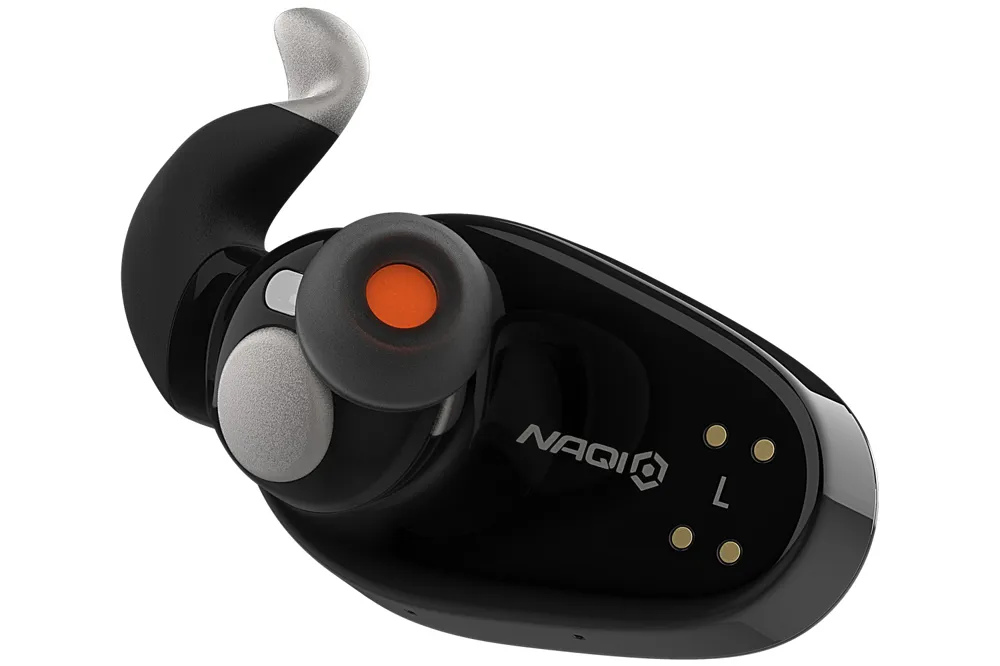
These are smart earbuds with an 'invisible UI' that detects the user's brainwaves and subtle facial movements to enable device control without hands or voice. For example, clenching the jaw or blinking can control computers, smart homes, wheelchairs, etc., providing an experience as if controlling devices with telepathy. They are worn like conventional earbuds, but use sensors inside the ear to understand the user's intentions and help control devices in various digital environments without screens, touch, or voice.
HonoreeAccessibility & Longevity뉴럴 인터페이스뇌파 인식인공지능웨어러블 기기생체 신호사용자 인터페이스
나키 뉴럴 이어버드 (Naqi Neural Earbuds) - 보이지 않는 사용자 인터페이스
11
0
Naqi Logix Inc.
One-Line Product Definition
Problem Definition
Limitations of existing interfaces using hands or voice: Existing interfaces using hands or voice have limitations for users with disabilities or in specific environments. For example, those with limited physical movement find it difficult to use touchscreens or keyboards and mice, and voice commands are unsuitable in noisy environments or situations where privacy is required.
Brain implants (e.g., Elon Musk's Neuralink) have attracted attention as a cutting-edge solution, but they have a significant burden as an invasive method requiring brain surgery. The emergence of Naqi Neural Earbuds can be seen as a solution to this problem – the desire to implement a non-invasive brain-device interface. By sensing the user's subtle facial movements or brain signals, it aims to control devices without the inconvenience of existing methods (voice, hand gestures, screen touch, etc.). In particular, the key background is to overcome the limitations of communication and device utilization for those with impaired motor or language skills, and to provide a quiet and invisible means of control in situations where hands cannot be used.
Limitations of existing methods: Existing hands-free solutions such as voice recognition have limitations such as ambient noise, privacy exposure, and difficulty in vocalization. Eye-tracking devices or gesture recognition cameras also require separate equipment, are conspicuous, and have accuracy issues.
Above all, brain neural implants such as Neuralink are difficult for the general public to use in terms of invasiveness and cost. On the other hand, Naqi earbuds aim to solve these limitations with the form factor of everyday devices – an innovative approach compared to existing technologies in that they read brainwaves and muscle signals to control devices without anyone knowing.
Key Differentiators
Non-invasive plus everyday form factor: The biggest differentiator is that it implements a brain-device interface simply by wearing it like ordinary wireless earphones, without the need for separate cumbersome equipment or surgery. This contrasts with existing methods that required helmet-type EEG, external cameras, or surgery for brain signal interfaces. Naqi has transformed earbuds, the world's most popular wearable device, into a neural interface, ensuring that users do not appear to be wearing any special device at all. This 'invisible UI' concept clearly distinguishes it from competing products in terms of user privacy and convenience.
Micro-signal interpretation accuracy: Naqi Neural Earbuds detect subtle biosignals such as jaw muscle spasms, eye movements, and facial expression changes and convert them into accurate digital commands. A dedicated AI algorithm based on machine learning interprets these signals to help control devices precisely without malfunction. For example, clenching your teeth twice can turn lights on and off, or moving your eyes quickly can move the screen cursor, enabling precise control. Existing similar attempts, such as Neurable's brainwave headphones, were limited to monitoring user concentration, but Naqi is evaluated as a much more ambitious approach in that it has expanded the scope to practical device control.
Versatility and integration: These earbuds are designed to control various platforms such as computers, smartphones, IoT devices, and electric wheelchairs, without being limited to specific apps or dedicated hardware. Developed in a module form that can be integrated into existing earphones, manufacturers can also incorporate Naqi's interface into their products. In addition, it has a wider range of applications than similar products, such as working with AI assistants or smart homes to perform tasks out of reach. This comprehensive compatibility is Naqi's unique strength that lowers the barrier to technology adoption.
Key Adoption Entities
Individual users (B2C): First of all, people with physical disabilities and the elderly with mobility issues are likely to purchase directly or adopt it for rehabilitation treatment. For example, quadriplegic patients can use this technology to operate wheelchairs or computers on their own. Also, gamers and e-sports professionals may be interested in it as a unique way to control games without using their hands. Although early adopters who seek innovative user experiences are also included, the initial expected price may be set high at over $1,000, so it is expected that special classes with urgent needs will mainly adopt it before it becomes popular.
Companies/Institutions (B2B/B2G): Medical institutions or rehabilitation centers can purchase it as an assistive technology device for patients. Hospitals can use these earbuds to support computer accessibility or wheelchair control for patients with disabilities. Government and public institutions are also interested, and Naqi Logix has been supported by the Canadian government's technology innovation program (selected as an innovative solution), demonstrating the possibility of public sector use.
Furthermore, in the defense and emergency rescue fields, it can be considered for controlling equipment in situations where hands are not free. For example, it can be integrated into the helmets of firefighters or soldiers to control drones or vehicles without voice or hand operation. In this case, organizational purchases (B2G) may occur.
OverallGeneral consumer target (B2C)Demand is expected to arise initially in the special purpose B2B/B2G market rather than , and gradually spread to B2C as the technology is verified and prices fall.
Scalability
Geographical and regulatory restrictions: Naqi Neural Earbuds are non-surgical devices, so they do not require strict clinical approval like medical devices. As general electronic products, there are no major regulatory hurdles other than basic certifications such as the FCC, so they can target the global market relatively freely. Although it is currently a Canadian company, it is receiving international attention through the CES awards, so it can be deployed overseas in North America, Europe, and Asia. However, if it is used as an accessibility aid, it may be necessary to meet medical device certification or government subsidy requirements in some countries. Overall, it is not tied to a specific country or environment, and the technology concept itself is universal.
Expansion to other industries and markets: Naqi's core technology can be applied to various forms of wearables in addition to earbuds. In fact, the company has stated that it can apply the interface to glasses, VR/AR headsets, etc. This suggests that it can be expanded to augmented reality (AR) controllers, interfaces for smart glasses, etc. In addition, it has already succeeded in controlling computers, robots, electric wheelchairs, and even flight simulators with just a blink of an eye, demonstrating its potential.
In the future, it can be applied in various industries such as smart homes (e.g., appliance control), gaming/entertainment (hands-free play), and defense/disaster response (quiet remote control). In particular, if an API is provided to interpret the signals from these earbuds through collaboration with the software industry, third-party developers may continue to discover new uses. In summary, Naqi earbud technology has the potential to develop into a universal interface platform that is not limited to specific uses.
Judges' Evaluation
CES review and industry response: This product won theBest of Innovation in the Accessibility & Longevity category at the CES 2026 Innovation Awardsand has been highly praised for its technology and design. The CES judging panel praised it as a "paradigm-shifting technology that transforms smart earbuds into AI-based neural input devices," and highly appreciated its ability to increase user independence, productivity, and inclusion.
It has already been selected as a CES Innovation Awards Honoree in 2024 and 2025, and has been recognized for its technological completeness and innovation by winning the 2023 Best Inventions selected by Time Magazine and the Edison Awards Gold Award. The media who experienced the product on-site also expressed great expectations, saying that it could be a "game changer in the field of accessibility." In particular, Tom's Guide described the potential as high, saying after a direct demonstration that it was "an experience close to the Jedi ability to control things with just thought." In the prototype demo, changing the color of the lighting or moving simple game characters was successful in almost real time, and it was reported that the level of technology implementation was quite mature, with control accuracy improving after a few practices.
Analysis of technological completeness and marketability: Despite the innovative concept, there are also indications that there are uncertain factors in the actual market entry. Naqi Logix is preparing to launch a commercial product, but the product price may be as high as several thousand dollars, making it difficult to form an initial market. In addition, users need time to learn new input methods, and sophisticated calibration work to reduce malfunctions in daily life remains a challenge. For example, tuning to distinguish between natural eye movements that glance sideways and intentional command inputs must continue to be improved.
Some media outletstend to over-promote it as 'earbud telepathy'and point out that users may be disappointed if they do not feel as comfortable as expected. Nevertheless, it has greatly increased industry credibility and awareness by winning the CES award, and is evaluated as having secured a favorable position in terms of attracting investment and partnerships in the future by standing shoulder to shoulder with global companies such as Samsung and LG.
In summary, the consensus is that the evaluation of the technology concept and prototype has been very positive to date, but market verification is still in its early stages and there are remaining challenges to be solved, such as price reduction and user education. In other words, there are many opinions that although innovation has been recognized through CES, the process of popularizing it and connecting it to commercial success must be watched.
Analyst Insights
⚠️ Technological innovation is excellent, but mass marketability is still uncertain: The possibility is highly evaluated as a groundbreaking HMI technology, but market verification and commercialization risks still exist as it is in the early stages of commercialization. It has the ultimate potential as an innovative neural interface, but it is unknown how quickly the public will accept this change. Technology demonstrations are amazing, but productization and ecosystem construction remain challenges, so it will start with niche applications in the near future and aim for popularization in the long term.
The award list data is based on the official CES 2026 website, and detailed analysis content is produced by USLab.ai. For content modification requests or inquiries, please contact contact@uslab.ai. Free to use with source attribution (USLab.ai) (CC BY)
댓글 (0)
댓글을 불러오는 중...