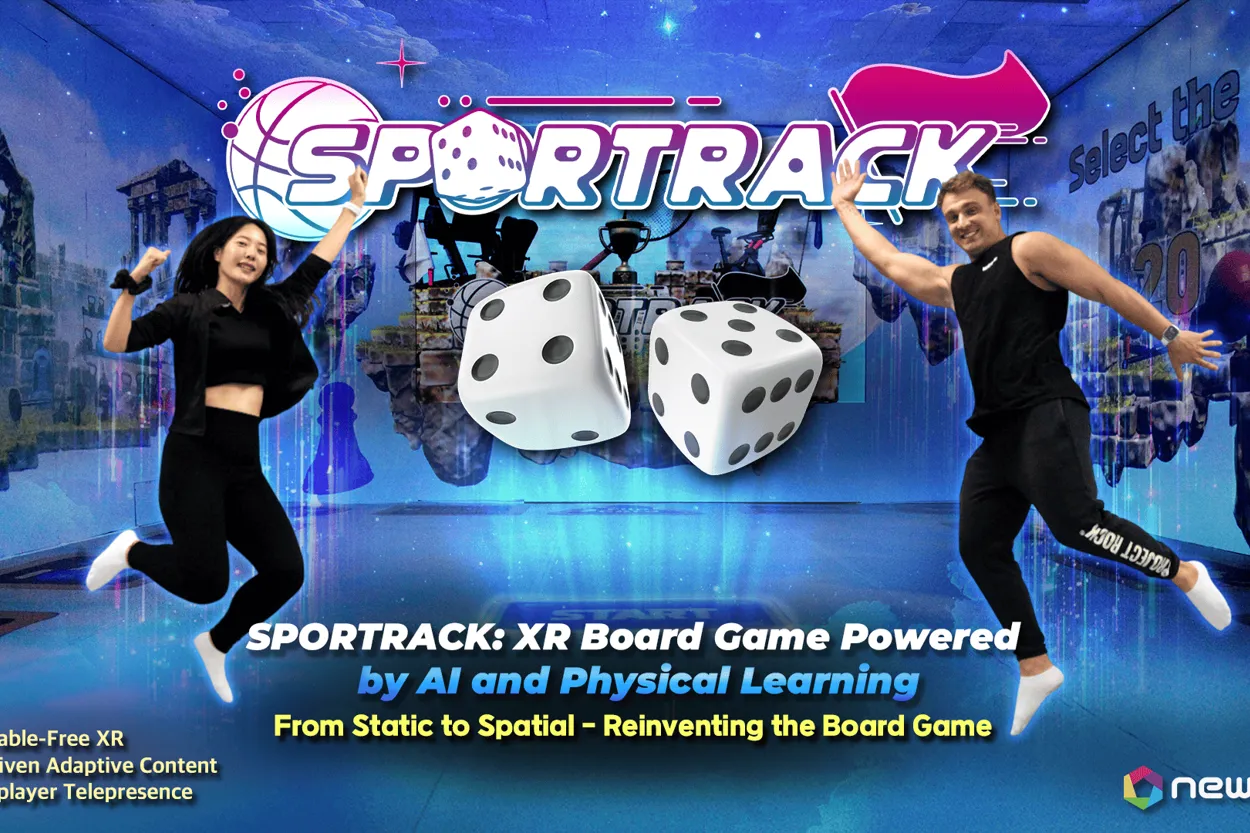
An XR fitness board game platform that combines physical activity and gaming on a virtual board projected onto the floor without a headset, allowing multiple people to enjoy an immersive gaming experience together.
HonoreekoXR & Spatial ComputingXR인공지능보드 게임피지컬 컴퓨팅교육용 게임실감형 인터랙션
SPORTRACK: XR 보드 게임 (AI 및 피지컬 학습 기반)
2
0
Newjak Co., Ltd.
One-Line Product Definition
Problem Definition
Existing metaverse and VR games rely on HMDs (headsets), which isolate users from reality and restrict movement. VR experiences at home alone can lead to a lack of social interaction and physical activity, reducing educational and exercise benefits. Additionally, demographics such as children and the elderly, who find headsets uncomfortable, are excluded from these XR experiences.
SPORTRACK emerged from the problem statement:"Let's make XR an activity that everyone can enjoy together."In other words, there was a need for a way for multiple people to move their bodies together and immerse themselves without headsets.
Key Differentiators
SPORTRACK isthe world's first attempt to implement a modular XR board (gameboard)on the floor, allowing multiple people to play simultaneously. It features a non-wearable (spatial) XR technology that configures 16 themed "Sports Island" maps, designed to have users perform tasks that appear when rolling virtual dice, using their whole bodies. This differentiates it by naturally incorporating exercise and learning elements into the game.
In particular, it is unique in that it incorporates an AI-based conversational interface and computer vision analysis to recognize player movements and dynamically adjust the game difficulty or background in real time. While competing products are limited to simple AR sports or VR games, SPORTRACK utilizes multimodal interaction (voice, motion, touch) and supports multiplayer, creating a new category of XR platform that encompasses education, fitness, and entertainment.
Key Adopters
This product is strongly B2B/B2G in nature. The primary targets are educational and wellness institutions such as schools, sports centers, kids cafes, and senior welfare facilities, where it can be adopted as a tool to promote physical activity. For example, it can be used as a teaching tool for physical education/creative classes in elementary schools or as a group exercise program in fitness centers.
It can also be operated as a public installation in public cultural centers or experience halls of local governments. While it could be sold for home use, initial sales/rentals are expected to focus on institutions, considering the system costs. In other words, the payers are likely to be boards of education/schools, healthcare institutions, and local governments (B2B/B2G).
Scalability
Currently, it focuses on indoor entertainment/education as a new field of XR board games, but there is much room for technological expansion. For example, it can be applied to physical therapy or rehabilitation training to make exercise fun, or customized for corporate team-building training.
Global expansion is also possible by localizing content in software to reflect different languages and exercise cultures in each country. However, there are limitations to expanding outdoors or to general households due to the environment setup costs and space constraints required for projectors and sensors. From a regulatory perspective, it is relatively favorable as a game with health/education benefits, but it will need to meet certification and safety standards to be distributed to schools, etc.
Overall,there is potential for application expansion into other XR markets (fitness, education, play),but XR board games themselves are a new concept, so they may initially remain in a niche market.
Judges' Evaluation
In the context of the CES Innovation Award, the "XR experience without a headset" was highly noted. It garnered attention from education experts and the wellness industry, who said it *"blurred the lines between games and exercise,"* but there were also views that it was *"still an experimental attempt at the prototype level."
The technical completeness was evaluated as excellent for multiplayer motion recognition and interactive production based on the demo, but the diversity of content and maintaining continuous user interest were pointed out as challenges. From a market perspective, expectations for XR immersive education/games have increased recently following the metaverse boom, which is positive, but there is a cautious outlook that it will take time to become popular due to commercialization prices and installation requirements.
Overall, it is evaluated as *"innovative but niche,"* and the atmosphere is one of recognizing the idea and technology rather than overestimating it.
Analyst Insights
🧪 R&D and concept verification stage (an experimental XR platform with innovative technology and ideas, but a conceptual solution that still needs commercial market verification)
The award list data is based on the official CES 2026 website, and detailed analysis content is produced by USLab.ai. For content modification requests or inquiries, please contact contact@uslab.ai. Free to use with source attribution (USLab.ai) (CC BY)
댓글 (0)
댓글을 불러오는 중...