Hybrid Electric Airport Fire Truck (CES Best of Innovation Award) – An advanced fire truck equipped with a battery-diesel dual power system in a large ARFF vehicle (Striker) used in airports worldwide. It achieves 28% faster acceleration than existing models by using emission-free electric driving in normal terminal areas and simultaneous diesel and battery power during emergency dispatches. It complies with NFPA 414 and ICAO standards, meets the 3-minute response rule, and enables low-noise, low-emission airport operations.
HonoreeTravel & Tourism전기 소방차공항 안전배터리-전기 하이브리드NFPA 414ICAO비상 대응
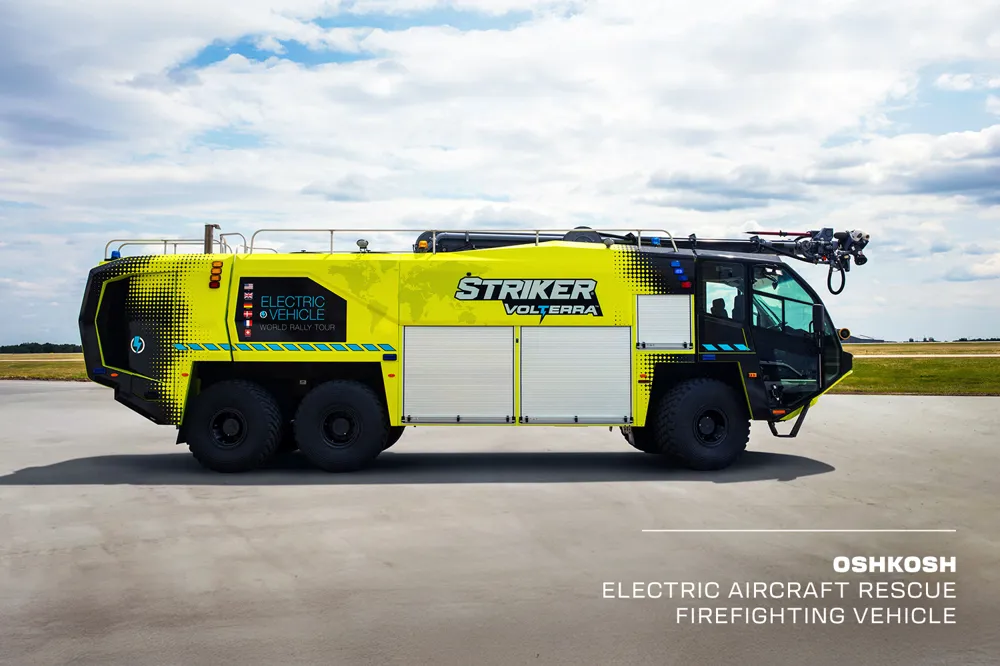
오시코시 스트라이커 볼테라 전동 공항 소방 구조 차량
1
0
Oshkosh Corporation
One-Line Product Definition
Problem Definition
Airport fire and rescue vehicles (ARFF) must arrive at the scene within 3 minutes in the event of an aircraft accident, so strong engine performance is essential.
However, under normal circumstances, they only move within the airport, causing the large diesel engine to idle and continuously generate exhaust gas and noise. In addition, as eco-friendly demands increase, airports are under pressure to reduce carbon emissions, but there is a dilemma that fire truck performance cannot be lowered for safety reasons.
Existing electric vehicles could not generate the power of a large ARFF, and the charging infrastructure was also a problem. Striker Volterra solves this problem by combining the advantages of electric and diesel – aiming to meet both safety and environmental goals by operating in maximum performance when needed and in eco-friendly mode otherwise.
Key Differentiators
The differentiator of Striker Volterra is that it achieves both performance improvement and emission-free mode through a dual powertrain.
Specifically, Oshkosh's patented electric drivetrain andElectric Variable Transmission (EVT)are applied, allowing it to move and stand by near the terminal quietly and without emissions in battery mode, and when dispatched, the engine + electric simultaneous operation accelerates a 42-ton vehicle from 0→80km/h in 21 seconds. This is 28% faster than the existing diesel model and the highest acceleration among existing ARFFs.
In addition, while maintaining fire-fighting specifications such as a 3,000-gallon water tank and a 500-pound powder tank, precise electronic control optimizes energy distribution to automatically manage battery level and mission speed. This vehicle is already in operation at DFW International Airport, and thanks to the electric mode, it can drive indoors in the terminal without exhaust gas, and the reduction in standby noise also improves the passenger experience.
In addition to meeting NFPA and ICAO standards, its greatest strength is that it adds *"eco-friendliness to ARFF-like performance"*. It is currently the only mass-produced hybrid ARFF compared to competitors, and Oshkosh's experience in actual deployment is also an important differentiating factor.
Key Adopters
Airport authorities and airlines around the world are direct customers. Large international airports operate their own fire brigades, so they introduce them as equipment, or national/local fire departments purchase them with a budget and deploy them at airports.
It is known that DFW Airport in the United States has already introduced it, and US military airfields are also showing interest. In Korea, Incheon International Airport Corporation or the Aviation Fire Department under the Ministry of Land, Infrastructure and Transport could also be the main adopters.
In addition, industrial complex fire brigades (petrochemical complexes, etc.) also use ARFFs, so they may also consider purchasing them in accordance with eco-friendly policies. It is mainly in the form of B2G/B2B public procurement and is sold to airports in each country through the Oshkosh Airport Products dealer network.
Scalability
Striker Volterra is already in service and is expected to spread to major airports around the world in the future. In particular, since ICAO is operating theAirport Carbon Accreditation (ACA)program, member airports have an incentive to introduce such eco-friendly fire trucks to reduce exhaust gas.
Oshkosh is strengthening overseas marketing as a result of winning the CES award and is preparing to debut in the Asian market, including Japan, in 2025. Technically, this dual-mode platformcan also be applied to other special fire trucks (e.g., city fire trucks), but it seems that they will focus on the airport sector first.
In addition, it also has a transitional position to evolve into a fully electric ARFF version as battery performance improves in the future. It is currently undergoing testing at other airports besides DFW (such as Chicago), and the US Department of Defense is also showing interest and considering replacing fire-fighting vehicles at military airfields.
Therefore, based on its exclusive position in the airport fire market, this product has the potential to expand into special-purpose vehicles in similar fields and secure scalability to preempt the market of hundreds of units worldwide.
Judges' Evaluation
It won the Best of Innovation Award in the Travel & Tourism category at CES 2026 and was highly praised in both technology and industry aspects. The CES judging comment mentioned *"innovation in a non-obvious but very important area"* and evaluated it as an example of simultaneously promoting safety and sustainability in the aviation industry.
In the actual aviation industry, the appearance of Striker Volterra is being positively received, saying *"Electrification is blowing in airport safety equipment as well"*. It has already been selected as one of Time Magazine's Inventions of the Year in 2025 (Jensen Huang, NVIDIA CEO, mentioned it directly in his keynote), and media such as Interesting Engineering interestingly introduced it as *"a 93,000-pound electric truck that protects the runway"*.
The level of technical completeness is high, and the feedback from DFW operation that *"response time is shortened and operating costs are reduced compared to diesel"* has gained trust. Of course, there is also an opinion that it is a *"transitional solution"* in that it is not fully battery-powered, but there is little disagreement that it is the optimal compromise in the industry reality.
Market response is also good, and news is heard that *"this vehicle is starting to be included in the budgets of airports in each country"*, and Oshkosh has greatly increased the purchase intention of existing customers by extensively promoting the CES Best of Innovation Award. Overall, both critics and the market are praising it as *"the ultimate innovation in this field"*, and Striker Volterra is cited as a model case of achieving both safety standards and eco-friendliness.
Analyst Insights
🔥 High marketability / Business connection possible – It has already built up trust with operating results, and immediate purchase demand is supported by meeting the eco-friendly and safety goals of airports. It is a solution with a very high possibility of commercial success, gaining worldwide attention by winning the CES Best of Innovation Award.
Demo video: CES 2026 Oshkosh Striker Volterra on-site sketch (TechGooch, YouTube) (Introduction of Striker Volterra electric fire truck in operation at DFW Airport and CES exhibition video)
The award list data is based on the official CES 2026 website, and detailed analysis content is produced by USLab.ai. For content modification requests or inquiries, please contact contact@uslab.ai. Free to use with source attribution (USLab.ai) (CC BY)
댓글 (0)
댓글을 불러오는 중...