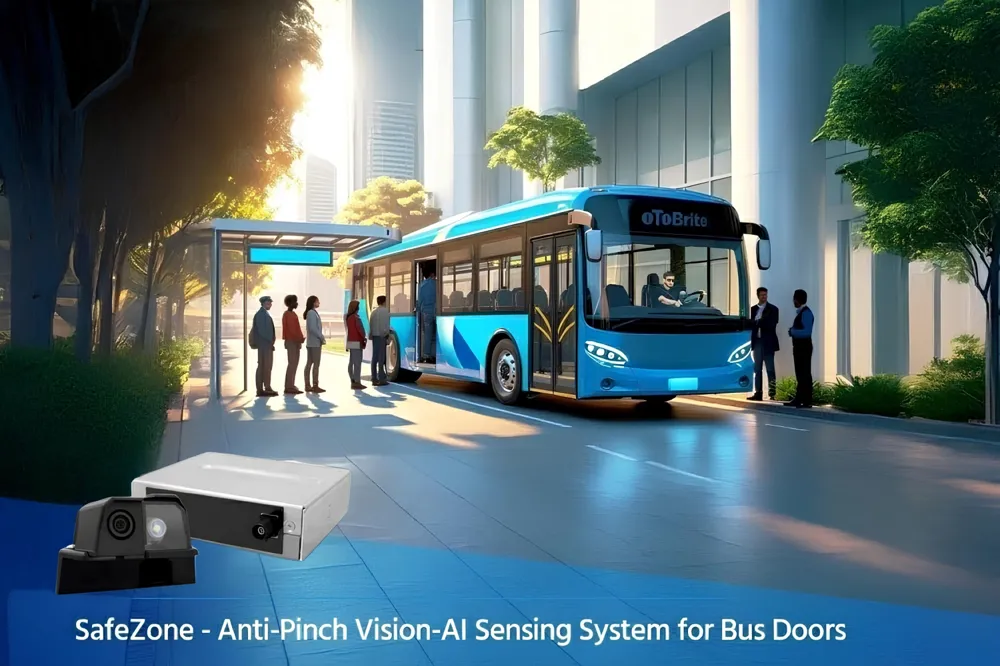
The first system to prevent bus door entrapment accidents using AI vision sensing. This smart safety device uses only a single camera and ECU to detect passengers or belongings in real-time and automatically respond before the door closes.
HonoreeVehicle Tech & Advanced MobilityVision-AI객체 감지안전 시스템버스 안전挟힘 방지AI 영상 분석
SafeZone - 버스 문용 挟힘 방지 Vision-AI 센싱 시스템
1
0
oToBrite Electronics, Inc.
One-Line Product Definition
Problem Definition
Entrapment accidents at bus doors are a frequent safety issue worldwide. Existing buses mainly rely on pressure-sensitive rubber pads (at the door edges) or the driver's visual confirmation to prevent passenger entrapment. However, these methods often fail to detect small objects or clothing, or the sensor activates only after the door has already closed, making complete prevention difficult.
In particular, if a person has not fully entered the doorway, blind spots can occur from the driver's seat, leading to the driver closing the door without noticing. During rush hour, crowded conditions and pressure to maintain schedules can also lead to insufficient checks before departure.
Consequently, this has led to serious accidents such as arms being trapped or bags being dragged by the bus. There is a growing need to supplement the limitations of existing pneumatic safety devices and human error with technology.
Key Differentiators
The SafeZone system continuously monitors a 30cm × 200cm area around the bus door using only one high-precision AI camera and one dedicated ECU, instantly determining whether a person or object is near the door while passengers are boarding or alighting. Through a deep learning-based image recognition algorithm, it identifies individual passengers even in crowded situations and detects partially obscured bodies (e.g., a person's legs still in the process of alighting) orbelongings (umbrellas, bag straps).This allows it to detect
“near-entrapment situations”that existing pressure sensors cannot recognize, before the door closes. The ECU immediately sends a signal to the bus door control device to delay or reopen the door. Furthermore, this system not only operates when the door is opening but also monitors the interior with a camera during operation, contributing to overall safety by alerting the driver if abnormal behavior (e.g., falls) occurs.that existing pressure sensors cannot recognize,
Another differentiator compared to existing solutions is its versatility. It can be retrofitted regardless of the bus manufacturer, and the same technology can be applied to industrial equipment with dangerous entrapment areas such as cranes, forklifts, and garbage trucks. In other words, SafeZone's greatest feature is that AI acts as the driver's "wide-eyed observer" around the door, dramatically increasing the effectiveness of preventing personal injury.
Key Adopters
Bus operating companies andvehicle manufacturers (B2B)are the main customers. Transportation companies operating city buses or commuter buses are highly likely to actively adopt the system to reduce passenger safety accidents and the associated legal risks. Several bus companies in Asia, including Taiwan, are already testing this system, and transportation companies in Japan, Singapore, and Canada are also showing interest.
In addition,public transportation management agencies (B2G)in their own country or local governments may invest in installing the system on all buses. From a vehicle manufacturing perspective, bus manufacturers can adopt it as an option for their new vehicles or offer it as an aftermarket upgrade. In this B2B2G structure, the final cost is borne by the bus company or local government.
While general consumers are not direct purchasers of this system, they will benefit from safer bus services.
Scalability
The SafeZone technology is scalable regardless of vehicle type due to its detachable camera + AI SW combination. In fact, the company plans to expand the application of this technology to construction machinery, logistics vehicles, etc., and is exploring applications in industrial safety areas such as preventing pinching during crane/excavator operations and detecting people near factory automatic doors.
Furthermore, if bus passenger safety regulations are strengthened in overseas markets, it has the potential to become a legal standard and be widely adopted. Although it has been developed specifically for buses to date, it can also be applied to preventing subway door entrapment or elevator door sensors in the future.
Technically, it operates with only a camera and AI, so it is easy to introduce in any country without relying on communication infrastructure or external data. However, the approval process of each country's transportation authority or the work of connecting to the electrical system when installing on existing vehicles is a variable, and it is expected that the company will cooperate with local partners to support this.
Overall,“Vision AI-based safety device”has great potential to expand into various industrial safety solutions by pioneering a new category.
Judges' Evaluation
It won the Innovation Award in the Vehicle Technology category at CES 2026, and the point that *"AI protects what is easy to miss"* was highly evaluated. Experts praised the technology for providing a solution to safety problems that had not been solved for a long time, such as bus door entrapment accidents.
In particular, there was admiration for the accuracy that covers a wide area with one camera while surpassing the limitations of pneumatic sensors (recognizing not only people but also luggage). The announcement that it has already been applied to five bus companies in Taiwan and is producing results also increased reliability.
Technical media such as EE Times compared SafeZone to *"a bus seatbelt that helps the driver with AI"*, praising the fact that it achieved great safety improvements with a simple configuration. The level of technical completeness is evaluated as stable at the mass production level, and at the time of the award, it was shown to perfectly detect real human models/luggage models in the demo and control the door without malfunction.
Market expectations are also quite realistic, as bus operators from several countries have expressed interest. However, unit price and installation costs are variables, but industry experts predict that there will be no major burden compared to pressure sensors when mass-produced.
Overall,“small but life-saving technology”is receiving positive reviews, and there are even expectations that *"it may soon become the standard for public transportation in each country."*
Analyst Insights
🔥 High marketability / Business connection possible – This solution is expected to have immediate demand, especially from bus operators and manufacturers worldwide. With the movement to strengthen regulations, the possibility of becoming a standard safety device is high, so commercialization and business success are very likely.
The award list data is based on the official CES 2026 website, and detailed analysis content is produced by USLab.ai. For content modification requests or inquiries, please contact contact@uslab.ai. Free to use with source attribution (USLab.ai) (CC BY)
댓글 (0)
댓글을 불러오는 중...