Second-life battery pack for industrial equipment – A smart deep-cycle battery that reuses electric vehicle waste batteries to solve lead-acid replacement cycles and carbon emission problems.
Best of InnovationkoSustainability & Energy Transition리튬 배터리딥 사이클 배터리산업용 배터리스마트 배터리에너지 효율배터리 모니터링
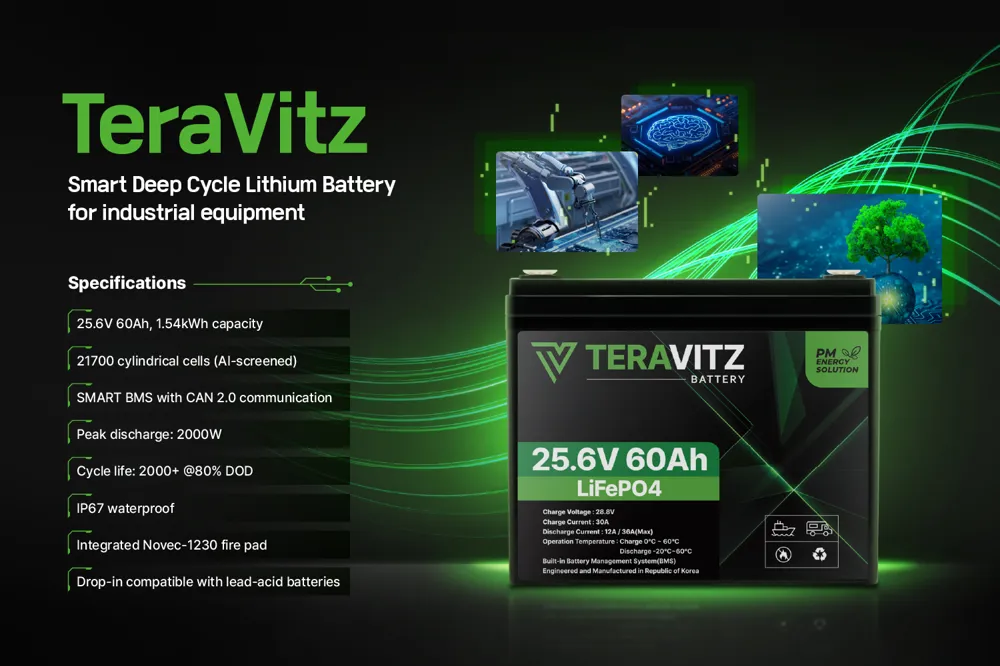
TeraVitz - 산업 장비용 스마트 딥 사이클 리튬 배터리
4
0
PM Energy Solution CO., LTD.
One-Line Product Definition
Problem Definition
Background Problem: In industrial equipment such as forklifts and aerial work platforms, lead-acid batteries must be replaced every 2 to 3 years, which accounts for 25% of the total maintenance cost. In addition, the production of a new 1.5kWh industrial battery emits approximately 100 kg of CO₂, which is a significant environmental burden.
Limitations of Existing Methods: Lead-acid batteries are heavy and have a short lifespan, requiring repeated replacement, and there are problems with the disposal of harmful substances. Replacing them with new lithium-ion products improves performance but is expensive, and the problem of carbon emissions during production remains. The lack of technology for utilizing reused batteries has also been a limitation.
Key Differentiators
The TeraVitz battery pack is manufactured by selectively reusing 21700 lithium-ion cells recovered from electric vehicles using an AI algorithm. This significantly reduces the environmental footprint with 65% less CO₂ emissions compared to new products (approximately 68.3 kg per pack).
In addition, one pack can be charged and discharged more than 2000 times, doubling the lifespan compared to lead-acid batteries. The built-in smart BMS monitors real-time cell voltage, temperature, and charge level, and blocks overvoltage, overheating, and short circuits to improve safety and lifespan. The size and cost are also designed to be compatible with existing lead-acid batteries, so they can be replaced immediately without modification.
Key Adopters
Industrial electric equipment operating companies and equipment manufacturers (B2B). For example, logistics warehouses, construction companies, and equipment leasing companies can consider adopting it to reduce battery replacement costs and achieve eco-friendly goals.
Scalability
This is a solution that can be used worldwide, not limited to a specific country. It can be applied in any market as long as the supply and demand of electric vehicle waste batteries and battery reuse regulations are met. In fact, we are also promoting entry into overseas markets such as Southeast Asia (e.g., establishing a branch in Vietnam).
In the future, it can be expanded and applied to other fields such as energy storage systems (ESS) in addition to industrial equipment. However, additional certification procedures may be required for fields that require specific safety certifications such as medical or aviation.
Judges' Evaluation
It was selected as an Innovation Award winner in the CES sustainability category for its carbon reduction effect and resource circulation innovation. The level of technical completion is at the prototype stage that can actually be driven, and it seems close to being realized as the mass production plan is scheduled for September 2026.
It is highly anticipated in the market as it achieves both operating cost reduction and eco-friendliness compared to lead-acid batteries. However, securing waste battery cells and managing cell quality deviation during mass production are pointed out as challenges, and responding to competition from large companies is also key. Overall, market verification is in the early stages, but interest is high due to eco-friendly policies.
Analyst Insights
🔥 High marketability / Business connection possible (Expected high demand in the industrial market due to clear cost reduction and eco-friendly value)
The award list data is based on the official CES 2026 website, and detailed analysis content is produced by USLab.ai. For content modification requests or inquiries, please contact contact@uslab.ai. Free to use with source attribution (USLab.ai) (CC BY)
댓글 (0)
댓글을 불러오는 중...