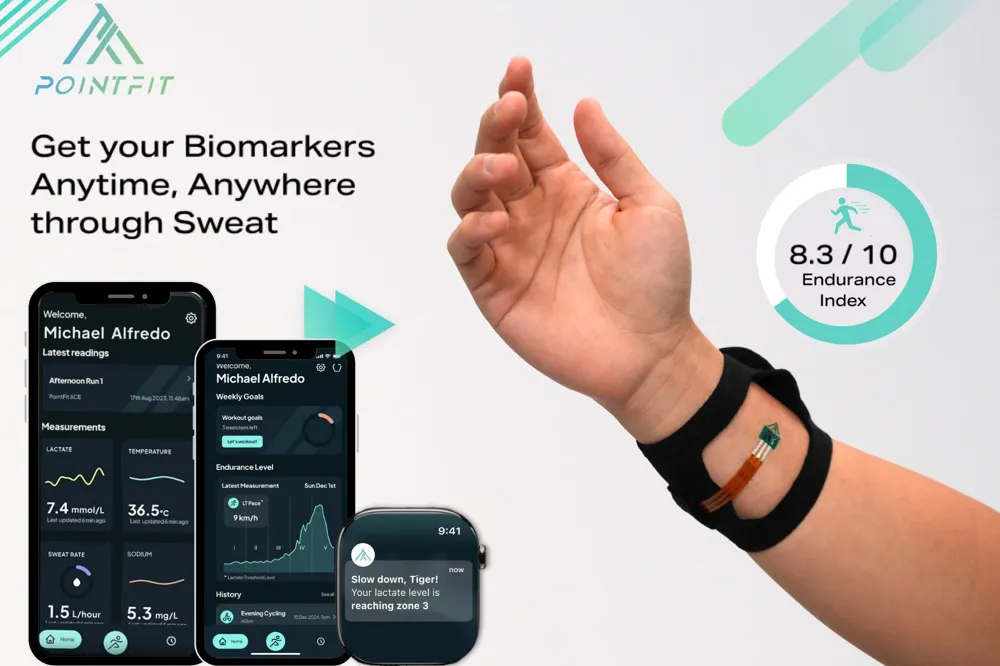
The world's first ultra-thin wearable patch sensor that continuously measures human biomarkers such as lactate and cortisol in sweat, which were previously only measurable in laboratories. During activities like running and cycling, real-time values are displayed on a smartphone app via Bluetooth, helping users adjust exercise intensity and manage their condition.
HonoreeDigital Health웨어러블 센서비침습적 모니터링젖산 센서스포츠 과학개인 맞춤형 헬스케어IoT 헬스케어
PF-스웨트 패치: 비침습적 연속 젖산 센서
1
0
Point Fit Technology Limited
One-Line Product Definition
Problem Definition
Athletes and fitness enthusiasts want to understand their endurance limits (lactate threshold) through lactate levels and assess their stress/fatigue levels through cortisol, etc. However, traditionally, they had to have their blood drawn and measured in hospitals or laboratories. Routine blood draws via needles are painful and cannot be done frequently, and the results are not real-time, making it difficult to use them for immediate feedback during exercise. Wearables such as smartwatches measure heart rate and oxygen saturation, but they have limitations in providing blood metabolite information. This has been a significant drawback in terms of training optimization and health monitoring.
Point Fit addresses this problem – the fitness and medical need to *"know your body's condition in real-time without drawing blood"* – by focusing on chemicals in sweat. Sweat contains as many diverse biomarkers as blood and has the advantage of being non-invasive to collect, but the technology to extract that information was lacking. The PF-Sweat Patch overcomes this with a nanomembrane sensor.
Key Differentiators
The PF-Sweat Patch is a flexible, 0.3mm-thick skin-attachable patch that electrochemically detects the concentration of specific molecules in sweat using a proprietary nanomembrane technology called Evaporative Dermal Biosensing. It is the world's first product to implement continuous measurement using sweat instead of blood, and it is innovative in that it allows real-time monitoring of lactate, cortisol, etc., during exercise, which was previously only possible in hospital laboratories. It is also highly accurate, with clinical validation showing over 92% agreement compared to blood analysis.
By attaching the patch to the skin and connecting to the PointFit app via BLE (Bluetooth Low Energy), users can see continuous numerical graphs at intervals of, for example, one minute throughout their workout. For example, if lactate levels rise sharply during running, the app can notify the user to adjust their pace, and if cortisol remains high after exercise, it can be used as an indicator of overtraining/stress. The patch has a modular design, and the initial version is dedicated to lactate, but in the future, cortisol, creatinine (muscle fatigue), and glucose (blood sugar) sensor modules will be added to measure multiple biomarkers with a single reader.
In summary,As a "mini-laboratory on the skin,"the biggest differentiator is that users can check their physical condition as often as they check their smartphone battery.
Key Adopters
Initially, the main target is B2C customers in the sports field, such as marathon runners, cyclists, and triathletes who want high-performance wearables. These individuals can purchase the patch directly for use in training, or coaches/trainers can purchase it for their athletes (B2B). In addition, healthcare/fitness companies (e.g., fitness tracker companies, exercise centers) may adopt it to integrate with their services.
In the long term, it can also be applied to the medical field (B2C/B2B hospitals) for patients with diabetes, etc., but it is not currently approved as a medical device and is positioned for "wellness," so customers for exercise purposes are responsible for the cost. Ultimately, the purchase decision will be made byindividual consumers (exercise and health enthusiasts),and although the price is high, they are highly willing to invest in their systematic health management. The B2G aspect is not significant, but as it was developed with support from the Hong Kong Science Park and universities, there is a possibility of linking it to public health projects in the future.
Scalability
This product can have a significant impact on the global fitness & digital health market. Until FDA or other regulatory approval is obtained, it can be sold for personal health management purposes rather than medical diagnosis, avoiding regional regulations and allowing immediate entry into the wellness device market in North America, the EU, Asia, etc. Subsequently, if clinical data is accumulated and medical device approval is obtained for blood glucose sensors, etc., it can be expanded into huge markets such as the diabetes management market.
Developer PointFit has already been recognized for its technology by winning awards at several international startup competitions and is building a global network by being selected for the Forbes 30 Under 30. Technically,other bodily fluids (tears, etc.)biosensing or animal biomonitoring can also be applied. In addition, accumulated personal biomarker data can be linked to insurance companies and healthcare platforms in the future to be used for new services (e.g., personalized fitness coaching).
However, since users must consistently wear the patch and exercise to obtain data, user habit formation can be a variable in its adoption. Nevertheless, the value of providing insights at the level of blood tests in everyday life is clear, and it has the potential to become a new category that will change the landscape of the wearable market in the future.
Judges' Evaluation
The PF-Sweat Patch is hailed as *"the future of wearable technology"* and has won the CES Innovation Award in the Digital Health category. Fitness media outlets such as The Barbell have highlighted it as *"reading body information with a drop of sweat during exercise,"* and the Hong Kong science and technology community has praised its innovation, saying that it *"replaces laboratory tests with a skin patch."
Following the release of clinical validation results (92% accuracy),industry credibility has also increased, and there are reports that existing smartwatch companies are interested in collaboration. Market expectations are very high, with evaluations such as *"if this product becomes popular, it will completely change the way we monitor health."
However, some point out realistic concerns about the initial price and user convenience. For example, it is mentioned that the patch must be replaced daily (consumable costs), and data is not available when sitting because measurement requires sweating. However, overall, it is considered *"the most interesting biosensing wearable since continuous glucose monitoring (CGM)"* and expectations are high rather than underestimated.
Analyst Insights
🔥 High marketability / Business connection possible – Immediate acceptance is expected in the athlete and health enthusiast market, and it has the potential to expand to the medical field in the future, making it a game-changer in the wearable/digital health industry.
Product demo video: PointFit – How the PF Sweat Patch works (Hong Kong Science and Technology Parks Corporation presentation video) (Introduction to patch structure and app integration screen)
The award list data is based on the official CES 2026 website, and detailed analysis content is produced by USLab.ai. For content modification requests or inquiries, please contact contact@uslab.ai. Free to use with source attribution (USLab.ai) (CC BY)
댓글 (0)
댓글을 불러오는 중...