• A 16-inch dual-view OLED display that allows the driver and passenger in a vehicle to simultaneously view different screens on a single display, solving both infotainment personalization and interior space-saving issues.
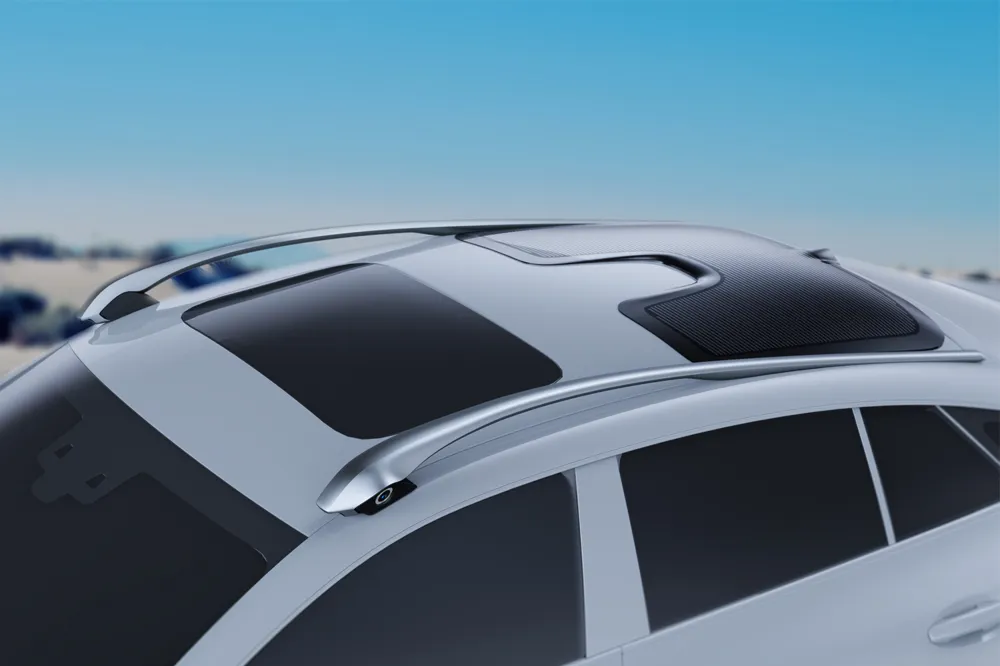
HonoreeVehicle Tech & Advanced MobilityAI루프 랙자율 주행커넥티드 차량모빌리티지능형 시스템
MOVZEN AI 루프 랙
2
0
Rayzen Technology(Shenzhen) R&D Center
One-Line Product Definition
Problem Definition
• Background Problem: As digital infotainment in vehicles advances, passengers in the front and rear seats expect to enjoy their desired content (movies, games, etc.). Previously, this required installing multiple displays, such as a central dashboard screen + a separate screen for the passenger seat or headrest-mounted rear seat monitors, which occupied interior space and increased costs and wiring complexity [13]. Especially in the front, passenger video viewing has been restricted while driving due to concerns about distracting the driver.
• Limitations of Existing Methods: Multi-display configurations clutter the dashboard design and increase vehicle weight and power consumption. Attempts to display two or more videos on one screen have resulted in narrow viewing angles and reduced screen utilization due to screen splitting.
Dual-view LCD technology was introduced in the past by Land Rover and others, but it did not gain much traction due to resolution degradation, limited viewing angles, and low passenger usage rates, which led to limitations in image quality and viewing angle.
In short, it has been difficult to overcome the limitation of "one vehicle, one screen = one content."
Key Differentiators
• What is Actually Different Compared to Similar Products: Dual View OLED is the world's first solution to allow two people to watch different content on a single OLED panel, and it provides a wider viewing angle and clearer image quality compared to existing LCD-based dual views. It is characterized by directional pixel arrangement technology that separates screen content according to the left and right seat positions, and a design that prevents the driver's touch interface from interfering with the passenger's video.
For example, even if the driver touches the navigation, it does not affect the movie playback on the passenger's screen.
In addition, the Tandem OLED structure (stacked OLED) is applied to increase brightness and lifespan, and automotive-grade reliability is secured to ensure stable operation even in harsh environments of -40 to 85℃. This product is also differentiated by its high versatility, as it can be used in multiple locations with one product, such as a center display, a passenger-only display, or a rear seat center display, depending on the application.
Key Adopters
• Adopters: This is a B2B supply product that finished vehicle manufacturers can consider as an innovation in vehicle interiors and a point of differentiation. In particular, automobile manufacturers and Tier 1 component suppliers that develop advanced infotainment systems for luxury cars or electric vehicles are expected to be the main adopters. As autonomous driving levels increase in the future, passenger entertainment will become more important, so companies investing in future vehicle UX may be interested.
• B2C/B2B/B2G Classification: As a B2B product, it is not directly purchased by general consumers, but is encountered in the form of vehicle options (B2C indirect). (Example: "Dual View Display Panel" option in a new car)
Scalability
• Environmental and National Restrictions: The technology itself is not tied to specific regional regulations, but the playback of front screen videos while driving may be restricted in some countries due to video regulations. However, Dual View is a solution that can bypass these regulations because it only shows information such as navigation to the driver, making it applicable to the global market.
It can be applied to any vehicle as long as the internal structure and seat arrangement of the vehicle are compatible, and it can be especially appealing in vehicles that emphasize digital cockpits, such as electric vehicles.
• Expansion to Other Industries: The technology of two viewers watching different screens at the same time can also be applied to aircraft personal seat displays or digital signage (double-sided advertising). However, since it is based on the assumption of a fixed viewing angle (car seat), industrial expansion other than for automobiles is not clear for the time being.
Instead, in terms of expanding the scope of application within the vehicle, Dual View can be used for rear seat sharing screens in addition to the center display in one vehicle, thereby maximizing space efficiency such as replacing multiple screens with one panel.
Judges' Evaluation
• Evaluation in the Context of the CES Award: Dual View OLED was recognized for its innovation and won the CES award for "providing a customized experience for each passenger while efficiently utilizing limited space." The judges noted that this technology provides entertainment to passengers without a separate screen and does not distract the driver. In terms of technical completeness, it was evaluated as being close to commercialization, including the implementation of touch separation and improved durability due to the dual OLED stack.
• Market Expectations: The industry is positive about the possibility that Dual View OLED can increase functionality while maintaining a minimalist vehicle interior design. In particular, premium brands may be interested in pursuing a clean UX with such solutions instead of placing multiple screens on the dashboard.
On the other hand, some also question the actual demand. When similar concepts were introduced by Land Rover and others in the early 2010s, users showed skeptical reactions such as "useless when driving alone to and from work" and "passengers would rather use a tablet." Due to these past examples, there are conflicting views that this OLED dual view may initially remain a niche luxury option, and that it is a preemptive move in preparation for the era of autonomous driving.
• Uncertainties and Evaluation Factors: Market verification is insufficient as it is a new technology that has not yet been announced for adoption in mass-produced vehicles. The increase in panel costs and content/UX support due to the implementation of the technology are also pointed out as challenges. For example, the preparation of the vehicle software ecosystem must also be supported, such as the car system managing video playback for passengers and separating audio with headphones. Overall, it was viewed as innovative at CES, but there is a cautious view that "it remains to be seen how much actual marketability there will be."
Analyst Insights
• ⚠️ Impressive technology but market uncertainty
The award list data is based on the official CES 2026 website, and detailed analysis content is produced by USLab.ai. For content modification requests or inquiries, please contact contact@uslab.ai. Free to use with source attribution (USLab.ai) (CC BY)
댓글 (0)
댓글을 불러오는 중...