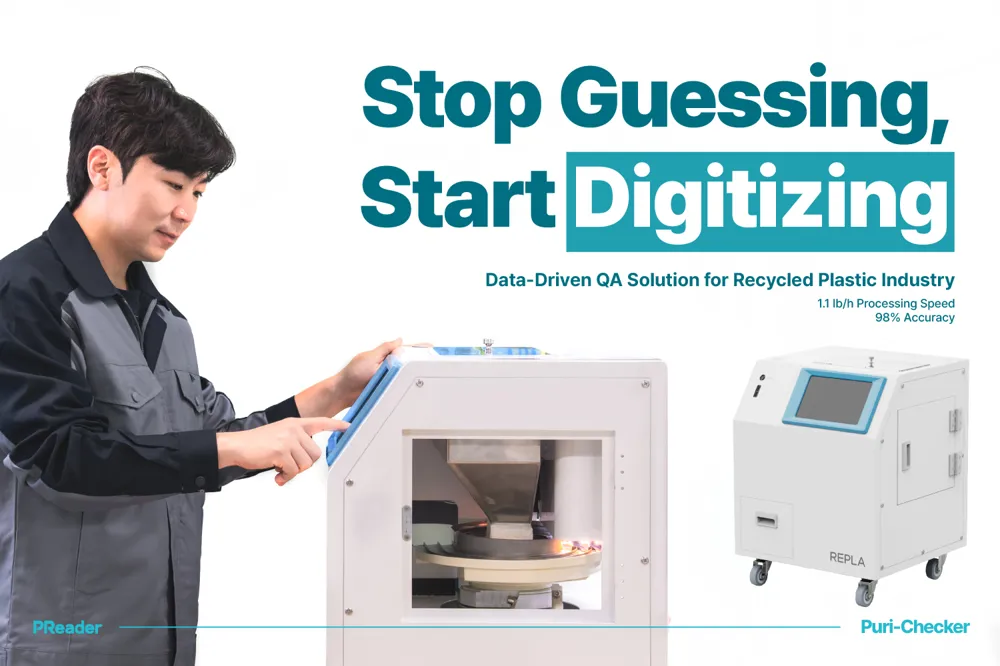
A material composition scanner for the recycled plastic industry. It is a solution that automates quality verification by using AI to analyze the composition and impurities of plastic pieces.
HonoreeProducts in Support of Human Security for All재활용 플라스틱품질 검사AI 기반 스캐너딥러닝광학 인식데이터 분석
퓨리-체커: 재활용 플라스틱 플레이크용 재료 성분 스캐너
3
0
REPLA Inc.
One-Line Product Definition
Problem Definition
In recycled plastic transactions, a major problem has been the lack of trust in material quality. Existing methods of manual sorting or inspection with limited sensors resulted in non-standardized and slow analysis, with inaccurate results frequently leading to transaction disputes. In particular, the difficulty in quickly and accurately identifying plastic types, colors, and metal contamination limited the quality control of recycled materials.
Key Differentiators
The Puri-Checker scans plastic pieces using optical recognition + deep learning to identify 9 plastic types, colors, and even metal particles with 98% accuracy. When a sample is placed on the conveyor, the sensor reads the material using spectral information, and the PC software displays the composition ratio on the screen in real time. It is differentiated by significantly increasing quality verification efficiency by reducing costs by 40-60% compared to existing methods and shortening analysis time to within 2 hours. In other words, it is a solution that increases industry reliability by providing fast, inexpensive, and standardized objective data.
Key Adopters
The main customers are companies that produce and utilize recycled plastic. Plastic recycling plants and raw material purchasers are likely to adopt it for quality assurance (B2B). In addition, it can be used bygovernment/local authorities (B2G)and circular resource certification bodies that promote eco-friendly policies. It is not a product for general consumers but a B2B equipment for industrial sites.
Scalability
With environmental regulations being strengthened and recycling demand increasing, this solution has high scalability in the global recycling market. It is relatively easy to apply on-site as it only requires standard power and a PC, and it can be used in any region/country that handles waste plastic. There are no elements that violate separate hazardous environment regulations, and rather, it can receive support in terms of promoting a circular economy. In the future, technology can be expanded to other recycled materials such as metal and glass, and there is great potential for growth as a quality standardization infrastructure for the industry as a whole.
Judges' Evaluation
It was selected as an Innovation Award winner in the "Human Security for All" category at CES, recognizing its technology and value. As it has entered the global stage with the support of Samsung C-Lab, it is mentioned as a good example of solving sustainability problems with technology. Experts positively evaluate the increase in recycling quality reliability and see it as a realistic solution based on clear industrial demand. However, there are remaining challenges such as competition with large-scale equipment companies and conservative verification procedures before actual on-site adoption, so expectations and cautiousness coexist rather than overestimation. Overall, it received favorable reviews at the CES showcase, and is now in the stage of being verified in the actual market.
Analyst Insights
🔥 High Marketability / Business Connection Potential – A solution that addresses a clear pain point in the recycling field, with definite global demand and high potential for business connections with procurement and environmental industries.
The award list data is based on the official CES 2026 website, and detailed analysis content is produced by USLab.ai. For content modification requests or inquiries, please contact contact@uslab.ai. Free to use with source attribution (USLab.ai) (CC BY)
댓글 (0)
댓글을 불러오는 중...