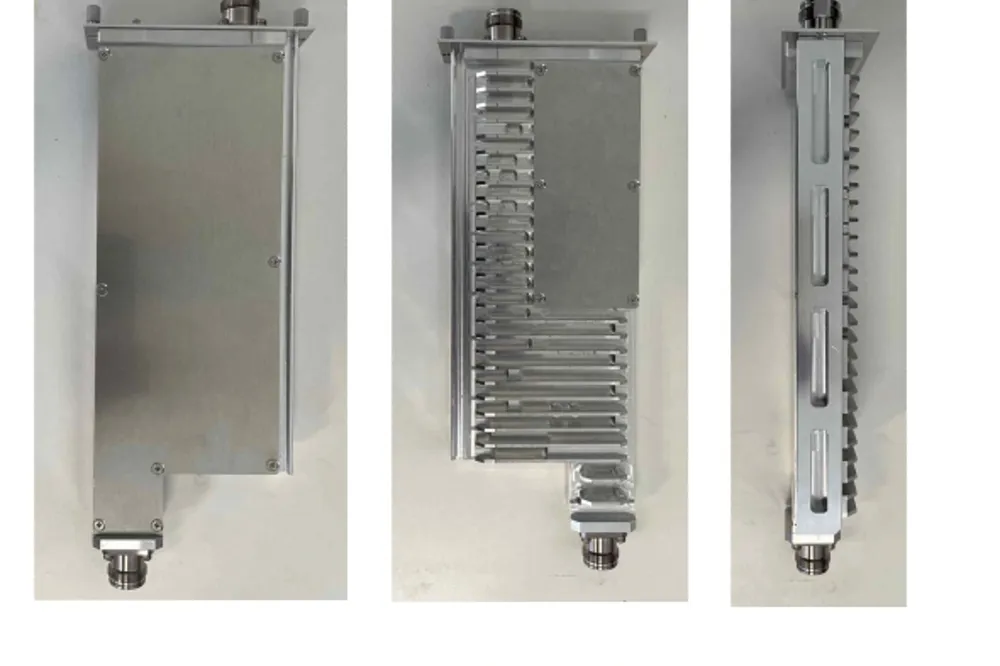
Energy Harvesting Indoor Communication Repeater. Inside buildingsRepeater (Point of Interface)distributes mobile communication signals from external base stations indoors, and is the world's first energy self-sufficient repeater that recovers more than 50% of the RF signal energy, which was previously discarded as heat, and uses it as its own power. By amplifying and transmitting mobile signals without external power, it greatly reduces power consumption and heat generation of communication devices, and enables more efficient and sustainable construction of indoor mobile communication networks.
HonoreekoSmart CommunitiesIoT5G인공지능스마트홈에너지 관리데이터 분석
EnerH POI
1
0
RFNISSI
One-Line Product Definition
Problem Definition
Repeaters (POI) are installed to facilitate mobile phone communication inside buildings, but in existing systems, more than 99.9% of the incoming base station signal is consumed as heat, resulting in significant energy waste. As a result, repeaters generate a lot of heat and always require a power supply, requiring large heat dissipation equipment and power costs.
When building an indoor communication network, additional power infrastructure construction is required, increasing costs and time, and there is also the problem of communication disruption in the event of a power outage. Furthermore, the wasted energy is also an environmental problem.
With the explosive growth in demand for indoor repeaters in the 5G/6G era, the limitations of existing methods with low energy efficiency and high heat generation are becoming prominent.
Key Differentiators
EnerH POI has achieved the world's first innovation by using RF energy harvesting technology based on GaN (gallium nitride) semiconductor circuits to recover more than half of the repeater input signal as power and use it to drive the device."Recovers 50%+ of the incoming signal that was mostly wasted as heat"and uses it as its own power source, greatly reducing reliance on external power and, as a result, reducing heat generation.
In addition, it is possible to implement small size and high efficiency at the same output, reducing the volume of the device, and increasing ease of use with a plug-and-play design (=no need to change the existing system) that allows it to operate immediately when attached to any elevator/building.
As a practical world-first example of a self-sufficient RF energy repeater, the fundamental solution to the power problem of indoor communication infrastructure is a decisive differentiating factor compared to similar products.
Key Adopters
Mobile carriers and building managers who want to improve the quality of mobile communication services in buildings are the main customers. For example, telecommunications companies install POIs for signal distribution in large buildings, shopping malls, and subways. If EnerH POI is introduced at this time, there are benefits of reducing power costs and ease of maintenance.
AlsoPublic institutions in charge of smart city infrastructure (B2G)orbuilding owners/management companies (B2B)can also consider installing it themselves.
In large projects, it is delivered in the form of B2B contracts with telecommunications companies and SI companies, and in small and medium-sized sites, it can be supplied through installation agencies. Ultimately, it is not a product for general consumers and is classified as a B2B professional communication infrastructure device.
Scalability
This solution started in the field of mobile communication repeaters, but it can be applied to all systems that use RF signals. For example, similar energy recycling principles can be applied to satellite communication repeaters and Internet of Things (IoT) gateways.
CurrentlyIndoor Mobile Communication (Smart Communities)However, we can expand the market to smart factory wireless networks and military communication relays.
Since it can be commonly applied to building environments around the world rather than in a specific country, there is also global market potential. However, as a communication device, there is a challenge of meeting frequency certification and communication regulations for each country.
Basically, since it is easy to replace existing infrastructure and the ROI is clear, it can be expanded to various industries and markets once regulations are resolved.
Judges' Evaluation
The CES Innovation Award (Smart Communities category) is interpreted as recognition for contributing to sustainable communication infrastructure. Experts say"It is the world's first innovation to apply RF energy harvesting to communication repeaters, enabling operation without external power."and was noted as an eco-friendly technology that reduces power consumption in the smart city and 5G fields.
The level of technical completeness is evaluated as already reaching the product level due to RF-NISSI's expertise in GaN circuit design, and the market expectation is that telecommunications companies are actively seeking to reduce energy costs, so the possibility of adoption is high.
On the other hand, there is also a view that it is a *"hidden strong technology"* in that it is not well known to the general public because it is a very special B2B field. Overall, it is a hidden innovation in the in-building communication field that is easily underestimated, and has received high scores from professional evaluators.
Analyst Insights
📌 Solution limited to a specific niche – Although it has achieved unparalleled efficiency improvements in the limited market of building communication infrastructure, it is expected to function as an essential solution in the professional field rather than having a popular impact.
The award list data is based on the official CES 2026 website, and detailed analysis content is produced by USLab.ai. For content modification requests or inquiries, please contact contact@uslab.ai. Free to use with source attribution (USLab.ai) (CC BY)
댓글 (0)
댓글을 불러오는 중...