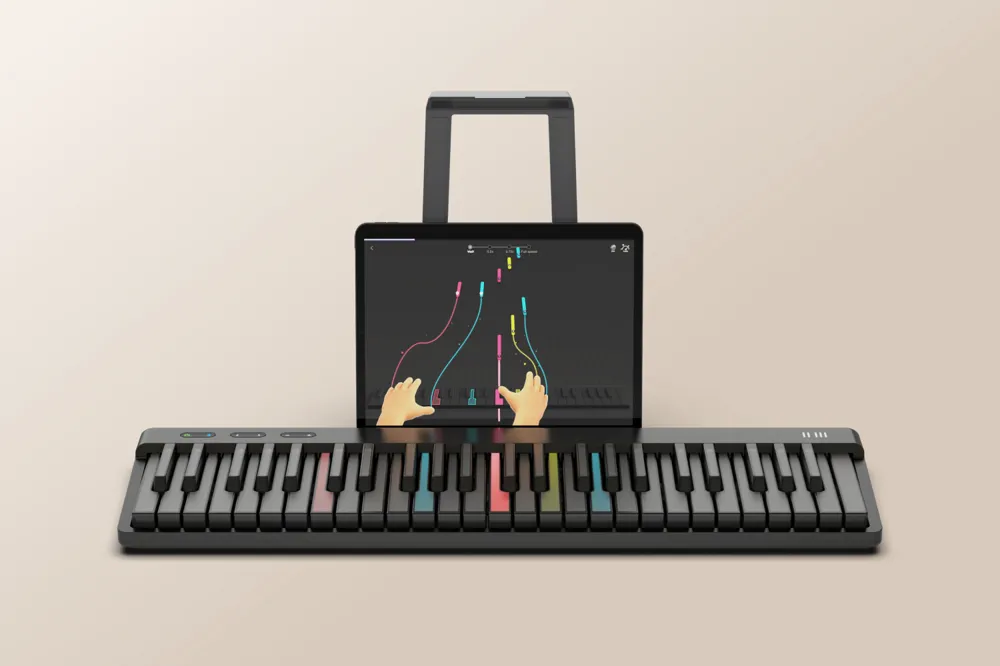
The world's first integrated piano learning platform using computer vision and AI. It recognizes finger positions in real-time to provide customized correction and coaching, helping anyone learn piano easily and enjoyably.
HonoreeComputer Peripherals & Accessories컴퓨터 비전AI 음악 교육핸드 트래킹실시간 피드백개인 맞춤형 학습지능형 연습 도우미
ROLI 피아노 시스템
6
0
ROLI
One-Line Product Definition
Problem Definition
Learning piano has long been perceived as a hobby with high barriers to entry and high costs. Traditionally, one-on-one lessons are required, which is costly, and self-study makes it difficult to correct bad habits due to the lack of immediate feedback.
In addition, existing digital piano learning apps only recognize which keys are pressed on the keyboard and provide only one-way practice without guiding detailed aspects such as finger shape or posture. As a result, beginners often feel bored and frustrated and give up easily, and the perception that *"only a gifted few can master musical instruments"* has spread. In other words, the lack of personalized feedback and motivation is a major problem.
Key Differentiators
The ROLI piano system solves this problem with a combination of dedicated hardware and AI software. First, a **high-resolution infrared camera (Stereo IR)** mounted on the piano keys tracks 27 joint points of the player's hands to digitize even the subtle positions and movements of the fingers. This allows us to understand not only which fingers are pressing the keys accurately, but also the hand shape, posture, and touch speed.
The ROLI AI practice assistant then analyzes this data in real-time to provide *"feedback and corrective coaching optimized for each player."* For example, it immediately alerts you if you use the wrong finger, and advises you to adjust your force if you hit a part that should sound weak too hard. In addition, an interactive AI tutor encourages or provides tips during the practice process, providing motivation as if a teacher is next to you.
Above all, it is a two-way learning process in which users directly play and receive corrections, rather than just listening, resulting in excellent learning efficiency and immersion. The decisive difference from existing similar apps is the computer vision-based precision feedback, which improves the player's form itself, unlike digital score-following learning. In addition, the system components, ROLI Airwave camera module, ROLI Piano keyboard, and ROLI Learn app, are organically integrated to operate, making installation and use easy.
Thanks to this practical, effect-oriented approach,"AI becomes a piano coach"is the evaluation it has received.
Key Adopters
Individual consumers (B2C) who want to learn pianoare the main adopters. It is especially attractive to children/adolescent learners or adult hobbyists who have difficulty attending academies due to time and cost constraints. From a parent's perspective, they can purchase this system instead of expensive lesson fees and use it for their child's music education, and adults can enjoy their hobbies through self-directed learning.
Also,schools and academies (B2B)can also introduce it as an auxiliary tool. For example, after-school music classes or piano academies can use this system to help students practice independently. Furthermore, it can be used in special education institutions for music rehabilitation training for students with disabilities, or in public welfare centers for hobby programs for seniors, and has potential for use in the public sector (B2G).
Basically, it has a strong B2C EdTech character as a smart learning device, but a B2B2C (sales through academies) model is also expected in collaboration with the education industry.
Scalability
The ROLI piano system is easy to expand to the global market because it is a product in the music field with low language barriers. It has already been globally promoted through the CES award, and by adding voice coaching functions in various languages through cloud updates, it can be customized for users in each country.
In terms of technology expansion, it can be applied to learning other instruments. For example, systems that track and coach hand movements with computer vision can be developed for guitars or violins. Also, although it currently consists of a dedicated keyboard and camera, it can be sold separately in the form of a camera kit that attaches to a regular piano in the future, allowing existing piano owners to use it.
If the API or SDK of this technology is released, there is room for linking with third-party education apps or combining with metaverse music education platforms. However, there are curriculum differences by culture in music education, and there is a challenge in localizing the content of AI coaching. Nevertheless, market scalability is very high considering the global potential demand (tens of millions of music learners worldwide).
In addition, future software upgrades such as real-time ensemble mode or composition mode can lead to markets beyond hobbies (producing, band practice, etc.).
Judges' Evaluation
It won Innovation Awards in two categories at CES 2026, computer peripherals and educational technology, and has been noted as a model case of education and technology convergence. The judges highly praised the fact that *"AI becomes a personal music teacher"* and praised it as an inclusive innovation that lowers the barrier to entry for music education.
Music media also called it *"the revolution of practice,"* and it is expected that the effect of immediate feedback will greatly shorten the time to acquire performance in actual user experience. In terms of technical completeness, the precise tracking and real-time processing performance of computer vision were smoothly implemented in the demo and received favorable reviews.
In addition, TrendHunter and other trend analyses mentioned that it shows the future of personalized learning that AI music education will bring, and the social value in terms of resolving educational disparities and expanding the base of the music population was also positively evaluated.
On the other hand, some conservative music educators point out the limitations of AI coaching (difficulty in teaching subtle touches or emotional expressions) and mention that it is difficult to completely replace the role of human teachers. However, the overall evaluation is"a groundbreaking solution that lowers the threshold of music education with technology,"and the atmosphere is that more applications are expected rather than overestimation.
Analyst Insights
🔥 High marketability / Business connection possible – This product realizes personalized music coaching that many beginner players around the world have needed, and is expected to be widely successful in the education and hobby markets. With high technical completeness and imminent commercial release, it has the potential to be a game changer in the music EdTech field.
The award list data is based on the official CES 2026 website, and detailed analysis content is produced by USLab.ai. For content modification requests or inquiries, please contact contact@uslab.ai. Free to use with source attribution (USLab.ai) (CC BY)
댓글 (0)
댓글을 불러오는 중...