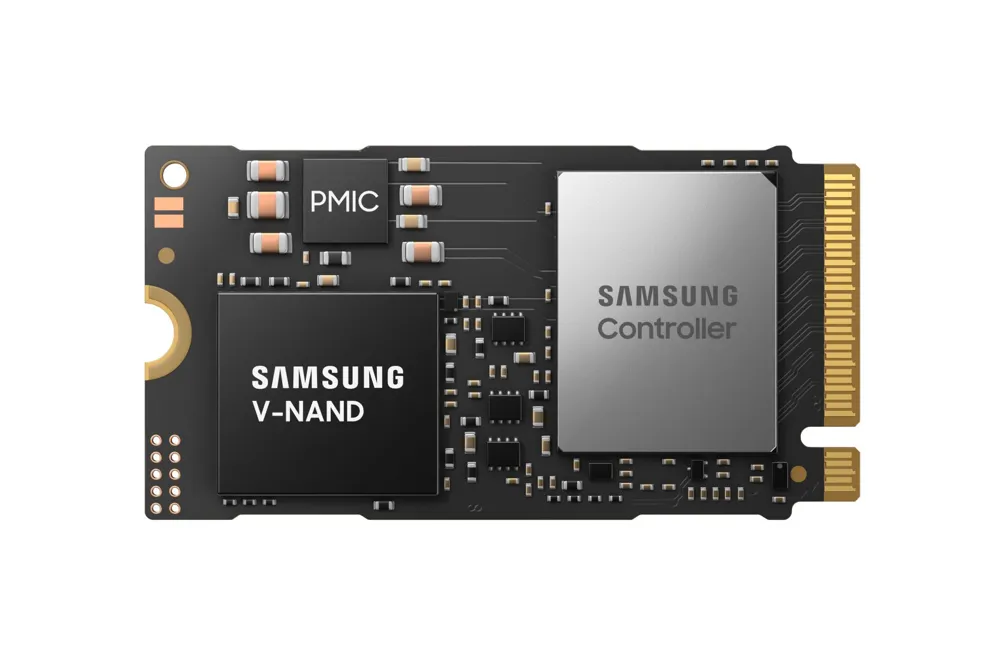
The world's first 22×42mm ultra-compact PCIe Gen5 NVMe SSD – packs up to 4TB of capacity and next-generation AI workload acceleration into a small M.2 card, providing excellent storage speed and space efficiency for high-performance laptops and edge devices.
HonoreekoComputer Hardware & ComponentsSSDM.2산업용 스토리지고성능낸드 플래시소형 폼팩터
PM9E1 M.2 22x42
2
0
Samsung Electronics America, Inc.
One-Line Product Definition
Problem Definition
Premium notebooks, ultra-compact PCs, and VR/AR devices have limited internal space, making it difficult to install sufficient high-speed storage. Existing high-performance NVMe SSDs are M.2 2280 standard (22×80mm) in size, which is often too long to fit in slim devices. Therefore, ultrabooks and similar devices use lower-capacity 2230 SSDs or eUFS, resulting in compromises in capacity and speed. Furthermore, as workloads that handle massive amounts of data, such as AI and machine learning, spread to PCs, the computational performance and continuous write processing capabilities of SSDs have become important even in small form factors. However, existing SSD architectures are not sufficiently optimized for AI. In short, there was a demand for "small, fast, and smart" storage, but there was a market gap.
Key Differentiators
The PM9E1 is the industry's first to implement PCIe Gen5 SSD performance in an ultra-compact 42mm long M.2 card. It achieves a maximum capacity of 4TB with double-sided mounting, providing unprecedented storage capacity in this size class. With next-generation speeds of up to 14.8GB/s for sequential reads and 13.4GB/s for writes, it achieves approximately 37% performance improvement in NPU computation scenarios compared to the previous generation.
In particular, it is designed for AI workload optimization, smoothly handling continuous write operations such as frequent checkpoint saving during large AI model training, and excelling at trained model loading and inference acceleration. To this end, Samsung's internal new "Presto" controller and 8th generation V-NAND are used to balance not only performance but also power efficiency and durability. In addition, it supports the SPDM 1.2 security protocol, which enhances security features such as device authentication and firmware integrity. In summary, the PM9E1 breaks space limitations and provides top performance, and is a high-speed, high-efficiency, and highly secure SSD for the AI era, with a significant advantage over similar products.
Main Adoption Entities
The main customers aremobile device manufacturers such as laptops and tablets (B2B).This product is for OEMs and will be used in ultra-slim premium laptops, VR/AR devices, and mini PCs to improve the performance of customer devices. Data center edge servers and industrial equipment where space is important, such as automotive IVI, are also potential customers.
Rather than being sold directly to general consumers, it is expected to be provided indirectly through finished products equipped with the SSD in the future. Therefore, the business model is centered on B2B (supply to device manufacturers).
Scalability
Since the target is IT device manufacturers worldwide, there are no regional limitations. Rather, it can be expanded to all computing devices that want to enhance AI functions. In the future, Samsung can expand this ultra-compact SSD technology to various form factors for automotive, IoT, etc., and since it uses the industry-standard M.2 form factor, it can easily penetrate other industries.
In terms of regulations, there are no special restrictions and the barrier to entry is low as long as each country's electromagnetic wave/safety certification is obtained. However, initially, it is only supported on the latest platforms (PCIe Gen5), but as compatible devices become more widespread over time, it will expand to the entire market.
Judges' Evaluation
The CES Computer Hardware Innovation Award demonstrates this well. Industry experts praised the difficulty of development, saying it was *"an implementation of an ultra-compact SSD architecture in preparation for the AI PC era."* Media outlets such as WCCFTech reported on Samsung's CES exhibition, noting that "14.8GB/s and 4TB were put into a 22×42mm size," which is a figure that competitors have not yet caught up with. The technical completeness is also high, and the product is scheduled to be mass-produced in 2026, and the main positive response is that it is an *"innovation in form factor by solving space limitations."*
Market expectations are that the launch of a new concept of ultra-lightweight workstations or AI notebooks equipped with this SSD will expand the horizons of mobile AI computing. Although it is less popular with the general public because it is a product for OEMs, the semiconductor industry evaluates it as a case where *"Samsung has proven its industry leadership."*
Analyst Insights
🔥 High marketability / Business connection possible – In the era of data deluge, the demand for small but fast storage is certain. If adopted by major notebooks and devices, it will directly lead to Samsung's B2B business performance and is expected to promote the growth of related ecosystems (mobile AI devices).
The award list data is based on the official CES 2026 website, and detailed analysis content is produced by USLab.ai. For content modification requests or inquiries, please contact contact@uslab.ai. Free to use with source attribution (USLab.ai) (CC BY)
댓글 (0)
댓글을 불러오는 중...