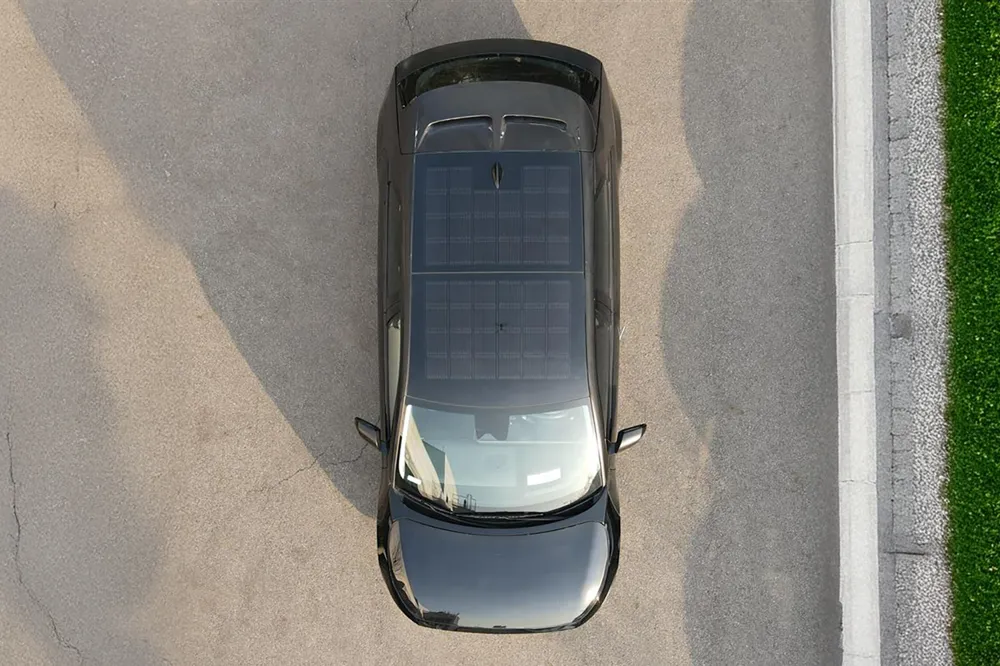
Lightweight solar panel module that can be directly attached to the electric vehicle body (curved solar panel made of plastic injection molding, which assists in charging the vehicle battery while driving and parking).
HonoreekoVehicle Tech & Advanced Mobility태양광 모듈사출 성형차량용 태양광에너지 효율자율 주행차친환경 자동차
Solarstic 사출 성형 차량용 태양광 모듈
10
0
Solarstic
One-Line Product Definition
Problem Definition
Vehicle solar panels have garnered attention as a way to increase the driving range of electric vehicles and reduce the burden of charging. However, existing solar panels are heavy and made of rigid glass, making them difficult to apply to the curved surfaces of vehicles and posing a high risk of damage upon impact.
As a prior solution, some companies have installed solar panels on vehicle roofs, but this has led to issues such as damage to the vehicle's design (change in silhouette due to the attachment of flat panels) and reduced efficiency due to the added weight. In addition, glass modules cannot be attached to curved surfaces, limiting their use to only flat areas, and they are prone to breaking from driving vibrations and collisions, raising concerns about durability.
Consequently, previous attempts at vehicle solar power have been criticized for their low cost-effectiveness compared to power generation and their lack of practicality. Furthermore, from a sustainability perspective, the issue of recycling 폐패널 (waste panels) has emerged, creating a demand for environmentally friendly, lightweight, and easily recyclable materials.
Key Differentiators
The key differentiator of the Solarstic module is that it encapsulates solar cells with a special plastic material using an injection molding method, resulting in a thin, lightweight, and flexible panel. This technology significantly reduces weight compared to glass (lightweight) and allows the panel to be closely integrated into the curved exterior of the vehicle.
As a result, it can be applied to the vehicle body as if solar cells are embedded on the surface without compromising the original character lines of the car's design, and it has high durability that can withstand impacts without the risk of breaking. In addition, Solarstic modules support variouscell types (monocrystalline, thin film, etc.)and can be manufactured in customized shapes for each vehicle model, enabling integrated design from the early stages of the automotive manufacturing line.
Another advantage is that it minimizes the heat and pressure applied to the solar cells through a low-pressure injection molding process, protecting them stably without reducing efficiency. In summary, it is differentiated by securing design flexibility + lightweight + robustness, thusVehicle Integrated PhotoVoltaics (VIPV)and accelerating the commercialization of.
Main Adoption Entities
Main Adoption Entities: The main customers are automobile manufacturers,Finished Vehicle Manufacturers (B2B)adopt the Solarstic module when developing new cars. In fact, Solarstic is a startup that has grown through Hyundai Motor Group's in-house accelerator, and Hyundai Motor and Kia plan to apply this technology to some of their future electric vehicle models.
Therefore, global finished vehicle OEMs are the main adopters, and the primary structure involves developing vehicles equipped with the module and selling them to consumers (B2C). Separately, building exterior material companies or solar panel installers may purchase lightweight plastic solar modules and use them for Building Integrated PhotoVoltaics (BIPV), etc.
However, as the current product name suggests, it is focused on vehicle applications (VIPV),B2B (Automotive Industry)is the main adoption path.
B2C/B2B Classification: B2B
Scalability
Environmental/Regulatory Constraints: As a vehicle component,vehicle safety standards (fragment scattering in the event of a collision, etc.)must be met. Solarstic claims to have the durability to meet the requirements of collision tests with its patented design. In addition, since the solar module generates electricity in the vehicle, regulations such as automotive electrical certification and EMC must also be reviewed, but it appears that this is being resolved through collaborative development with Hyundai Motor.
Industry/Market Scalability: The market potential is very high. In the EV era, attempts to utilize the vehicle surface for energy production are an inevitable trend, and if production and design issues are resolved like Solarstic, adoption is highly likely.
In fact, Solarstic is aiming to mass-produce Hyundai and Kia models in 2027, and if successful, it is expected to be installed in tens of thousands to hundreds of thousands of vehicles annually, leading to rapid revenue growth. In addition,other global automakers (Toyota, Volkswagen, etc.)may also be interested, and if Solarstic secures patents and trust as a market first mover, it has the potential to grow into a standard supplier.
In addition, the current parallel business of lightweight solar panels for buildings is expected to provide a stable cash flow, supporting the expansion of the vehicle business. However, due to the nature of the automotive industry, the development cycle until model application is long, and evaluations may vary depending on the actual consumer utility (how much does solar power generation increase driving range).
For example, it is necessary to present a clear value proposition such as securing tens of kilometers of driving range per day with solar power. The current trend is largely positive, suggesting that it will sufficiently contribute to auxiliary power and battery preservation during parking. Considering the sustainability trend (eco-friendly appeal), the "solar-powered car body" may become a differentiating point for EVs in the future, impacting the entire industry.
Judges' Evaluation
At CES 2026, the Solarstic module was selected as an Innovation Award winner in the Vehicle Tech & Advanced Mobility category, highlighting it as an example of the sustainable mobility trend. The judges praised it as a "vehicle solar power technology that solves both design constraints and weight issues," and highly valued its acceleration of the practical use of EV auxiliary charging.
Automotive industry officials who saw the prototype unveiled at the eventresponded with "Finally, a realistic level of vehicle solar panel has emerged,"and expressed particular admiration for the curved application demo. The technical completeness is judged to be in the pre-mass production stage, and the credibility was high, as Hyundai executives directly introduced it at the CES booth.
Market expectations are quite encouraging, but some experts cited the failed examples of Lightyear One and Sono Sion, stating that "the cost issue compared to power generation efficiency should be monitored." In other words, the key is whether the Solarstic module provides a sufficient increase in driving range compared to the additional cost, and regarding this,"replenishing several km of driving distance per day is realistic, but it is a small amount for consumers"is also a view.
However, on the other hand,"it is attractive enough when including battery preservation and eco-friendly image value"is also a positive evaluation. It is difficult to see it as an overestimation, and rather, it is an element that will receive more attention with the popularization of electric vehicles, so investors and automakers are very interested.
Analyst Insights
🔥 High Marketability / Business Connection Possible
The award list data is based on the official CES 2026 website, and detailed analysis content is produced by USLab.ai. For content modification requests or inquiries, please contact contact@uslab.ai. Free to use with source attribution (USLab.ai) (CC BY)
댓글 (0)
댓글을 불러오는 중...