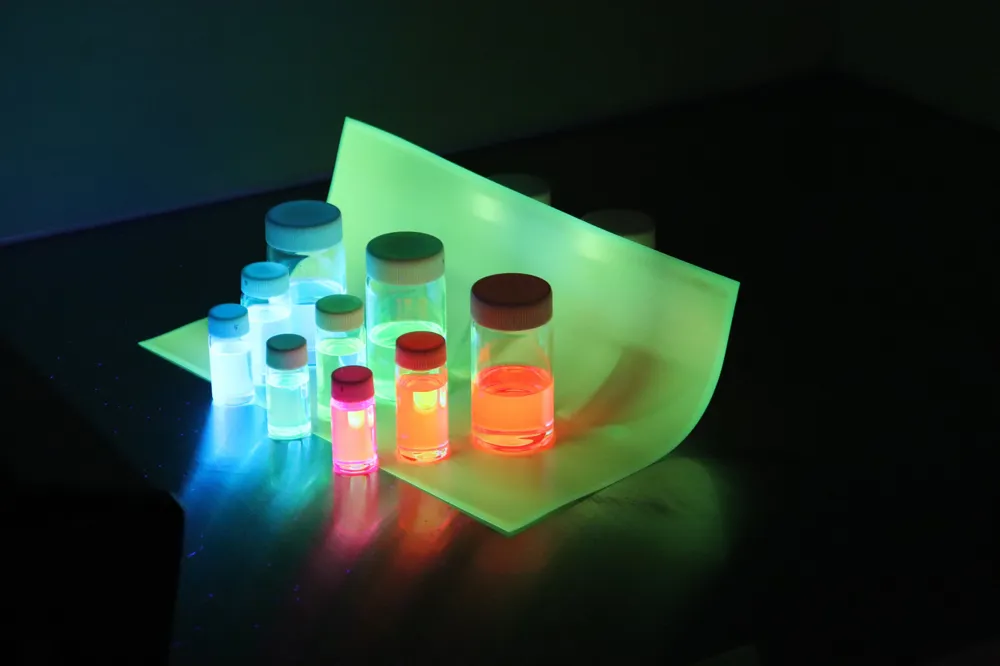
Perovskite nanocrystal-based color conversion film, a high-purity light conversion material technology that implements over 95% Rec.2020 color gamut and increases energy efficiency in next-generation displays.
HonoreekoImaging페로브스카이트컬러 컨버전 필름Rec.2020초고색순도디스플레이롤투롤 공정
페로브스카이트 컬러 컨버전 필름
3
0
SN Display Co., Ltd.
One-Line Product Definition
Problem Definition
Background Problem: Current high-end displays cannot fully express the next-generation standard Rec.2020 color gamut, resulting in a limitation in the actual color reproduction of HDR video. For example, current TVs using quantum dot (QD) technology only implement about 75-90% of the Rec.2020 color space, falling short of perfect color expression.
Limitations of Existing Methods: 1st generation QDs (quantum dots) were phased out due to regulations on cadmium use, and 2nd generation indium-based QDs lowered toxicity but also reduced color purity, remaining at 76% of Rec.2020. Self-emissive displays such as OLEDs also remain around 90% due to physical limitations. In addition, existing QD sheets are produced in limited widths and lengths due to the manufacturing process, which restricts scaling up, and there were also durability issues such as performance degradation in high-temperature and high-humidity environments.
Key Differentiators
Innovative Color Reproduction Performance: SN Display's perovskite film covers over 95% of the Rec.2020 standard, expressing a wider color gamut than any existing display. This is because the emission line width of perovskite nanocrystals is very narrow at 25nm or less, resulting in excellent pure color implementation. As a result, it expresses more vivid and realistic colors, further enhancing the quality of HDR content.
Ease of Manufacturing and Integration: This film can be mass-produced continuously with a roll-to-roll UV curing process with a width of 110cm and a length of 100m or more, making it possible to apply it to large TV panels with uniform performance. In addition, it can be applied directly to the blue LED backlight of existing LCD/QD-OLEDs, so it can be put into the production line without separate equipment or design changes. In other words, it has the practical advantage of greatly improving performance while utilizing the current infrastructure.
Durability and Efficiency: By applying proprietary particle protection technology and a polymer matrix, the moisture and thermal instability, which are chronic weaknesses of perovskite, are improved, maintaining stable performance even in high-temperature and high-humidity environments. This makes it possible to use it in harsh environments such as automotive displays and medical monitors.
In addition, with a light conversion efficiency (quantum efficiency) of over 90%, energy loss is minimized, reducing power consumption by reducing the backlight intensity required to produce the same brightness. In summary, this technology surpasses existing color conversion materials in terms of color purity, scaling, stability, and efficiency.
Key Adopters
Parties Responsible for Actual Costs: Display panel manufacturers are the main customers for this material. OLED/QD-LCD panel manufacturers such as Samsung Display and LG Display, or LCD TV manufacturers such as BOE and TCL, can adopt it as a color film. In addition, micro LED developers may also be interested in it as a color conversion layer. It is also highly likely to be provided to large display companies in the form of technology licensing.
B2C/B2B/B2G: B2B. Although end consumers will purchase TVs, monitors, etc., this material itself is mounted on panels through business-to-business transactions in the form of parts. (In the future, finished products using this technology will appeal to consumers as "Rec.2020 95% TV", etc.)
Scalability
Environmental/National Restrictions: Since it is a material technology, there are no specific regulations in certain countries. (Universal application is possible as long as there are no harmful substances such as cadmium.) Perovskite may contain a small amount of lead, but if it is a trace amount, it may be encapsulated to meet regulations such as RoHS. Overall, it can be applied to any global display market.
Industry/Market Scalability: First, it is applied to displays such as TVs, monitors, and tablets, but it will also be useful in ultra-high-resolution microdisplays for AR/VR in the future. As the pixel size decreases, there are limitations with existing QDs, but perovskite is attracting attention as a next-generation color conversion material that responds to ultra-fine pixels, so it can be expanded to related markets. SN Display is seeking collaboration with various companies through technology licensing, and if standardization is achieved, it will have an impact on the entire industry.
Judges' Evaluation
CES Award Context: Winning the CES 2026 Innovation Award (Imaging category), it has attracted attention as a breakthrough in the field of display materials. The judges seem to have highly evaluated the fact that it is a "3rd generation color conversion technology following QD" and the proof of commercialization potential (securing patents and manufacturing processes).
Technological Completeness: Related industry journals comment that "the results of 10 years of research as a first mover are finally ready to be applied to the industry." In fact, SN Display has a leading technological position, having filed the world's first perovskite light-emitting patent in 2014 and holding more than 9 international patents. Although it has not yet been applied to mass-produced TVs, it is said to be close to the commercialization stage, having completed prototype verification such as a 75-inch TV panel demonstration.
Market Expectations: Display industry experts expect that if this technology is commercialized, "the limitations of color reproduction of QLED TVs and OLED TVs will be overcome, opening an era of virtually complete HDR color expression." In particular, there is a high level of interest, with rumors that Samsung and TCL are exploring the introduction of this technology. However, since the stability of mass production and life verification are key, it is expected that it will be introduced sequentially from high-end models within a few years.
Overestimation/Underestimation Factors: From an investor's perspective, there are concerns about the business structure that depends on large display companies due to the nature of material technology. Even if the technology is innovative, market penetration is difficult without partnerships with large companies. Therefore, although the current Innovation Award is a good sign that the technology has been externally recognized, there is a cautious view that excessive short-term expectations should be avoided as it may take some time to translate into actual business results. On the other hand, there is a consensus in the industry that perovskite is the core of the future of displays, so there is a coexistence of opinions that it should be highly valued in the long term.
Analyst Insights
🧪 R&D and Concept Verification Stage: The technical achievement is very impressive and is expected to further improve the color expression of future displays, but it is still in a stage where more verification and time are needed before mass production and adoption by major companies. In other words, it is a technology that should be watched with the possibility of becoming an industry standard in the next few years, rather than immediate large sales.
The award list data is based on the official CES 2026 website, and detailed analysis content is produced by USLab.ai. For content modification requests or inquiries, please contact contact@uslab.ai. Free to use with source attribution (USLab.ai) (CC BY)
댓글 (0)
댓글을 불러오는 중...