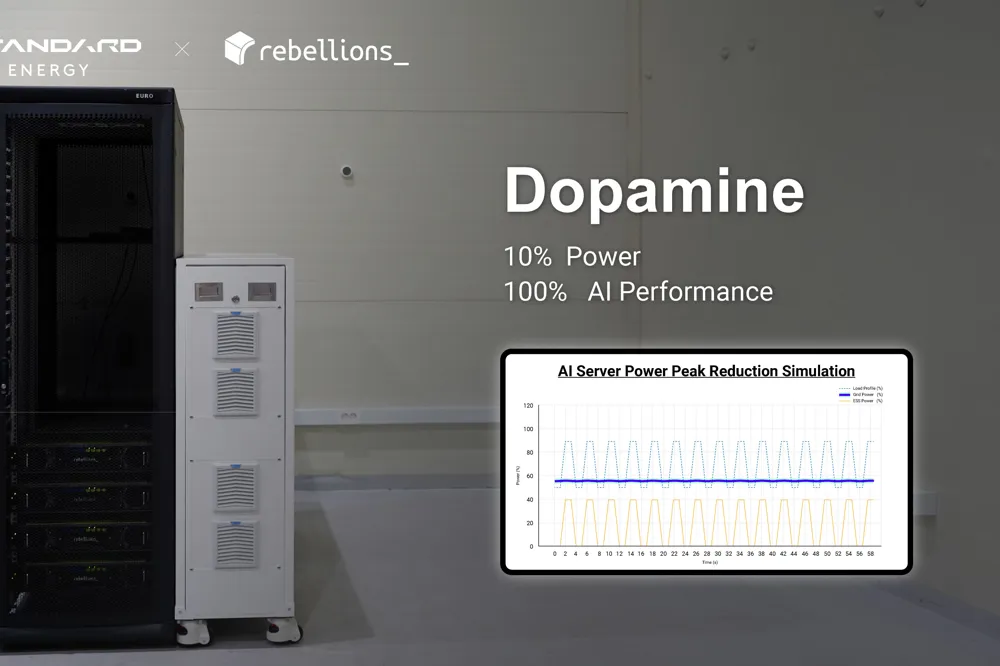
This is a hybrid power supply system that combines an energy storage system (ESS) with an AI semiconductor server. With ultra-low-power AI chips and high-speed response batteries, it increases data center AI performance and lowers power peaks, providing a solution that stably drives high-performance AI services with less power.
HonoreekoSustainability & Energy Transition에너지 저장 시스템(ESS)인공지능(AI)전력 효율에너지 관리지속가능한 기술탄소 배출 감소
Dopamine - AI & ESS 기반 에너지 효율 하이브리드 AI 전력 시스템
1
0
Standard Energy and Rebellions
One-Line Product Definition
Problem Definition
Power Bottleneck in AI Infrastructure: The latest AI servers (GPUs, etc.) consume enormous amounts of power, leading to soaring electricity bills and overloading power infrastructure. For example, performing thousands of AI calculations requires multiple GPUs, which leads to rapid peak power and sustained high energy consumption. Many small and medium-sized data centers or edge sites hesitate to adopt AI because they cannot handle this power demand.
Power Fluctuations and Performance Degradation: AI workloads have a spike pattern in which power consumption surges and drops instantaneously. Existing power infrastructure cannot keep up with these fluctuations immediately, resulting in momentary voltage drops or performance degradation (AI calculation delays), or requiring conservative and excessive power equipment, which is inefficient.
Limitations of ESS Integration: Typically, AI equipment and energy storage systems are installed separately, with AI servers indoors and large-capacity ESS batteries outdoors, connected by large cables. This increases installation complexity, and, more importantly, the fire risk of lithium-ion ESS makes indoor installation impossible. As a result, it has been difficult to actively utilize ESS for power stabilization, and AI systems have been vulnerable to power outages or voltage fluctuations.
Sustainability Challenges: Expanding AI services directly leads to increased power consumption, raising issues of carbon emissions and rising operating costs. If power peaks are not reduced, expanding AI infrastructure will increase the environmental burden, which is a problem that needs to be solved in terms of companies' ESG.
Key Differentiators
AI Semiconductor + Battery Integrated System: Dopamine is a single system that physically integrates Rebellions' ultra-low-power AI NPU server rack and Standard Energy's vanadium ion battery (VIB) ESS. The AI calculation unit and power storage unit are in one case, enabling real-time power supply control and operating in a tightly coupled manner without separate wiring losses. This is a major difference from the existing separate AI server and ESS, where simultaneous optimization occurs in the same space.
GPU-Level AI Performance with 1/10th the Power: Rebellions' Atom NPU chip delivers equivalent AI inference performance while reducing power consumption by more than 80% compared to existing GPUs. In addition, the ESS assists with power peaks by immediately supplying energy when needed, allowing tasks such as 1000-channel video analysis to be performed with only 16 NPU chips instead of 40 GPUs. As a result, dramatic efficiency improvements have been achieved, reducing system power consumption by 90% (from 9200W to 560W). The key is to drive high-performance AI, which was previously impossible due to power constraints, with less power.
Power Response and Stability of Less Than 1ms: The VIB battery is designed with a 4C-rate high output, enabling immediate power supply and supplementing power within 1 millisecond even when the AI chip load changes rapidly. Thanks to this ultra-high-speed response, there is no voltage drop during calculations, so AI performance degradation or calculation interruptions do not occur. In addition, since the battery absorbs the spikes in the power load, external power only needs to be supplied at a flat level. This lowers the peak power requirements of the entire data center, reducing facility costs and increasing power grid stability.
Safe ESS for Indoor Installation: Standard Energy's VIB battery is based on an aqueous electrolyte and has almost no risk of fire, unlike lithium batteries. Therefore, the server rack and battery can be attached together for indoor installation, and there is no need for a huge outdoor battery box or explosion-proof measures. This low-heat, safe characteristic leads to reduced cooling costs and increased installation freedom. Previously, AI equipment was placed indoors and ESS was placed outdoors, resulting in inefficient placement, but now they can be placed together in the same space to maximize efficiency without cable loss or conversion loss.
Realizing a Compact Edge AI Data Center: With the above features, the Dopamine system builds a high-performance AI infrastructure with a small footprint and low power consumption. Therefore, it has opened the way for AI services to be introduced at the edge or in small data centers. Traditionally, large-scale GPU farms required huge power and cooling infrastructure, but Dopamine has been reduced to the level of one rack, allowing medium-sized companies and research institutions to have their own AI centers. This is differentiated in terms of improving accessibility and decentralization of AI infrastructure.
Key Adoption Entities
Cloud and Data Center Operators (B2B): Companies that provide AI cloud services are the main customers who are interested in improving power efficiency. Examples include AI startup's GPU farms, telecom MEC (mobile edge computing) centers, and university/research institute AI research data centers. Since they need to maximize AI performance in limited space and power, they should consider adopting Dopamine's high-efficiency AI rack.
On-site AI Demand Companies in Manufacturing and Security (B2B): Edge AI demand is also a target, such as installing AI vision analysis servers in factory facilities or placing AI analysis systems in urban CCTV control centers. Since they can run AI with just one Dopamine without a large computer room, companies that want to build AI in small sites (e.g., smart factory companies, small and medium-sized local governments, etc.) can be major customers.
Government/Public (B2G): In terms of national backbone network energy saving, it can be introduced on a trial basis in national defense AI systems or public research institutions. In particular, when building data centers in developing countries with insufficient power infrastructure, such low-power, high-performance solutions are likely to be in the spotlight. However, initially, demand is being sought mainly for private B2B projects.
Scalability
Expansion Across Industries: Dopamine's concept is a high-output power + AI computing integrated platform, and can be applied to other computationally intensive environments. For example, it can be applied to fields with large power constraints, such as mobile data centers for autonomous vehicles and aerospace portable AI platforms. Currently, it is specialized for AI inference, but it can be expanded to high-performance computing (HPC), 5G edge equipment, etc. in the future.
Global Market Potential: Both companies are Korean companies, but AI energy saving is a common global topic, so there is a lot of room for overseas expansion. In particular, it can appeal to Europe, where electricity costs are high, and Southeast Asia, where power infrastructure is weak. Rebellions and Standard Energy have also declared that they will simultaneously target domestic and overseas markets with this solution, so there is a high possibility that they will seek scale-up through overseas partnerships or local production in the future.
Regulations and Certification: Since it is a new technology ESS, there is a challenge to obtain electrical safety certification in each country. In addition, large customers must be able to trust that data center industry standards (e.g., Uptime Institute certification, etc.) are met. However, if the contribution to eco-friendliness (carbon reduction) is proven, government support or policy benefits can be received, so if policy drives are received in the medium to long term, diffusion can be accelerated.
Technical Expansion Limitations: The current solution is optimized for Rebellions' Atom NPU, but if customers want to use other AI chips (e.g., NVIDIA), it is difficult to apply. Therefore, scalability is somewhat linked to the market penetration of Rebellions chips. To compensate for this, the release of Dopamine for other AI chip versions may be considered. In addition, VIB batteries are bulky, so multiple parallel configurations are required for ultra-large-scale calculations (tens of thousands of TOPS), etc., and there are scale limitations, but this is a part that will gradually improve with technological advancements.
Judges' Evaluation
Favorable Reviews on Innovation:"The key to fundamentally solving the power problem of AI data centers"It was awarded the Innovation Award in the CES 2026 Sustainability & Energy Transition category. An AI expert called Dopamine a *"creative integration that maximizes AI computing efficiency,"* and in particular, sees peak reduction using batteries and indoor installation design as innovative. Media such as BusinessKorea also introduced it as "'Dopamine' solution that guarantees safe energy supply to the brain (AI chip)."
Completeness and Demonstration Evaluation: An early prototype was demonstrated at the 2025 Busan World Climate Industry Expo, proving functions such as switching within 3ms in the event of a power outage. Industry officials who saw this responded that "the technology is closer to the practical stage than expected," and gave positive reviews of both Rebellions' AI chip performance and Standard Energy's battery technology. However, there are also opinions that the actual application effect should be further observed because information on the specifications of the commercial version (e.g., accurate throughput, range of supported AI models, etc.) is still limited.
Market Reality: Despite positive interest, there is a cautious view in the market about the lack of verification at the commercial stage. For example, to compete with the existing GPU ecosystem such as NVIDIA, there are challenges to be solved, such as software compatibility and maintenance support. There is also an evaluation that "It is a combination of an AI semiconductor startup + a new ESS startup, so it will take time to secure reliability." Investors and experts believe that DopamineConcept Verification (R&D)is successful, but building a large-scale mass production and sales pipeline is the next task. Nevertheless, it is expected that it will gradually grow from niche markets because it meets the demands of the times for energy saving in AI infrastructure.
Analyst Insights
🧪 R&D and Concept Verification Stage: It has proven technical feasibility with a creative combination of AI semiconductors and ESS, but it seems to be only at the stage of proof of concept. Despite the innovative energy saving effect, reference acquisition and ecosystem creation are required before it can be adopted in the conservative data center market. Currently, it is evaluated as an advanced concept experiment stage, and the success of commercialization depends on the verification results over the next 1-2 years.
The award list data is based on the official CES 2026 website, and detailed analysis content is produced by USLab.ai. For content modification requests or inquiries, please contact contact@uslab.ai. Free to use with source attribution (USLab.ai) (CC BY)
댓글 (0)
댓글을 불러오는 중...