A security lighting solution for companies and institutions that neutralizes camera shooting and AI identification in spaces where confidentiality is required, preventing the leakage of visual information.
HonoreekoCybersecurityAI 보안카메라 무력화영상 왜곡정보 유출 방지컴퓨터 비전 방해보안 조명
라이트세이버(LIGHTSAVER)
5
0
sPresto Co., Ltd.
One-Line Product Definition
Problem Definition
With the proliferation of smartphones and the development of ultra-compact cameras, the risk of confidential information leakage due to unauthorized photography has increased. If internal images are taken and leaked from research labs or military facilities, it constitutes a security breach. There is also the possibility of someone subtly recording a meeting with their phone.
Furthermore, with the recent advancements in AI video recognition technology, it is easy to identify people's faces or products even with just CCTV footage, which can be exploited in sensitive areas. Existing countermeasures include using electromagnetic detectors to find hidden cameras or prohibiting cameras altogether, but these are not perfect and can be cumbersome. Extreme methods, such as using lasers to burn camera sensors, have also been studied but are dangerous. In other words, there was a need for an easier and more fundamental visual security method.
Key Differentiators
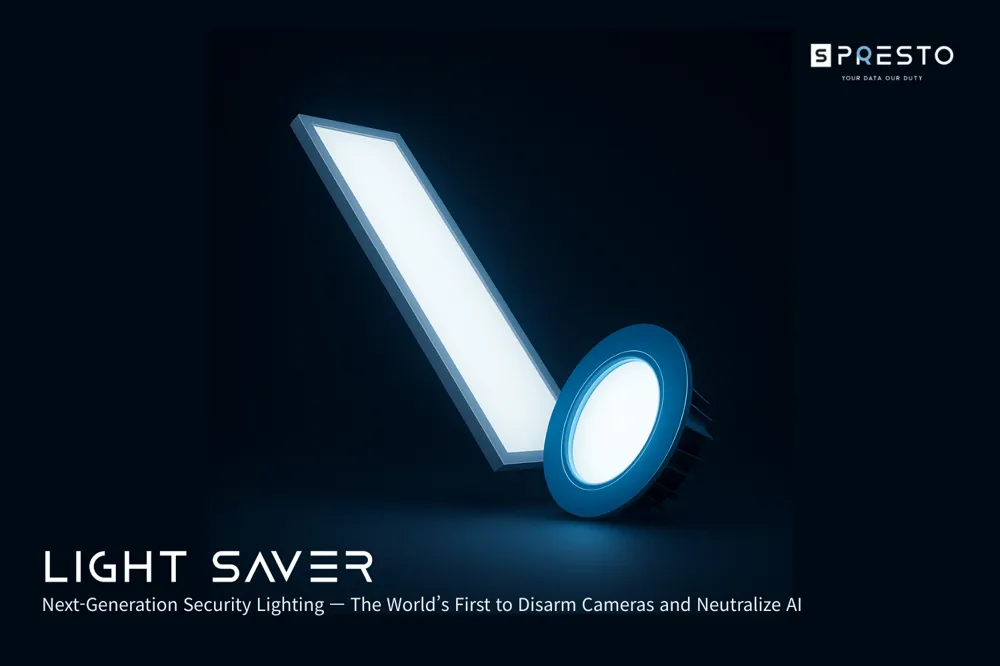
LightSaver is the first case of using the lighting itself as a jamming device. Special LED lighting emits normal light to the human eye, but high-frequency flickering or patterns are input to digital camera sensors, causing noise and distortion in the video. As a result, recorded videos are blurry or full of color lines, making it impossible to identify people or read documents. At this time, there is little inconvenience felt by humans on-site, so there is no disruption to daily tasks.
Additionally, AI recognition disturbance patterns are included to prevent computer vision algorithms from capturing feature points, increasing the failure rate of face and object recognition even if someone tries to collect and process the video with AI. As the world's first optical-based anti-AI security, it is innovative in that it passively responds with light alone, without radio wave blocking or communication interference.
Installation is as simple as replacing a regular light fixture, and multiple lights can be remotely controlled via 4G/Wirepas mesh communication for unified ON/OFF management depending on the situation. For example, turning on LightSaver mode with an app at the start of a meeting switches all the lights in the room to security mode. Solar power generation can also be used, allowing operation without power wiring. As such, it is expected to become an essential security facility in the AI era as a discreet yet powerful means of information protection.
Key Adopters
Companies and public institutions (B2B/B2G)are the main customers. For example, it can be first introduced in R&D departments, defense-related conference rooms, and government classified facilities. It is also applicable to places where camera entry is controlled or where there are concerns about information leakage, such as financial institutions and test centers (to prevent cheating). It can also be installed in spaces where illegal filming needs to be prevented, such as hotels and public restrooms.
The sales format will be a B2B method in which facility management companies or construction companies adopt it as lighting equipment and place orders. It is not easy for general consumers to purchase directly due to the price or installation, so it is a solution that will be adopted by organizations rather than individuals.
Scalability
This solution is only effective in specific places (indoor spaces). It is difficult to install widely outdoors, and the security that requires CCTV may conflict with privacy protection. In other words, the market size may be limited as it must be limited to some sensitive areas.
However, as it has pioneered a new field in the global security market, there is room for expansion into the entertainment industry, such as movie theaters (to prevent illegal recording) and concert halls (to prevent performance filming). In addition, various derivative possibilities are being discussed, such as applying it to vehicle headlights to make specific vehicles invisible to dashcams or traffic cameras (although there are legal issues). In terms of regulations, there are no clear regulations on optical security yet, but demand is expected to increase in the trend of strengthening personal information protection. sPresto is currently expected to focus on the Asian market, including Korea, and the market could grow if it is adopted as a public safety standard in cooperation with governments in each country.
Judges' Evaluation
It was selected in the Cybersecurity category of the CES Innovation Awards and recognized for the originality of its technology. Experts praised it as a "reverse-thinking technology for humans in the AI era," and also noted that a Korean startup struggling with the molka (spycam) problem has come up with a solution. Although the technical completeness is at the prototype demonstration level, the core principle is simple, so the possibility of implementation is highly evaluated. Market expectations are limited to special markets, but the impact is very large. In particular, there are many reactions that it is a "necessary technology" in that it addresses an underestimated security blind spot.
On the other hand, some raise concerns that "criminals may abuse it" (e.g., a burglar carrying a LightSaver to avoid CCTV), but the counterargument is that it would require bright lighting, making them more noticeable. Overall, it may have been somewhat undervalued compared to its innovation and social utility, but interest has increased with this award.
Analyst Insights
📌 A solution limited to a specific niche – A dedicated technology used only in extremely sensitive security environments, it will be a solution with stable demand in the industrial and public niche market rather than popularization.
The award list data is based on the official CES 2026 website, and detailed analysis content is produced by USLab.ai. For content modification requests or inquiries, please contact contact@uslab.ai. Free to use with source attribution (USLab.ai) (CC BY)
댓글 (0)
댓글을 불러오는 중...