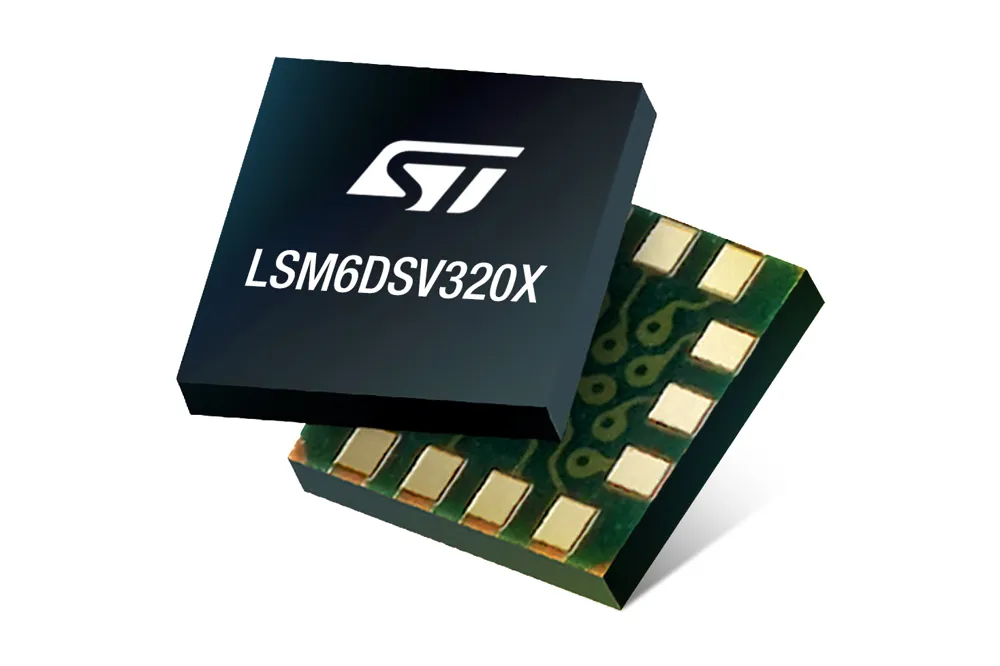
The world's first integrated high-g accelerometer inertial sensor with a dual accelerometer + gyroscope integrated IMU sensor that detects everything from ±16g of micro-vibration to ±320g of extreme shock in a single chip.
HonoreeEmbedded TechnologiesIMU관성 측정 장치모션 센서저전력고정밀도AR/VR
STMicroelectronics LSM6DSV320X 관성 측정 장치
2
0
STMicroelectronics
One-Line Product Definition
Problem Definition
Most devices, such as smartphones, are equipped with accelerometers in the ±16g range to measure posture, steps, etc. However,extreme acceleration such as vehicle collisions (hundreds of g's)or sports impacts cannot be measured with existing sensors, resulting in sensor saturation.
For this reason, implementing vehicle collision detection on mobile devices or concussion detection on wearable devices required separate high-g accelerometers or roundabout methods. However, separate sensors increase space and cost, and combining multiple sensors complicates power consumption and chip calibration.
In short,there was a demand to "measure everything from everyday ranges to accident ranges with a single chip,"but it was difficult to simultaneously implement fine sensitivity and resistance to large impacts. There was also a market demand to detect extreme events missed by existing IMUs to provide new safety/tracking features.
Key Differentiators
The LSM6DSV320X is the world's first IMU to incorporate two different accelerometer structures (low-g ±16g, high-g ±320g) into a single IMU. This makes it possible to capture everything from subtle movements to very large impacts, and even though the two sensors are on a single chip, they operate independently without interfering with each other, so the low-g channel is not affected even if the high-g sensor is saturated.
It also integrates a high-speed gyroscope that measures up to 4000dps, andAI program functions (machine learning core, FSM)are also built-in to perform smart data processing on the sensor itself.
With this multi-functional integrated platform, for example, a single smartphone can handle everything from everyday motion detection to automatic collision detection eCall in the event of a traffic accident. In addition, ST's ultra-small MEMS process minimizes the chip size, making it small enough to fit into smartwatches and other devices.
In conclusion, as the only commercially available IMU that integrates two accelerometers compared to competitors, its key differentiator is that it expands the realm of motion sensing by providing best-in-class versatility andaccuracy/consistency (minimum sensor deviation).accuracy/consistency (minimum sensor deviation).
Key Adopters
The main customers areelectronics manufacturers (OEMs),and all product manufacturers that incorporate motion sensors, such as smartphones, smartwatches, automotive IoT devices, and AR/VR headsets, are target adopters.
In particular, smartphone companies are highly interested in this sensor because it can be used to implement new safety features such as collision detection and fall detection, and wearable manufacturers can enhance their intense exercise measurement capabilities. In the automotive sector, modules equipped with this sensor can also be used for airbag or eCall systems using data from vehicle collisions.
As a B2B business, consumers pay for devices (e.g., smartphones) that incorporate this sensor. Global electronics OEMs purchase it as a component, and B2B2C delivers end-user value.
Scalability
This IMU can be widely applied from smartphones to industrial applications in terms of specifications, so the market base is very broad. The MEMS sensor itself uses a globally standardized interface (I²C/SPI), so manufacturers can adopt it anywhere without regional restrictions.
The fields of application are also endless, including sports sensors, drone impact monitoring, and military impact recording devices. ST is already pioneering new uses for this sensor (e.g., collision recording for car black boxes, condition monitoring for construction equipment), and will release derivative products with adjusted low/high-g ranges to meet a variety of needs in the future.
In addition, the chip has built-in AI capabilities, so performance can be expanded even after release, such as adding new motion recognition algorithms via OTA firmware updates in the future. In summary, it will grow as a platform-type sensor that can penetrate various industries without being tied to a specific environment.
Judges' Evaluation
The product won an innovation award in the embedded technology category, with rave reviews that it "broadened the horizons of the MEMS sensor field." In particular, the judges praised the fact that a single chip covers all heterogeneous acceleration ranges, and commented that "high-impact detection can now be easily introduced into general consumer devices."
It has already been recognized by the industry with awards at Embedded World and other technology awards, and at the CES site, there were voices expecting concrete applications, such as "Now smartphones will be able to detect car accidents."
The technical completeness is considered to be high in mass production stability due to ST's proven MEMS process, and its maturity has already been proven by winning the Embedded World NA 'Best in Show' award. Market expectations are very positive, and there are rumors that several mobile manufacturers are considering adopting it in their next models.
Overall, it is considered an innovation that will change the landscape of the sensor industry, with almost no criticism of overestimation, and is welcomed to the point of "Why did it only come out now?"
Analyst Insights
🔥 High marketability / Business connection possible
The award list data is based on the official CES 2026 website, and detailed analysis content is produced by USLab.ai. For content modification requests or inquiries, please contact contact@uslab.ai. Free to use with source attribution (USLab.ai) (CC BY)
댓글 (0)
댓글을 불러오는 중...