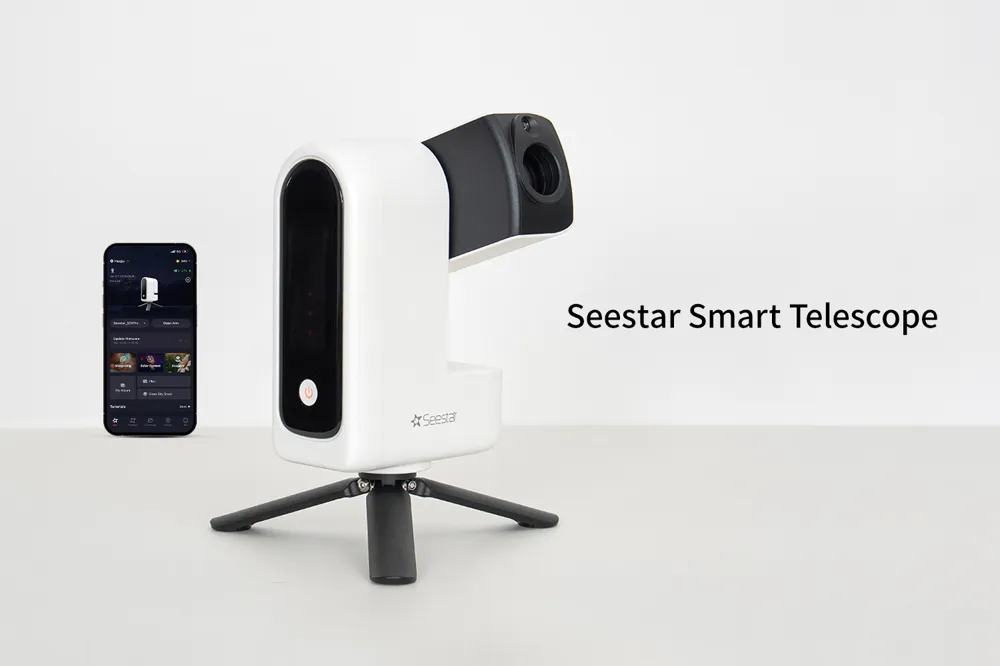
An all-in-one smart telescope designed for beginners to easily photograph stars and the universe (integrated portable telescope + camera + automatic tracking system).
Best of InnovationEdTech스마트 망원경천체 관측이미지 처리천문학 교육자동 추적모바일 앱 연동
Seestar S30 Pro
9
0
Suzhou ZWO Co., Ltd.
One-Line Product Definition
Problem Definition
Traditionally, astronomical observation and astrophotography have been hobbies requiring specialized knowledge and complex equipment. For example, viewing stars required separate telescopes, equatorial mounts, cameras, and tripods, as well as cumbersome procedures such as star alignment (polar alignment), focus adjustment, long exposure shooting, and post-processing (stacking). This often led beginners to become frustrated with the weight and difficulty of setting up the equipment, or to quickly lose interest due to light pollution in the city and limited observation opportunities.
The limitations of the existing method include: ① long equipment setup time, ② difficulty for beginners to find target celestial objects, ③ blurred stars due to poor tracking, and ④ the need for complex image processing after shooting.
In short,"Let anyone see the universe easily."There was a demand, but existing solutions were either very expensive or still required expertise.
Key Differentiators
The biggest differentiator of the Seestar S30 Pro is that it integrates a telescope, fully automatic adaptive mount, 4K dual camera, and automatic tracking/stacking software into one device, realizing"one-button astronomical observation."is the biggest differentiation.
Specifically, it is lightweight at 3.65 pounds (1.65kg) and portable at the size of a book, and it provides professional-level optical performance in a small size by incorporating a quadruple APO lens and high-performance image sensors such as the IMX585.With AUTO GOTO (automatic target finding)and automatic star alignment, the telescope automatically identifies constellations and precisely aims at the celestial object when the user selects a target in the app. During shooting, AI-based live stacking and noise removal are performed in real time, allowing users to obtain clear nebula and galaxy photos without long exposures.
In addition, up to 8 people can simultaneously connect to one S30 Pro telescope through guest mode to share the observation screen, which is useful for classroom lessons or family observations. In daytime mode, the telescope becomes a super-telephoto camera that can automatically track and photograph birds or landscapes, and in mosaic mode, multiple images can be easily stitched together to obtain high-resolution nebula panoramas.
Compared to competing smart telescopes, its price accessibility (a fraction of the price of traditional high-end telescopes) is also excellent, making it a crucial differentiator in popularizing astronomy as a hobby.
Key Adopters
Key adopters: Beginner astronomical observers, amateur astronomy enthusiasts, and educational institutions are the core buyers. Among individual consumers (B2C), hobbyists who want to easily view and photograph stars without complex equipment are the main target.
In addition, there is a high possibility that many will be introduced for educational purposes in elementary, middle, and high schools, astronomy clubs, and science museums, so B2B (educational institution) demand is also expected. For example, multiple students can experience observation simultaneously with one telescope in the classroom, or families can use it to view stars together at a campsite. From a corporate perspective, science education equipment companies or astronomy-related tourism industries (glamping celestial tours, etc.) can also purchase and use it for their services.
In summary, it is B2C-oriented (products for general consumers), butB2B (education/leisure industry)may also be partially adopted.
B2C/B2B classification: Mainly B2C (for personal use), secondarily B2B (for education/service)
Scalability
Environmental/regulatory constraints: The telescope itself has no regulatory barriers, and no special permission is required because it does not use satellite communication or lasers. However, due to observation environment constraints, its use is limited in areas with severe light pollution or in bad weather, which is a non-technical limitation. To compensate for this, ZWO incorporates light pollution filters and anti-dew dehumidification systems into the lens barrel to address this to some extent.
Industry/market scalability: Just as smartphones have grown the camera industry, the Seestar series has the potential to greatly expand the base of the astronomical observation market. Its reasonable price and convenience can increase the number of amateur astronomers worldwide, and its sales area is already global, including the United States, Europe, and Asia.
Given ZWO's brand power in the astronomical camera field, it can attract not only existing customers but also adjacent hobbyist groups such as drone/camera enthusiasts. In addition, by applying this technology, it can be expanded to markets such as security surveillance (low-light cameras) and ecological observation (wildlife tracking cameras).
However, there is also competition, with French Vaonis and American Unistellar having released similar smart telescopes. The Seestar S30 Pro is expected to have an advantage due to its strengths in being lightweight, multi-functional, and inexpensive compared to them, but continuous upgrades are needed to prepare for future technological advancements from competitors.
Overall, market expansion is optimistic in conjunction with the increase in leisure time for single-person households and the trend toward strengthening STEM education.
Judges' Evaluation
As a CES 2026 Innovation Award winner in the EdTech category, the Seestar S30 Pro was praised in the context of"the meeting of education and technology."Professional media outlets have called this product"democratizing astronomy"and highly praised its popularization of complex astrophotography. Actual user reviews also frequently mentioned it as a"game changer"and the dramatic performance improvement (dual camera, improved resolution, etc.) compared to the existing S50 model has been proven, giving confidence in the completeness of the technology.
Market expectations are also high, with significant interest from the global amateur astronomy community from the pre-order stage.
However, some experts point out that there are limitations compared to large-aperture professional telescopes. For example, it is difficult to get as much detail when observing very dark nebulae as with a large-aperture telescope, so the product does not replace all astronomical observations (i.e., it is optimal for beginners, and high-end demand is separate). In addition, it is difficult to apply to research observations that require long exposure, so the line with the expert area is clear.
However, this is accepted as a limitation within the product's planning intention, and rather than being undervalued,"it has attracted a class that had no interest in astronomy until now."it seems to be a proper positioning. Overall, the reaction at the CES site was enthusiastic, and positive reviews prevail that it is an innovative product in both the education field and the hobby market.
Analyst Insights
🔥 High marketability / Possible business connection (A product that can greatly increase the potential consumer base by lowering the barrier to entry for astronomical observation, and is expected to be highly commercially successful in the global hobby and education markets.)
The award list data is based on the official CES 2026 website, and detailed analysis content is produced by USLab.ai. For content modification requests or inquiries, please contact contact@uslab.ai. Free to use with source attribution (USLab.ai) (CC BY)
댓글 (0)
댓글을 불러오는 중...