The world's first true holographic display chipset,a spatial light modulator (SLM) with nanometer-scale pixel pitchthat delivers realistic stereoscopic images to next-generation XR devices by implementing high-resolution 3D hologram videos.
HonoreeXR & Spatial Computing확장 현실(XR)홀로그래픽 디스플레이Spatial Light Modulator3D 이미징광학 기술메타버스
홀로그래픽 eXtended Reality Onyx Spatial Light Modulator
4
0
Swave Photonics
One-Line Product Definition
Problem Definition
Current AR/VR headsets display images on flat panels or waveguides,leading to a Vergence-Accommodation Conflict where the eye's focus and the depth of the image do not match.This causes dizziness and eye fatigue during prolonged use. Furthermore, current displays do not fully reproduce stereoscopic effects, resulting in a lack of realism, and also have limitations in viewing angle and brightness. Moreover, creating thin and light AR glasses requires the removal of existing optical elements (lenses, waveguides, etc.), but this has been difficult with current technology. True 3D holographic displays have been considered a solution, but there has been a lack of ultra-compact, high-resolution light modulation chips to implement them.
Key Differentiators
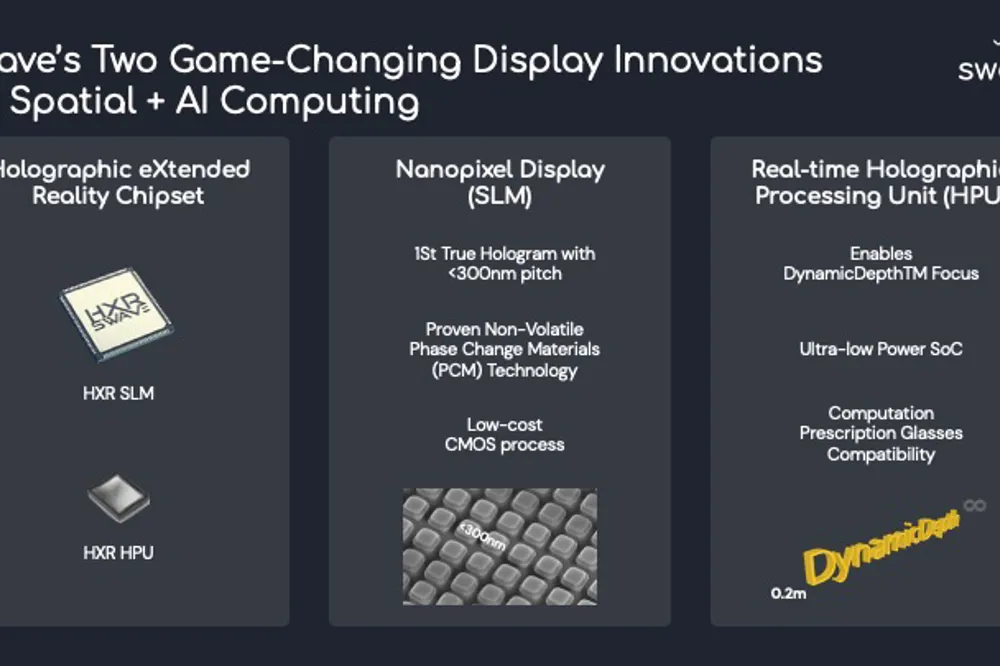
Swave's Onyx SLM isPhase Change Material(PCM)a CMOS-based spatial light modulation chipset utilizing,the world's smallest pixels (less than 300nm pixel pitch)to generate hologram images by precisely controlling the diffraction patterns of light. A prototype consisting of 256 million nano-pixels has already achieved initial success, successfully sculpting light waves to create 3D images. This technology is manufactured using standard CMOS processes, enabling low-cost mass production, and can be embedded in AR glasses in a thin-film form factor, significantly reducing volume. As a result, it achieves full-color, high-brightness, and thin optics, while projecting pupil-matched 3D images to ensure accurate depth focus for each user. This provides a "Reality-first" experience where digital images blend seamlessly with the real world, and the removal of complex optical components (waveguides, variable focus lenses, etc.) allows for lighter AR glasses. The key is that it is the first chip to realize true 3D with digital-physical interaction as a HXR (Holographic eXtended Reality) platform utilizing even AI.
Key Adopters
AR/VR headset manufacturers andsmart glass developers (B2B)are the primary customers. For example, companies like Meta, Apple, MS, and Magic Leap may adopt this holographic chip to create next-generation devices in the future. In addition, automotive HUD companies and hologram display startups can purchase the SLM to productize it. Defense/medical simulator companies may also be interested in enhancing realism. Rather than selling directly to consumers, Swave supplies the chipset in the form of semiconductor IP or modules, which device manufacturers integrate. As it expands into areas such as AI smart glasses in the future, the entire mobile and wearable device industry could become target customers.
Scalability
Swave's technology is the result of 12 years of research at imec and is currently in the prototype stage, but it is accelerating the development of commercial chips through investment attraction and joint development. The use of CMOS processes allows it to be manufactured on existing semiconductor production lines, resulting in high mass production scalability. As the XR market grows, explosive demand is expected if it becomes a standard component. It is also possible to expand into new applications such as optical computing combined with AI (e.g., optical AI chips). However, since it is still in the R&D stage before product integration, short-term sales are limited, andit must win the competition with competing technologies (e.g., micro OLED + modulation devices).Patent competition may be a variable rather than regulation, but Swave is known to have already secured key patents. In the long term, it can advance into all areas where 3D hologram displays can be used (education, remote conferencing, entertainment),so the ripple effect is very large.
Judges' Evaluation
With the Innovation Award in the XR & Spatial Computing category,it was praised as "a triumph of 12 years of hologram technology."The CES judging panel noted the world's first implementation of 300nm pixels and the resolution of the VAC issue, andpraised it as a "game-changer that will bring true 3D to XR."An electro-optics industry publication identified Swave as a star player produced by imec, saying that this awardhas "further increased the possibility of commercializing hologram technology."In addition, there is news that investors are positive about additional investment because the reliability of the technology has been proven with the CES award. However, since additional development is needed until productization, there are many views that it is currently at the"innovative proof-of-concept stage."In summary, there is universal acclaim for the technological ripple effect, but everyone is paying attention to the fact that market verification is a future task.
Analyst Insights
🧪 R&D and concept verification stage – A foundational technology that will change the landscape of XR, but it must go through more development and verification gates before being integrated into commercial products.
The award list data is based on the official CES 2026 website, and detailed analysis content is produced by USLab.ai. For content modification requests or inquiries, please contact contact@uslab.ai. Free to use with source attribution (USLab.ai) (CC BY)
댓글 (0)
댓글을 불러오는 중...