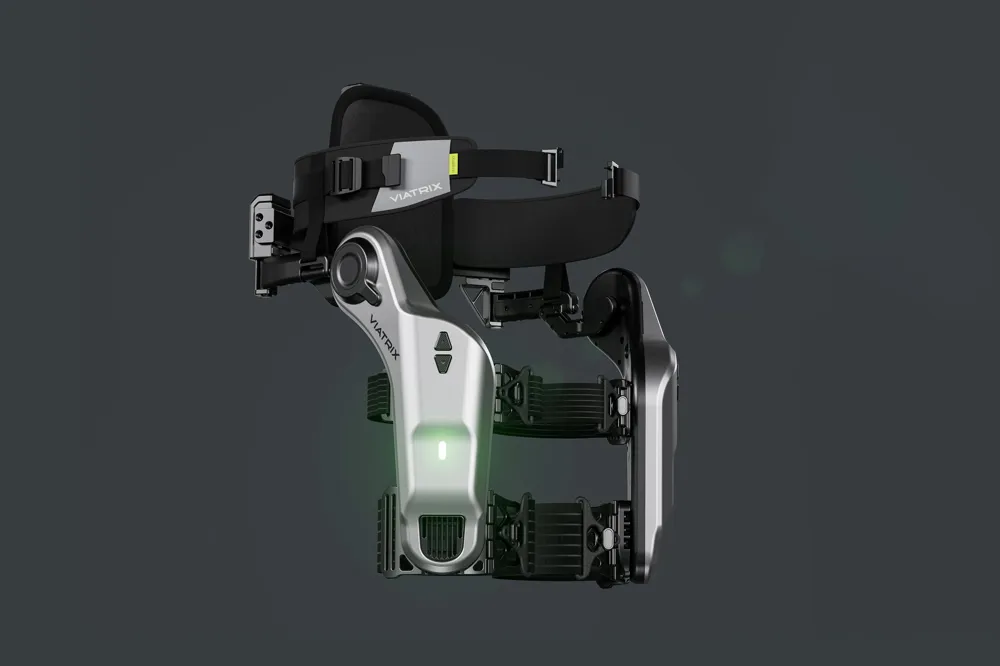
General-purpose walking assistance exoskeleton – A wearable robot suit that supports everything from daily walking to hiking and marathons with multiple modes such as AI adaptive mode and impedance mode, reducing physical strain and expanding mobility limits.
HonoreeRobotics웨어러블 로봇파워드 외골격근력 보조산업 안전작업 효율성 향상로봇공학
VIATRIX™ 레인지 확장형 파워드 외골격
6
0
ULS Robotics Co., Ltd.
One-Line Product Definition
Problem Definition
Background Problem: With the aging population and the increase in outdoor enthusiasts, there is a demand for effortless movement over longer distances and rough terrains. Additionally, individuals with walking difficulties due to rehabilitation or muscle weakness want to expand their range of daily activities. While industrial wearable robots exist, there is a lack of lightweight, intelligent walking assistance devices suitable for general consumers.
Limitations of Existing Methods: Existing walking aids are either limited in operation for medical/industrial use or provide only specific force assistance, leading to accumulated fatigue during use. Furthermore, they are bulky and have simple controls, making them unsuitable for various everyday activities (walking, running, cycling, etc.). The high price also hinders the formation of a consumer market.
Key Differentiators
VIATRIX™ is the first consumer-grade powered exoskeleton from ULS Robotics, which has accumulated 20 years of industrial exoskeleton technology. In AI adaptive mode, it learns the user's walking pattern in real-time to provide appropriate propulsion, reducing energy consumption and significantly decreasing fatigue during long-distance travel. Switching to impedance mode enables a training function that intentionally adds resistance to enhance exercise efficiency, allowing users to receive power assistance during normal activities and utilize it for strength training during workouts.
As the product name 'Viatrix' (traveler) suggests, situation-specific modes such as urban walking, hiking, long-distance cycling, and running are available, and users can simply switch modes with a button. The world's first Float360™ floating hip joint structure is adopted as a core hardware feature, allowing users to freely spread their legs or bend deeply while wearing it, enabling smooth execution of extreme movements such as splits or squats. ULS's self-developed automotive-grade servo motor delivers powerful propulsion with high energy efficiency while remaining lightweight and stable, and the high-capacity battery allows for up to 25km of continuous use (compatible with extreme environments from -20°C to +65°C), making it sufficient for outdoor use. Additionally, the AI walking learning system remembers the user's gait characteristics to provide personalized assistance, which is another differentiating factor.
Key Adopters
Outdoor enthusiasts such as hikers and runners, and general consumers who want to improve their physical abilities (B2C). For example, long-distance trekkers, marathon runners, and the elderly are potential individual consumers. Initially, it may be limited to consumers in the hobby/professional domain due to the price, but gradually, rehabilitation patients or those with muscle weakness may also become potential customers as a healthcare device. For businesses/institutions (B2B), it can also be considered for special purposes such as firefighters and rescue workers wearing it to reduce physical burden.
Scalability
ULS Robotics has already supplied industrial exoskeletons to over 30 industries, so it is expected that the consumer product will also have a global sales network in the future. The company plans to enter the North American and European outdoor markets, starting with China, and is also pursuing international standards certifications.
If the price range is lowered, there is a high potential for general-purpose expansion, such as walking assistance for the elderly or assistance for logistics workers. However, at this point, it is in the concept verification and initial market education stage, and the challenge is to increase consumer acceptance. From a regulatory perspective, it is not classified as a medical device, so it can be sold relatively freely, but in some countries, wearing robot guidelines may be established for safety.
Judges' Evaluation
CES Innovation Award in RoboticsReceived the evaluation of"Paradigm shift from industrial to consumer use."
Technically, it is highly complete, reflecting the know-how of five generations of industrial products, and it received great attention from visitors through direct wearing demonstrations on-site (some media introduced it as "the most desirable product to try on at the CES booth"). However, opinions are divided on marketability. There are criticisms that it may remain a niche product for early adopters due to its innovative nature but also its price and wearing burden, and there is also a view that it is too early for the public to accept exoskeletons as everyday devices. Since it is a new category that has never been sold before, market verification is insufficient, and it is difficult to predict how much demand it will create.
Analyst Insights
⚠️ Impressive technology but market uncertainty (Innovative wearable robot, but significant uncertainty in forming a consumer market)
The award list data is based on the official CES 2026 website, and detailed analysis content is produced by USLab.ai. For content modification requests or inquiries, please contact contact@uslab.ai. Free to use with source attribution (USLab.ai) (CC BY)
댓글 (0)
댓글을 불러오는 중...