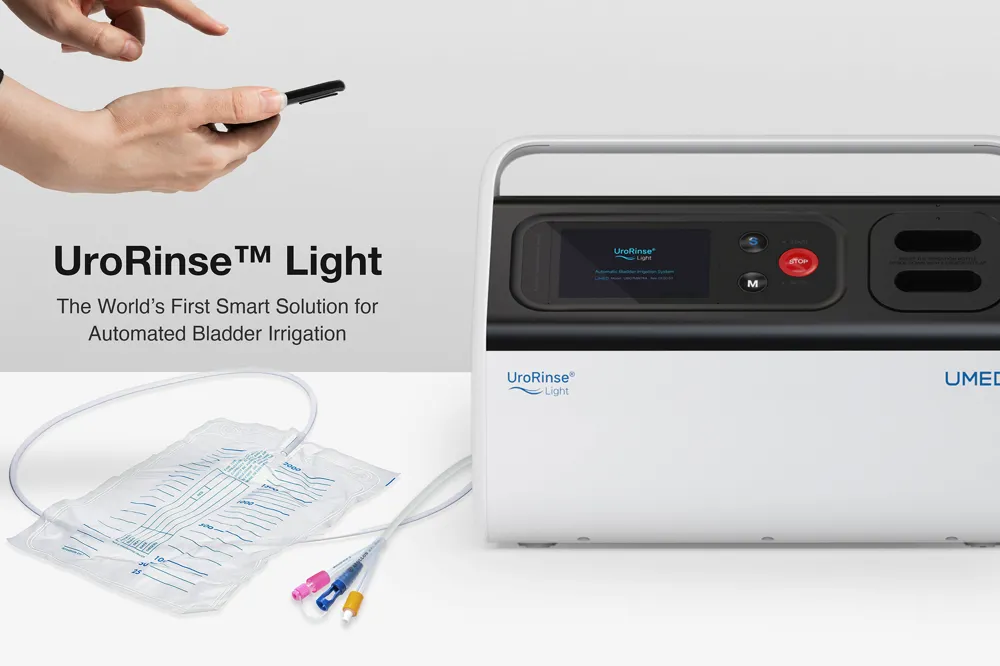
Automatic Urocatheter Washer – A button-operated bladder care device that automatically and periodically irrigates the bladder of long-term urocatheter patients, preventing complications such as catheter-associated urinary tract infections (CAUTI).
HonoreekoDigital HealthAI 헬스케어IoT 의료디지털 헬스텔레헬스임베디드 시스템정서 인식
UroRinse™ Light
5
0
UMED Inc.
One-Line Product Definition
Problem Definition
Background Problem: Urinary tract infections are common in patients using indwelling urinary catheters (catheters) for extended periods, accounting for a significant proportion of hospital-acquired infections. Infections caused by catheters are becoming increasingly difficult to treat due to bacterial biofilm formation and antibiotic resistance. Regular bladder irrigation is ideal for preventing infection.
Limitations of Existing Methods: Currently, bladder irrigation is performed manually by healthcare providers using saline injections, and even then, it is only done intermittently in hospitals. It is impossible to do in everyday home care, so long-term catheter patients have to manually endure the risk of infection. The manual method lacks consistency, resulting in significant variations in effectiveness, and it is difficult to respond quickly to blockages or hematuria.
Key Differentiators
UroRinse™ Light is the world's first fully automated irrigation system that performs a standardized bladder washing cycle at a set interval with the push of a button. It operates in a closed circuit with a disposable tubing set to prevent external contamination, and it controls the infusion and drainage of the cleaning solution based on sensors to perform cleaning with a constant flow rate and pressure.
Thanks to this, consistent cleaning is possible without medical staff, shifting infection risk to preventive management. It also automatically detects and treats blockages caused by blood clots and sediment, and actively manages complications by detecting bleeding (hematuria) with a color sensor and issuing a warning.
The device is designed for use in hospitals and facilities, as well as in patients' homes.Non-experts (caregivers, patients themselves)It has an intuitive interface and a portable size so that it can be used safely. With mobile app and cloud integration, healthcare professionals can remotely monitor and guide cleaning history, allowing expert support even outside of the hospital.
Key Adopters
General hospital urology and rehabilitation hospitals, nursing facilities (B2B) and long-term catheter patients/families (B2C). Initially, it is expected that hospitals will introduce it for infection control and then rent/sell it to patients for home use upon discharge. If insurance coverage is available, a personal purchase base may be formed where patients or their families purchase and use it at home. Government/insurance agencies (B2G) may provide support in terms of infection prevention cost savings.
Scalability
There are many long-term urocatheter users worldwide, so the global market potential is high. It has already obtained domestic manufacturing certification and plans to enter North America and Europe after undergoing approval procedures such as the US FDA in the future.
Because it is cloud-based, it is also compatible with remote medical environments, and electric infusion pump technology may be applied to similar fields such as peritoneal dialysis automation. However, market formation may take time due to conservative practices and regulations in the medical field. Securing the trust of the medical community and adopting insurance coverage are key to expansion in the early stages.
Judges' Evaluation
Received the CES Innovation Award in the Digital Health categoryRecognized as an "innovation that extends hospital care to the home".The level of technical completeness has been proven safe and of high quality, as it has been approved for domestic medical devices, and its innovation has been recognized on the global stage with the CES award.
In the market, there is high interest from healthcare professionals due to the importance of preventing urinary tract infections, but market verification is still in its early stages as a clinical culture change is needed for proactive prevention solutions. Experts say that "this is an example of how automation technology can improve patient safety and clinical efficiency," but predict that insurance coverage and pricing will be challenges in actual commercialization.
Analyst Insights
⚠️ Impressive technology but market uncertainty (innovative solution that will only become popular if the medical community's perception changes and institutional support follows)
The award list data is based on the official CES 2026 website, and detailed analysis content is produced by USLab.ai. For content modification requests or inquiries, please contact contact@uslab.ai. Free to use with source attribution (USLab.ai) (CC BY)
댓글 (0)
댓글을 불러오는 중...