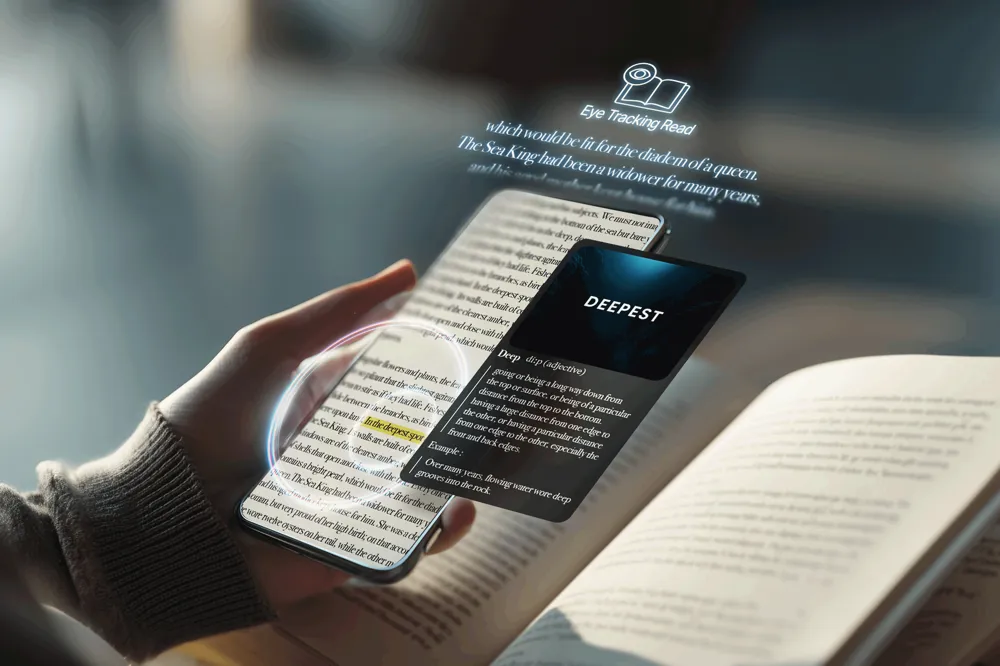
Woongjin Thinkbig Corp.'s Booxtory 2.0 is a service that uses AI eye-tracking technology to detect cognitive load during reading and automatically adjusts text difficulty and layout in real-time to provide a customized reading experience.
HonoreekoAccessibility & Longevity인공지능(AI)맞춤형 학습독서 진단데이터 분석개인화 추천스마트 교육
Booxtory 2.0
6
0
Woongjin Thinkbig Corp.
One-Line Product Definition
Problem Definition
Learners with dyslexia or ADHD have difficulty concentrating and understanding when reading regular paper books, but paper books do not adjust the difficulty level on the spot. Seniors with weakened eyesight also find reading difficult due to font size and arrangement.
Of course, e-book readers have features such as font enlargement, but many people prefer the feel of paper books. In addition, many general students give up when they encounter difficult sentences or skip over them without understanding.
Booxtory aims to solve this problem with an innovation that recognizes the reader's cognitive load and instantly changes the text to make it easier.
##
Key Differentiators
Booxtory 2.0 is the world's first attempt to "reconfigure paper book content in real-time to suit the reader."When the camera recognizes a book, OCR and NLP AI analyze the content, and AI analyzes the user's gaze and facial expressions to detect where they are having difficulty understanding.
For example, if a reader lingers on a sentence and frowns, the system determines that the sentence is difficult and immediately rewrites it next to it in easier language. The layout is also dynamically re-edited to increase readability by adjusting the font size and line spacing. Also, if desired,TTS(Text-to-Speech)can be used to read difficult parts aloud at the user's reading speed.
There are no similar cases of this real-time adaptive reading, and the technology to detect cognitive load through eye-tracking is a key differentiator. As a result, children with dyslexia have difficult sentences automatically simplified, and ADHD readers receive rearranged passages that are shortened before they become distracted, making it possible to induce immersion.
Key Benefits
The target is both the B2B education market and B2C individual learners.Schools or academies (B2B) with students who need special educationcan introduce it in the form of a license and use it in classroom lessons.
For example, if a dyslexic student uses this system on a tablet in a general class, they can follow the class without being discriminated against by using it as their own learning aid.General households (B2C)can also use a subscription-based app for reading guidance. It may also be possible to provide it as an additional service to Woongjin Thinkbig's existing subscribers (learning materials, etc.) or to partner with publishers to provide coupons when purchasing books.
In addition, if libraries, senior welfare centers (B2G), etc. install this system for seniors with weak eyesight, they can help them read a variety of books without large-print editions of paper books.
##
Scalability
As an example of AI utilization in the publishing and education fields, it has great scalability. It can be applied to multiple languages around the world, and considering the 7-10% of the population with dyslexia, the potential demand is considerable.
Technically, if AR glasses interlock is developed, more natural use is possible in the form of overlapping paper books, and this can be used by general readers as a convenience function (e.g., viewing easy explanations of unknown words), which can expand to the mass market.
However, in the early stages, it seems that the strategy is to focus on niche targets such as dyslexia/learning disabilities to establish a market position, and then gradually move towards a smart reading assistant for all readers. In terms of data, accumulated reading behavior data can be used for various educational policies such as reading comprehension education and textbook difficulty adjustment.
##
Judges' Evaluation
Through the CES Innovation Award selection, it has attracted great attention as an example of the convergence of AI and human cognition in the education technology sector. The judges' comments are summarized as *"the potential to reduce learning gaps by personalizing the way people read books."*
In particular, organizations related to dyslexia have expressed their welcome, and the domestic education industry has focused on the fact that Woongjin Thinkbig has introduced such innovation based on its experience in operating AI elementary school learning. In industry discussions on LinkedIn, there were opinions such as "The idea is amazing, but it will take time to apply it to actual classrooms" and "It will become a killer app when AR glasses are distributed."
In other words,There is also a view that "the concept is innovative, but the completeness and on-site introduction effect will be verified later."However, foreign media such as Forbes positively evaluated Booxtory as one of the "best educational AIs I met at CES."
##
Analyst Insights
⚠️ The technology is impressive, but the market is uncertain (it is an innovative approach to the education field, but it may take time to permeate conservative systems such as schools, and the monetization model for general readers is still in the testing stage, so commercial success is unknown.)
## Demo Video
Booxtory 2.0 Camera Reading & Automatic Difficulty Adjustment Demo – YouTube: "AI Coach for Reading – Booxtory Demo"
The award list data is based on the official CES 2026 website, and detailed analysis content is produced by USLab.ai. For content modification requests or inquiries, please contact contact@uslab.ai. Free to use with source attribution (USLab.ai) (CC BY)
댓글 (0)
댓글을 불러오는 중...