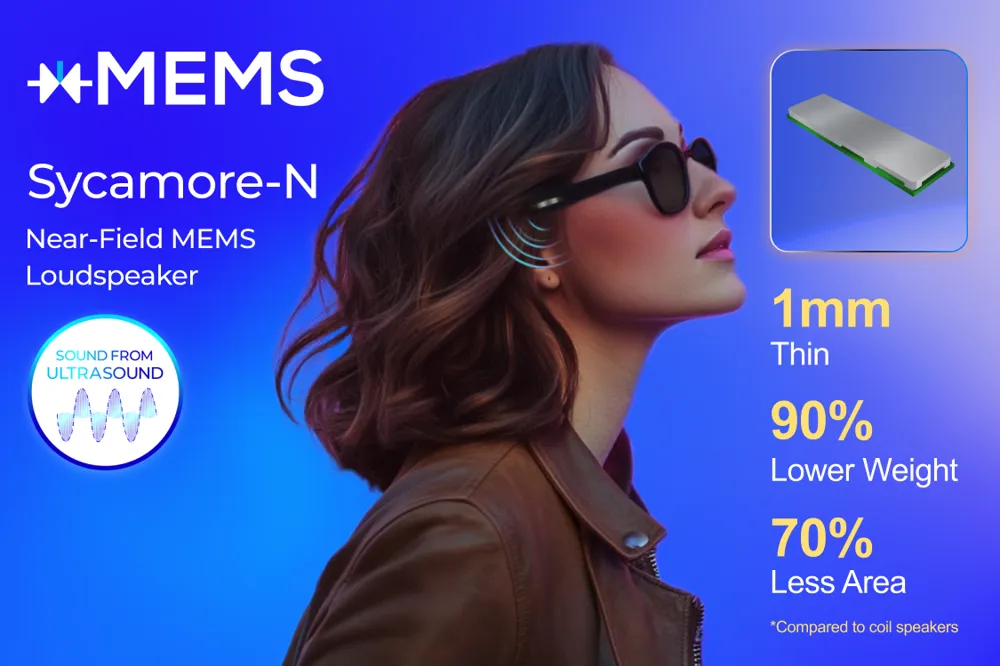
An ultra-compact solid-state speaker module, only 1mm thick, that delivers full-range audio and can be integrated into smart glasses frames. It is the world's lightest MEMS micro speaker.
Best of InnovationEmbedded TechnologiesMEMS 스피커초소형 스피커스마트 글래스AR/VR오디오 기술음향기기
Sycamore-N 스마트 글래스용 1mm 초박형 풀레인지 MEMS 마이크로 스피커
6
0
xMEMS Labs, Inc.
One-Line Product Definition
Problem Definition
Wearable devices like AR glasses or audio sunglasses need to incorporate audio output into the temples, but existing speakers suffer from poor sound quality when made small, and thicker glasses that reduce comfort when made larger.
Existing bone conduction or open-ear earbuds have limitations in sound quality (especially bass), resulting in low satisfaction. To achieve better sound, ear tips are required, preventing the device from being truly as comfortable as glasses. Additionally, smaller speakers tend to have greater performance variations between units, causing issues such as phase differences when used in stereo.
In short, the popularization of smart glasses requires speakers that are lightweight, thin, and produce high-quality sound, while also being waterproof and durable enough to withstand daily use. Sycamore-N meets these requirements by overcoming the physical limitations of traditional speakers with MEMS technology, resolving the trade-off between comfort and sound quality.
Key Differentiators
Sycamore-N is a solid-state speaker made with MEMS semiconductor processes. Instead of heavy magnets and diaphragms like coil speakers, it generates sound by driving ultra-fine MEMS structures, making it extremely small.
As a result, it is over 70% smaller and lighter than traditional speakers, with a thickness of 1.0mm and a weight of tens of mg, making it easy to place two or more in the entire glasses temple. Despite its small size, it delivers full-range frequency response and low distortion, clearly reproducing everything from speech to music.
Also, because it is a MEMS chip, there is almost no performance variation between units during mass production, ensuring that both speakers exhibit uniform acoustic characteristics, facilitating precise beamforming or Privacy mode (acoustic transmission only in a specific direction to prevent sound leakage). It has IP58 waterproof/dustproof rating and high impact resistance, making it suitable for everyday sports and can be sealed inside the frame.
In summary, Sycamore-N is the only speaker solution that has successfully achieved lightweight design without compromise, significantly improving both the design freedom of smart glasses and the user's audio experience.
Key Adopters
The main customers are manufacturers of smart glasses, AR/VR headsets, and audio sunglasses. For example, if Meta, Apple, Samsung, etc., incorporate this speaker when developing next-generation AR glasses, they can simultaneously achieve design slimming and performance improvement.
Also, hearing aid or earbud manufacturers may be interested in ultra-small, high-quality speakers. xMEMS primarily supplies components (speaker modules) on a B2B basis, and finished product brands create products with this technology. End consumers do not purchase it directly but purchase glasses/earphones with this speaker built-in.
Currently, major global electronics/eyewear companies are reportedly testing samples, and it is expected to appear in the market in a B2B2C format.
Scalability
This technology can be applied to the global device market without specific national restrictions. In addition to AR/VR wearables, it can be expanded to various fields with space constraints, such as smart helmets and car headrest speakers.
Due to the nature of the MEMS process, it is easy to lower unit costs and expand supply during mass production, and xMEMS already has experience in expanding the ecosystem, as it has applied this technology to wireless earbuds (commercial product launch in 2024). If it becomes a micro-speaker standard in the future, various sized derivative models (e.g., smaller Sycamore-M, etc.) will also be released, leading to product line expansion.
One thing to note is that verification may take time in the high-end market, which is conservative about audio quality, but if it is first adopted in wearables where a small form factor is essential, it will naturally gain trust.
Also, in terms of market growth, the smart glasses market is expected to grow from $6.7 billion in 2024 to $19.3 billion in 2032, a 14% CAGR, so demand is expected to surge along with it. In other words, it is highly likely to expand along with the market itself.
Judges' Evaluation
This product at CES 2026Received the Best of Innovation award in the Embedded Technologies categoryIt has been recognized for its technical completeness and impact to the extent that it has been recognized. It was praised as *"a decisive component that removed the obstacles of smart glasses,"* and the AR industry welcomes it, saying, *"Now glasses-type devices can be as light as real glasses."*
Experts highly praised the achievement of both sound quality and size reduction, and the expression "the era of MEMS speakers has begun" was also used. There was already trust because xMEMS's previous products had been well received in the earphone market, and expectations are very high as this Sycamore-N received the highest award among the innovation awards.
In the market, movements such as several smart glasses startups announcing the installation of this speaker or large corporations strategically investing in it are being observed. It is reported that the technical completeness has been proven to produce clear sound even under real-world noise in sample tests, and production is scheduled for mass production in 2026, so there seems to be no problem with the schedule.
Rather than concerns about overestimation, there is a widespread view that it is being properly evaluated as a hidden key player in the popularization of AR glasses.
Analyst Insights
🔥 High Marketability / Business Connection Potential (As an essential component of the smart glasses/wearable market, which is expected to grow explosively, commercial success and market influence will be very high as a key solution provider)
The award list data is based on the official CES 2026 website, and detailed analysis content is produced by USLab.ai. For content modification requests or inquiries, please contact contact@uslab.ai. Free to use with source attribution (USLab.ai) (CC BY)
댓글 (0)
댓글을 불러오는 중...