I Built a CES 2026 Page in Two Days with Vibecoding
“Korean companies swept more than half of the CES 2026 Innovation Awards.”
I heard this story here and there.
But when I tried to check it, strangely, there was no site or list where I could see it at a glance.
Which company won in which field with which product?
I couldn't find a place where I could check it in an organized form.
So, simply,
I decided to create it myself.
To get to the point,I made a draft in two days,,
and after that,I spent 4 days stabilizing and verifying it.
👉 CES 2026 Summary Page
https://uslab.ai/ko/ces
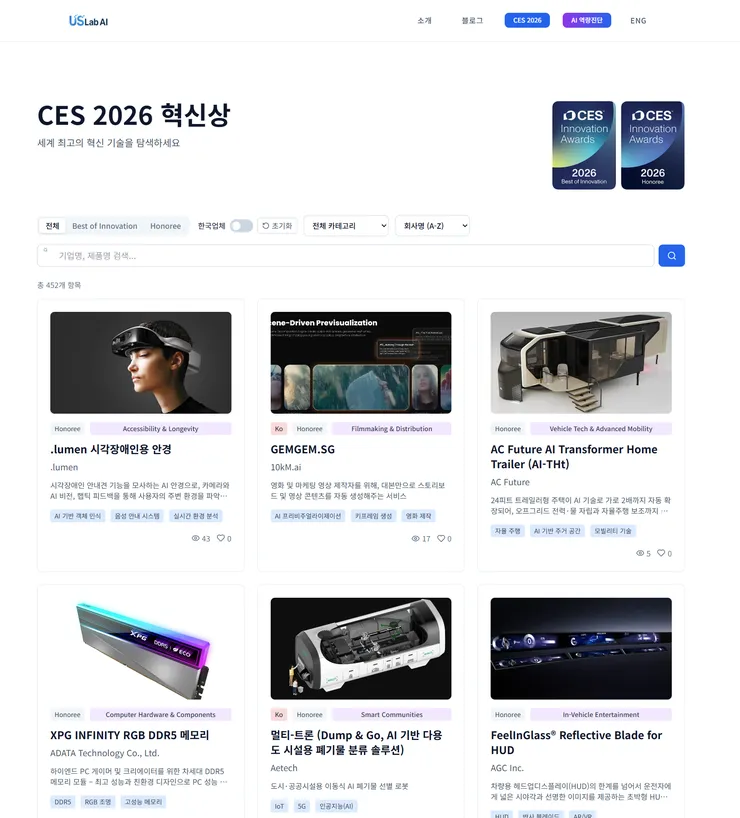
If you click on a product in the list,
for each item,you can check the analysis organized through deep research.
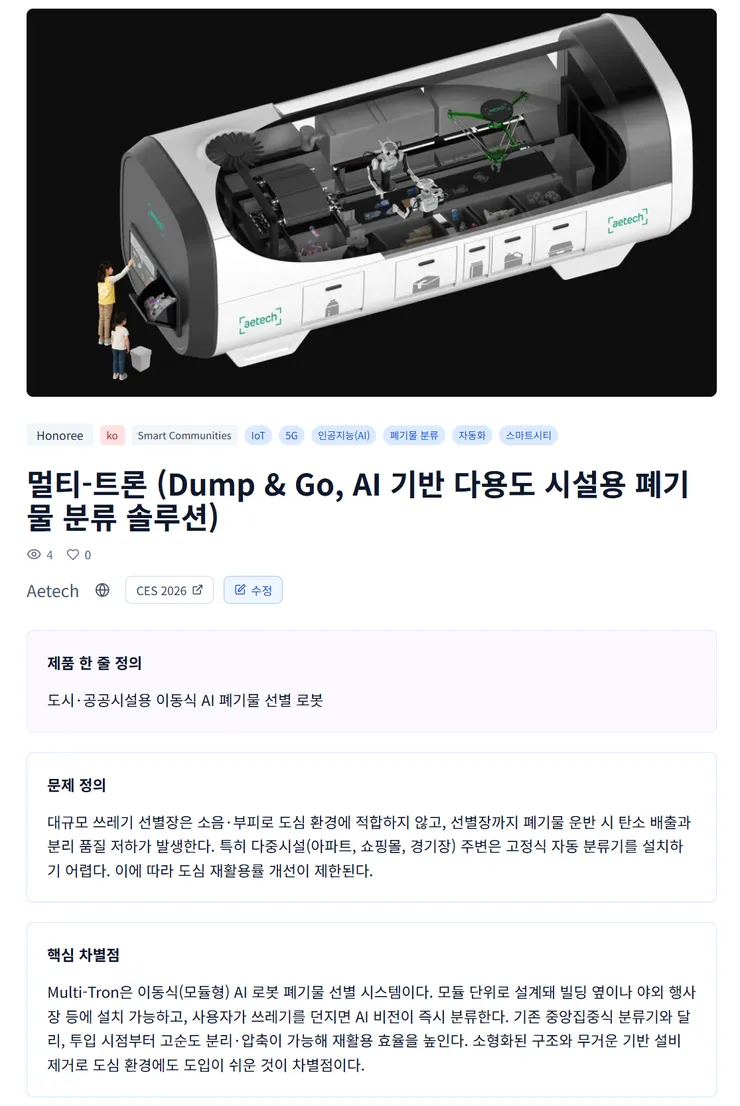
1. This time, I wanted to do ‘proper analysis’ rather than just ‘citing data’
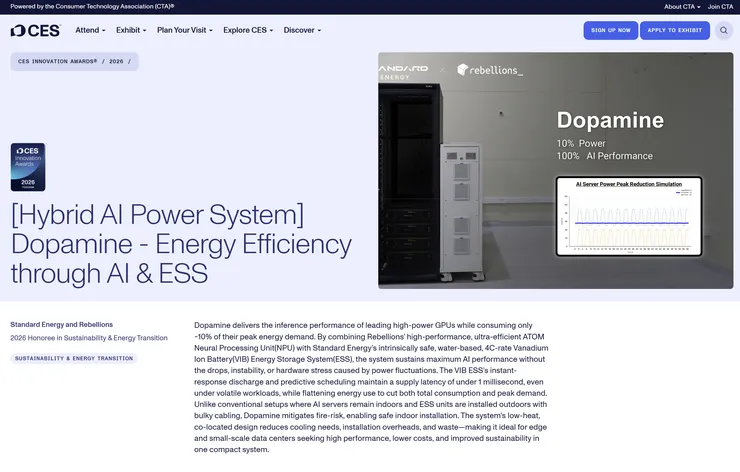
On the official CES page, each award-winning work usually provides only the following information:
One-page description
Simple product introduction
https://www.ces.tech/ces-innovation-awards/
But personally, I always found that lacking.
Whether this companyis a Korean company
Where the company's official website is
Why this productcame out
Who is likely to adopt it first
I thought that only with this kind of information could we say we “judged” rather than just “saw”.“judged”That's why I decided to collect the entire data and reinterpret it with deep research, rather than simply extracting parts of it.
That's why, instead of simply excerpting parts,
I decided to collect the entire data and reinterpret it with deep research.
2. Design with GPT and Gemini, implementation with Cursor (Vibe Coding)
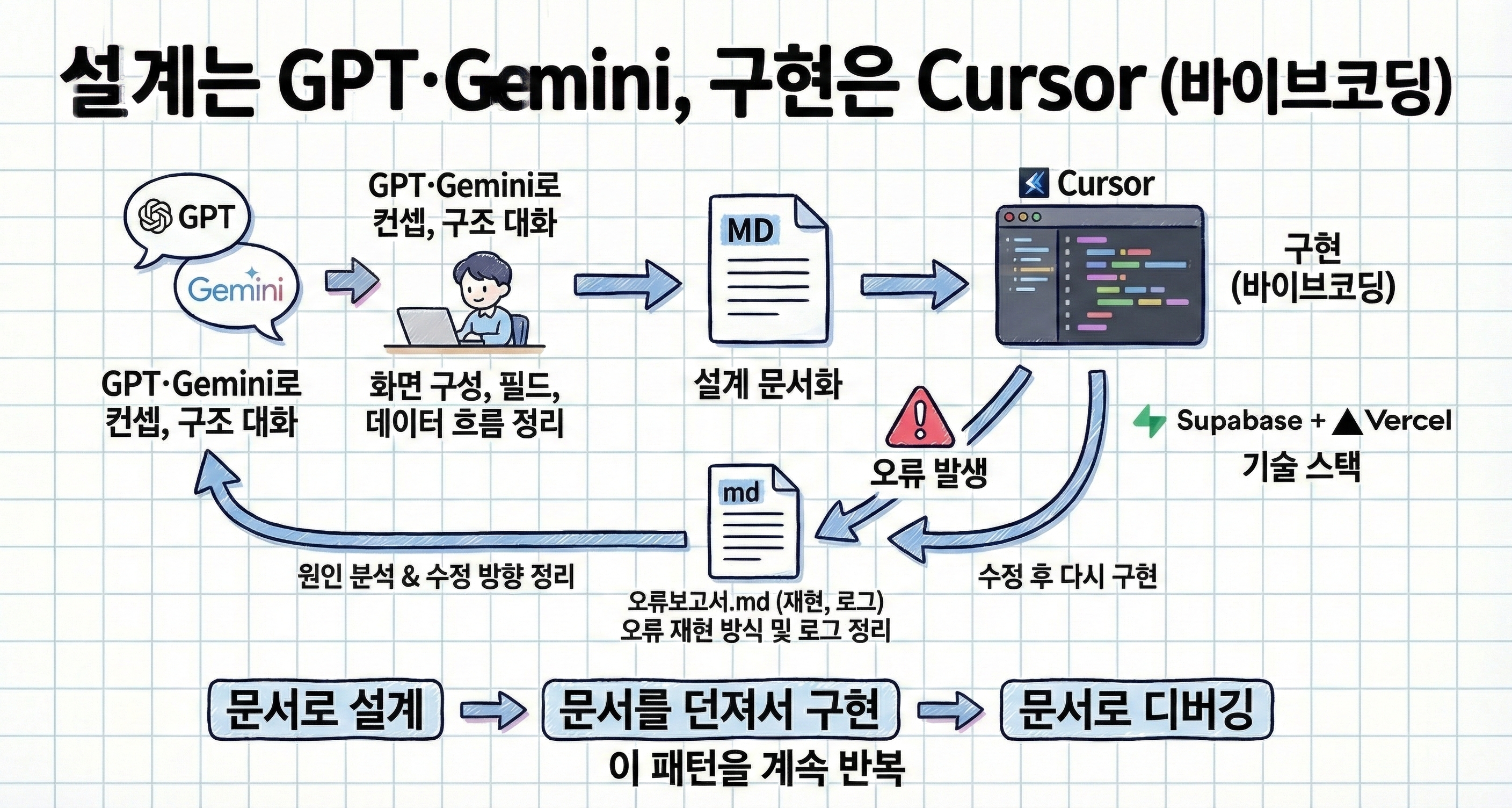
The working method for this project was quite simple.
Have enough conversations with GPT and Gemini about the overall concept and structure
Organize the screen configuration, fields, and data flow
Once the design is finalized,document it in MD files
Pass that document as is to Cursor for implementation.Cursor for implementation
If an error occurs during the implementation process,
organize the error reproduction method and logs
**오류보고서.md**Break down the cause with GPT and Gemini
Organize the direction of modification and return to Cursor
To summarize,
Design with documents → Implement by throwing documents → Debug with documents
I kept repeating this pattern.
The technology stack is composed of a Supabase + Vercel combination.Supabase + Vercel combination.
3. First, I collected ‘all’ 452 of them
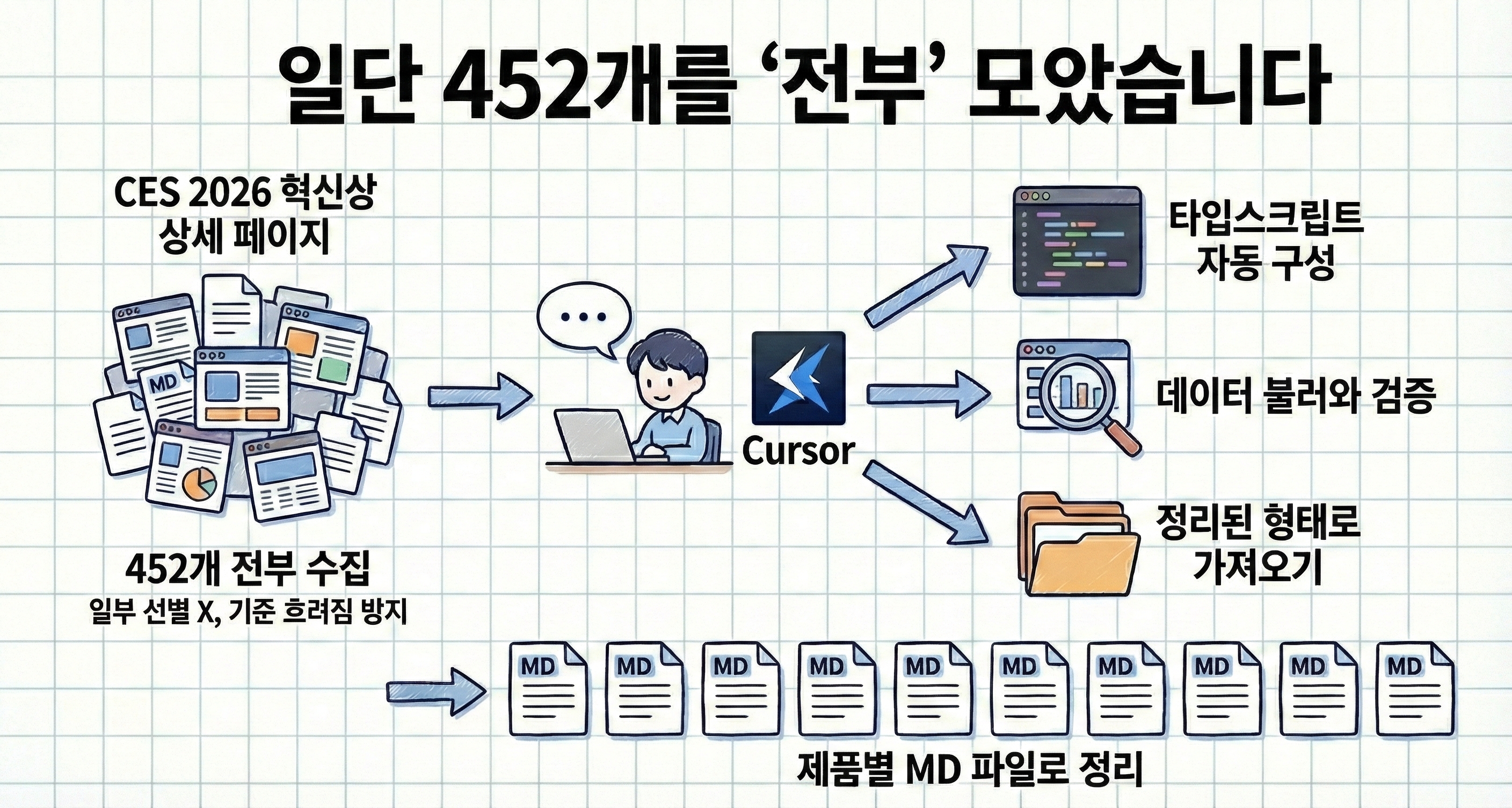
I didn't use the method of selecting only a part from the beginning. I thought the criteria would become blurred from that moment on. So, based on the CES 2026 Innovation Awards details page,I collected all 452 products.
I told Cursor the site structure and asked it to crawl, and it automatically configured TypeScript,
automatically configured TypeScript,
loaded and verified the data,
and brought it in an organized form.
The collected data was organized into MD files, one for each product.MD files
4. Deep Research: I couldn't run all 452 at once
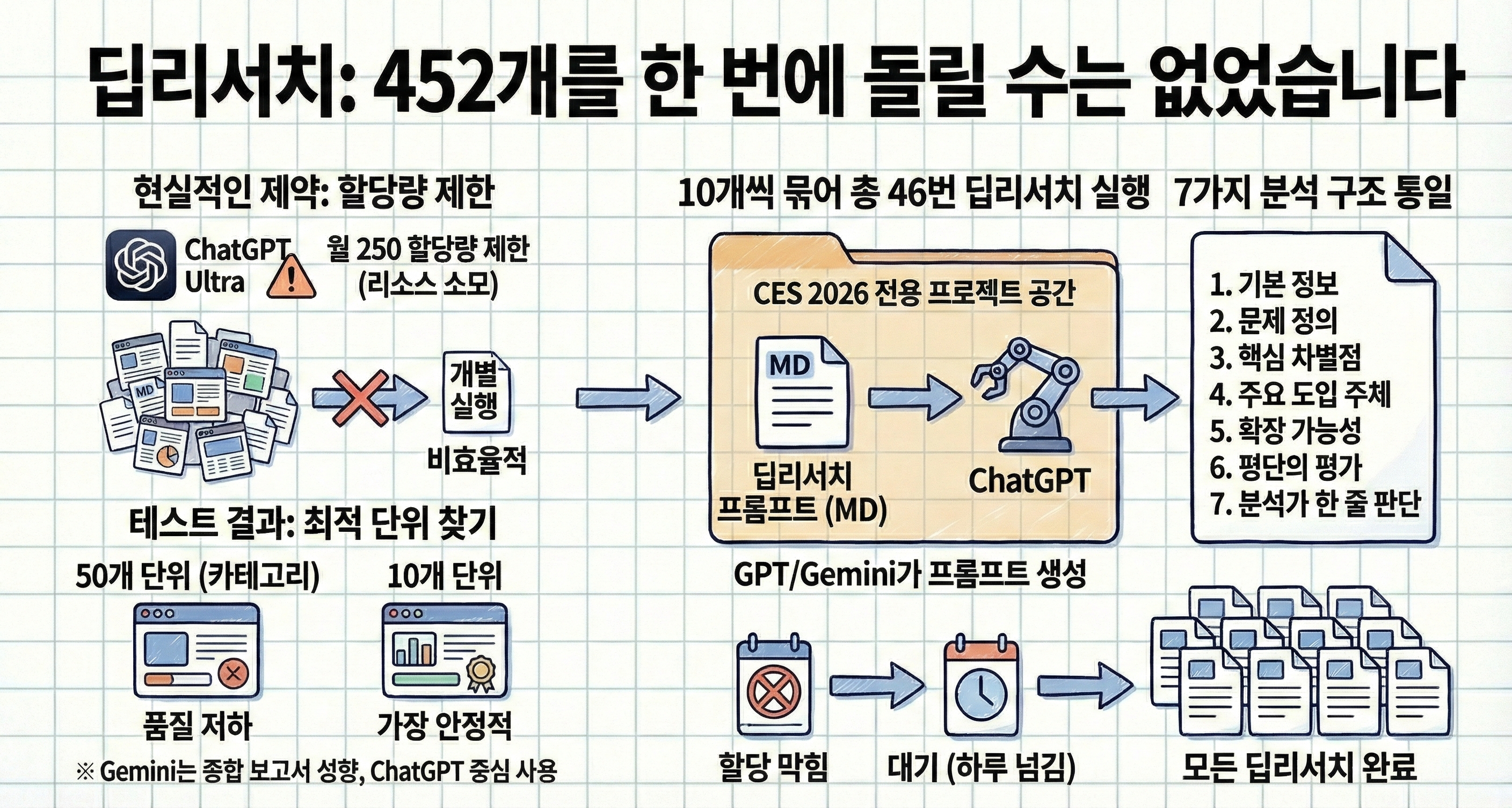
There were realistic constraints here.
I was using the ChatGPT Ultra plan, and the deep research allocation was limited to 250 per month. (It was closer to an internal resource consumption structure rather than a number of times.) Running 452 individually was inefficient, and at first, I tried grouping them by category, but if 50 were included in one category, the analysis quality noticeably decreased.
Test results showed that
10 units were the most stable.
So:
452 items
grouped by 10
I conducted a total of 46 deep research sessions.
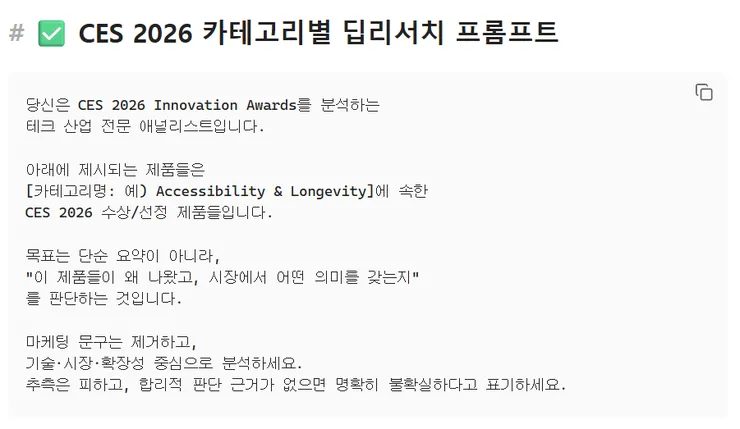
The deep research prompts were organized separately into MD files, and the analysis structure was unified into the following 7 categories:
Basic Information (Company Name / Website / Whether it is a Korean Company / One-line Definition of the Product)
Problem Definition
Key Differentiators
Main Adopters
Scalability
Evaluation by Critics
Analyst's One-Line Judgment
GPT and Gemini created almost all of the prompts themselves. To avoid complicating the chat window,
I created a separate CES 2026 dedicated project space and ran deep research within it.I created a separate CES 2026 dedicated project space
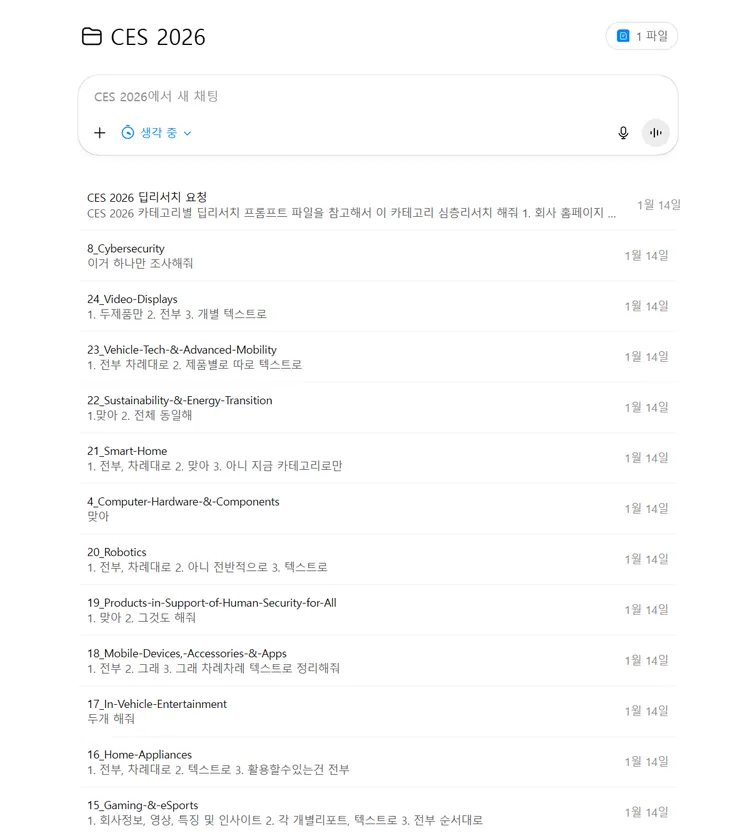
ChatGPT stably performed deep research in the desired direction in units of 10, and Gemini tended to produce comprehensive reports, so in this project, I mainly used ChatGPT.I mainly used ChatGPT.
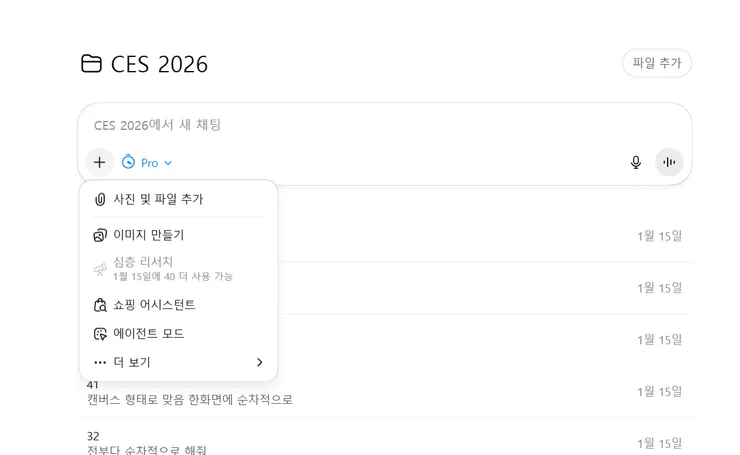
The allocation was blocked in the middle, and I waited for it to be released little by little over a day, but as a result, I completed all the deep research.I completed all the deep research.
5. The prototype took two days, the real work was after that
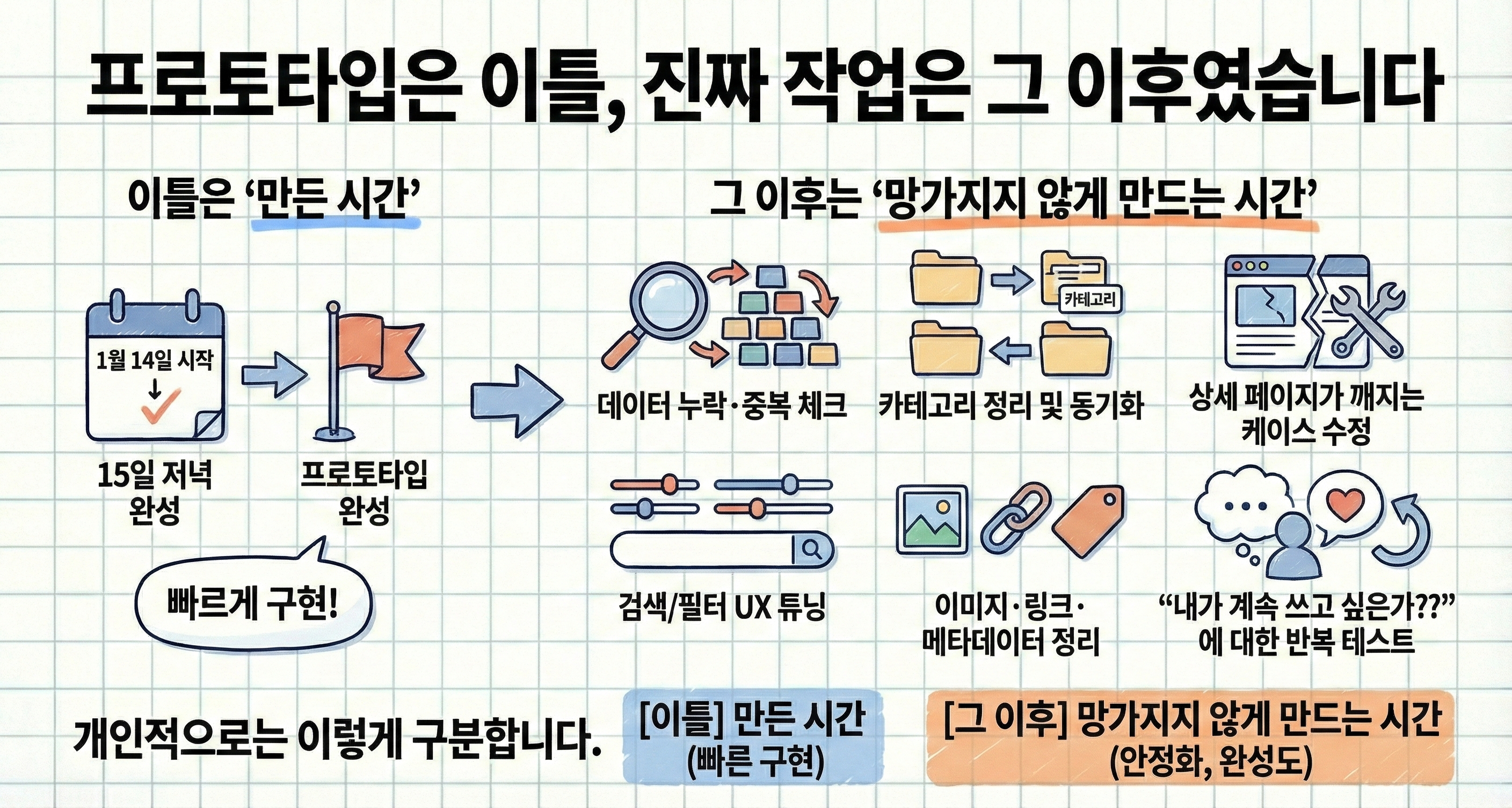
The project started on January 14th, and the prototype was completed on the evening of the 15th.
But the real work, I felt, was after that.
Checking for missing/duplicate data
Category organization and synchronization
Fixing cases where the details page was broken
Search/filter UX tuning
Image/link/metadata organization
Above all, repeated testing of “Do I want to keep using it?”
So personally, I'm dividing it like this.
Two days is ‘the time to create,’ and the time after that is ‘the time to keep it from breaking.’
One thing to note about the numbers is that
The article says that 357 companies received the Innovation Award, but when I actually collected data based on the details page of the official CES website,there were a total of 452 items.
This seemed to be due to the previous award history + the structure that is additionally exposed during the CES 2026 event process, and I was a little surprised myself that there was more data to organize than I thought.
While organizing,
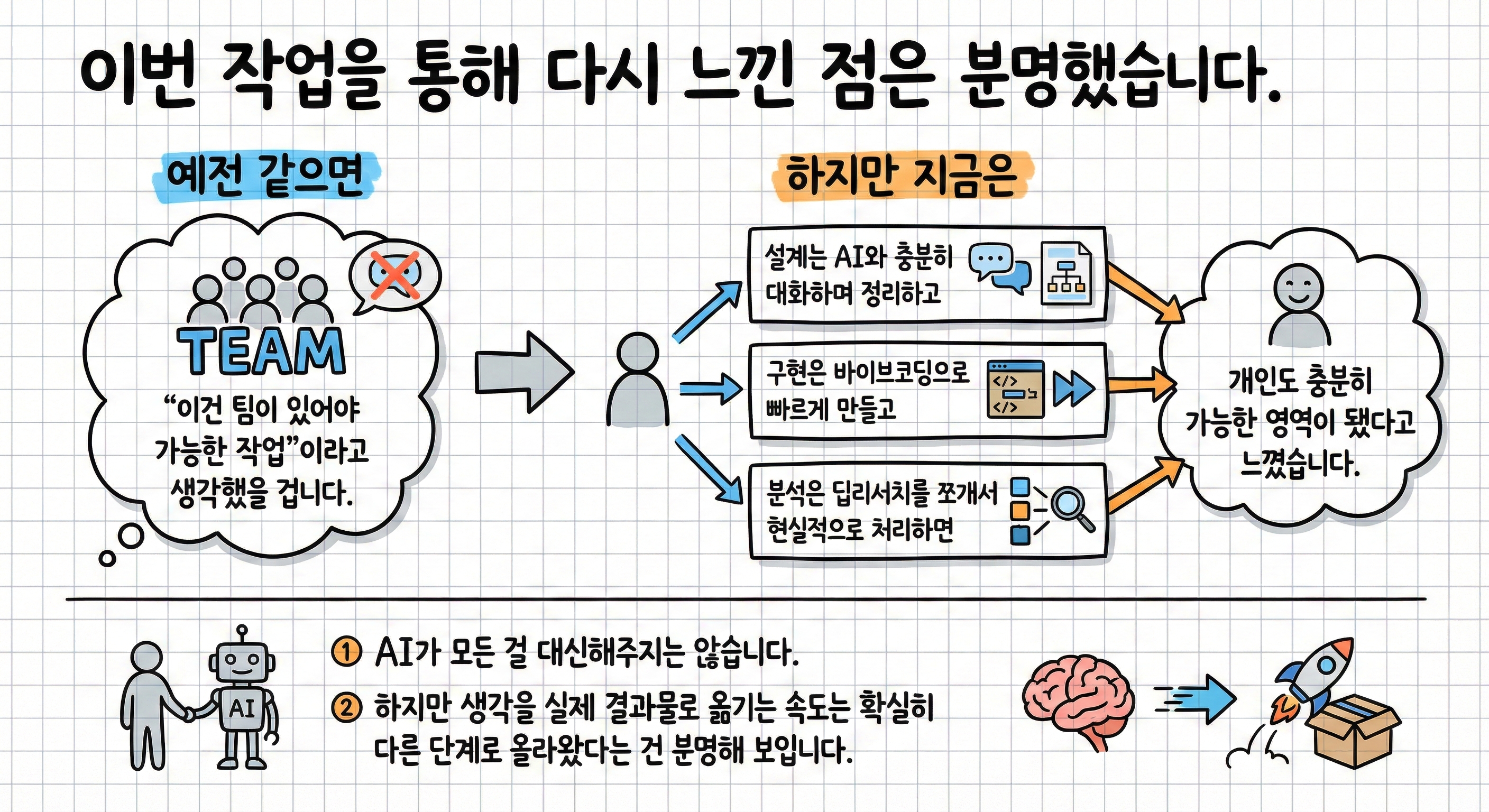
what I realized again through this work was clear.
In the past,
I would have thought, “This is a task that requires a team.”
But now,
I can fully discuss and organize the design with AI,
quickly create the implementation with vibe coding,
and realistically handle the analysis by breaking down the deep research.
I felt that this has become an area that individuals can fully handle.
The data organized in this way is stored as MD files and used in NotebookLM.NotebookLMI am using it.
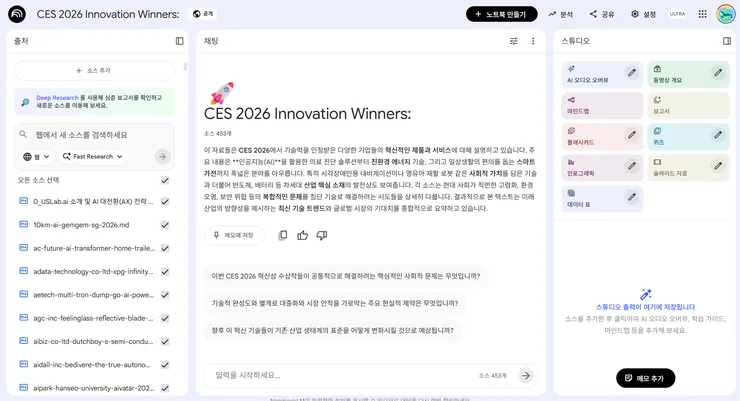
It's suitable for creating personal reports or
digging deeper into topics of interest.
👉 CES 2026 Summary:https://uslab.ai/ko/ces
👉 NotebookLM
https://notebooklm.google.com/notebook/b7e0cea7-a0e2-4aa7-a4f1-58b43de862ca
👉 NotebookLM Usage Guide
https://uslab.ai/ko/blog/ces-2026-notebooklm-complete-guide
AI doesn't replace everything.
Butthe speed of translating thoughts into actual resultshas definitely moved to a different level.