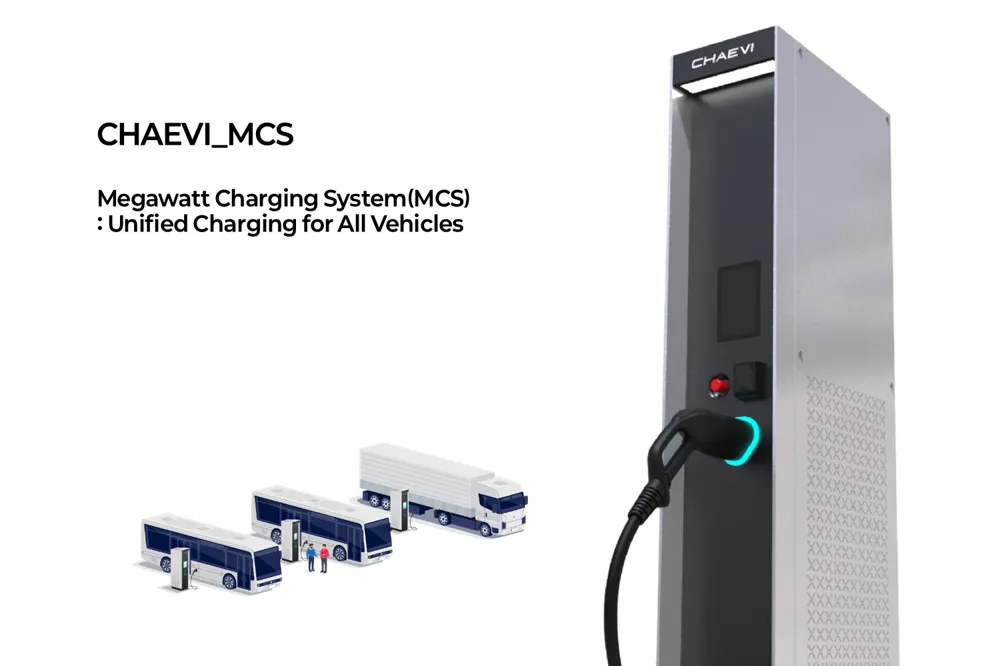
A next-generation megawatt-class charging platform that can rapidly charge large commercial vehicles such as electric trucks with up to 3.75MW output within 10 minutes, and also supports 400kW ultra-fast charging for passenger cars. It is the world's first multi-standard charging system (supporting MCS+CCS+NACS).
HonoreeArtificial Intelligence전기차 충전메가와트 충전 시스템MCS전동화상용차 충전충전 인프라
CHAEVI_MCS - 메가와트 충전 시스템(MCS): 모든 차량을 위한 통합 충전
63
0
CHAEVI
One-Line Product Definition
Problem Definition
The lack of charging speed has been the biggest obstacle to the commercialization of large electric trucks and buses. The current standard for fast charging of general electric vehicles (CCS) is several hundred kW, which takes several hours to charge a truck with a large battery, disrupting logistics operations.
In addition, charging standards such as Tesla NACS, CCS, and future MCS are in disarray, creating inefficiencies where charging infrastructure must be built separately for each vehicle type. Even if chargers for trucks are installed at highway rest stops, the number of vehicles that can be charged simultaneously is limited, and long-distance drivers cannot fully charge during the mandatory 8-hour rest period, disrupting their next schedule. In other words, insufficient output, lack of standard unification, and charging waiting times have been identified as bottlenecks in the adoption of commercial electric vehicles.
Key Differentiators
The CHAEVI_MCS system provides an overwhelming charging output of up to 3.75MW, enabling charging that is 10 times faster than existing systems. Through this, electric trucks equipped with large-capacity batteries can be mostly charged within 10-15 minutes, achieving a speed comparable to refueling diesel trucks.
It is also the world's first multi-standard platform that supports three standards, MCS (Megawatt Charging System), CCS (Combo), and NACS (Tesla Standard), in one charger, allowing all EV drivers, including those in the US market, to charge at a single station. This reduces separate facility investments by standard for charging operators, and for users,"Any car to CHAEVI station"provides convenience.
CHAEVI MCS also adopts a modular power stack design, allowing chargers to be expanded as needed, like stacking blocks. Capacity can be increased by simply adding modules when demand increases, starting with a small number of charging ports initially. This distributes construction costs in stages and reduces charging queues due to under-installation.
In particular, it is equipped with an AI-based smart scheduling function tailored to the environment of long-distance truck rest stops on highways. It optimizes the schedule so that one charger automatically charges dozens of trucks sequentially while several trucks take an 8-hour legal break at night. For example, one port sequentially charges 10 trucks for 8 hours, so that all trucks can depart fully charged in the morning. This increases logistics operation efficiency by completing charging using rest time even with a limited number of chargers.
Technically, liquid-cooled cables and high-efficiency power conversion technology are used to control heat generation and minimize energy loss during high-current (up to 3,000A) charging, ensuring stable and safe operation even at 3.75MW ultra-high output. In summary, CHAEVI_MCS is an integrated ultra-fast charging solution that significantly improves the limitations of existing charging infrastructure in terms of output, compatibility, scalability, and intelligent operation.
Key Adopters
The main adopters are EV charging infrastructure operators and the logistics/transportation industry. For example, US truck stop operators, highway rest area operators, or domestic and internationalcharging network companies (B2B)can build this platform to provide services to large commercial EV drivers.
In addition, large logistics companies (delivery companies, freight truck fleet owners) can install MCS at their own vehicle bases to charge their electric trucks all at once at night. The government and public sector (B2G) can also consider investing in building eco-friendly logistics infrastructure. In fact, the City of Riverside in the US has signed an MOU with CHAEVI for electric vehicle technology cooperation, and there is demand for ultra-fast charging projects for trucks led by local governments.
Ultimately, companies that operate commercial EVs or provide charging services pay for and install the system, and the final beneficiaries are thetruck drivers (B2B2C)who use it. As CHAEVI operates approximately 10,000 fast charging ports in Korea, it is expected to introduce MCS to its charging stations and expand overseas, pursuing a B2B direct operation + equipment supply parallel model.
Scalability
As megawatt-class charging infrastructure is essential in 2025-2030, when the electric truck/bus market is in full bloom, the market potential of CHAEVI_MCS is very high. Currently, the company has experience building the first megawatt charging station in Asia and operating more than 10,000 fast chargers in Korea, giving it an advantage in terms of technological reliability and operational know-how.
MCS standards are being finalized and regulations are being prepared in the United States and Europe, making it possible to enter developed markets. In fact, related cooperation movements are appearing in California and other states in the United States. However, there are limitations in terms of power infrastructure, so supplying 3.75MW requires expanding the distribution network and linking large-capacity ESS, which may cause initial installation costs and licensing issues.
In addition, global companies such as ABB and Siemens are also expected to enter the megawatt charging market, so the key is how quickly CHAEVI secures overseas references. However, CHAEVI's multi-standard support and modular design are strengths compared to competitors, and are differentiators that charging station operators are likely to prefer. Government subsidies for eco-friendly trucks and support policies for charging infrastructure are also emerging one after another, improving business conditions.
Overall, the global scalability of CHAEVI_MCS is quite high as it is a field strongly supported by policy and market demand. If it enters the North American and European markets through local partnerships and investment attraction in the future, it is likely to be mass-produced as a standardized platform.
Judges' Evaluation
CES 2026 Innovation Award (Artificial Intelligence and Mobility Category)and was recognized as a game changer in the EV infrastructure field. The judges focused on multi-standard integration, citing "flexibility to charge all electric vehicles in one place" as an innovation point, and praised the 3.75MW output as "an essential technology for the future distribution of e-trucks."
Domestic and foreign media said, "With CHAEVI's system, large electric trucks can be charged as quickly as refueling and driven immediately," expressing expectations as a key infrastructure for the commercial electric vehicle era. Meanwhile, industry experts, considering the infrastructure demonstration stage, also mentioned that "although the implemented technology is excellent, large-scale installation is accompanied by real-world problems such as power grid expansion." It is pointed out that there are remaining issues to be resolved, such as power demand management and installation costs.
However, the overall atmosphere is very positive, and there are praises such as "a leader in megawatt charging standardization" and "a hidden MVP in the commercialization of electric trucks." In summary, it has both technical completeness and market suitability, so the judges' expectations are high, and commercialization is considered to be not far off.
Analyst Insights
🔥 High marketability / Promising commercialization – As an essential infrastructure for the large EV era, it is a solution with high commercial success potential in the global charging market by preempting technology and standards.
The award list data is based on the official CES 2026 website, and detailed analysis content is produced by USLab.ai. For content modification requests or inquiries, please contact [email protected]. Free to use with source attribution (USLab.ai) (CC BY)
댓글 (0)
댓글을 불러오는 중...