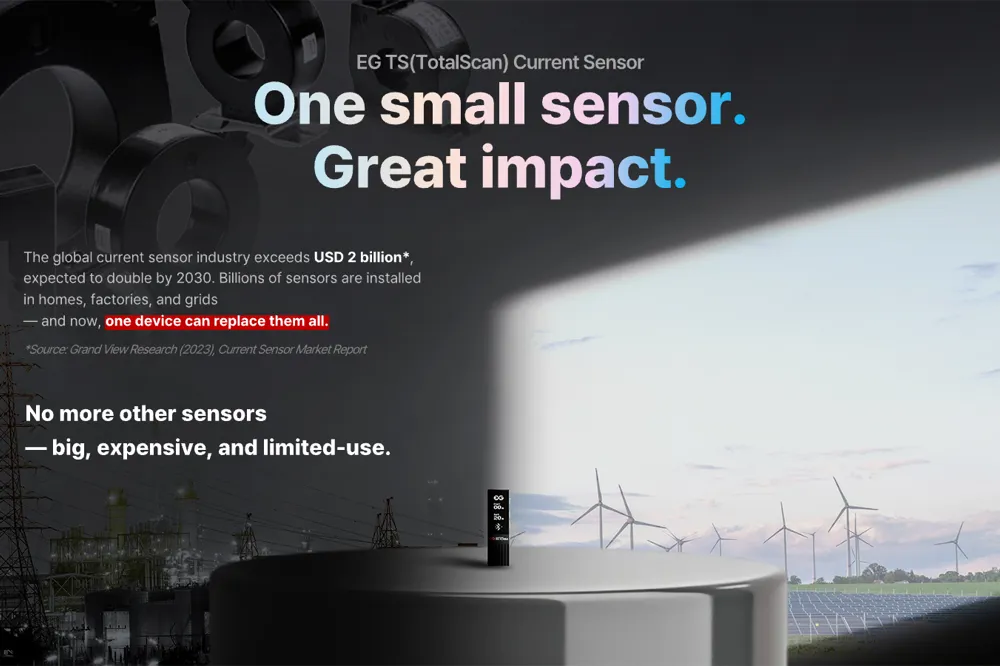
PCB integrated unsaturated current sensor. Unlike conventional current sensors, this unsaturated current sensor can measure from 0.1A to over 5000A with a single compact device without cable penetration. It is a solution that provides non-invasive, real-time, and accurate current data in high-voltage and high-current environments such as EV, renewable energy, data centers, and power grids. This sensor is used for AI-based predictive maintenance and safety monitoring, and contributes to the construction of a sustainable energy infrastructure by reducing material usage by more than 90%.
HonoreekoSustainability & Energy Transition전류 센서에너지 효율스마트 홈에너지 관리 시스템IoT 센서친환경 기술
EG TS(TotalScan) 전류 센서
35
0
EG KOREA Co., Ltd.
One-Line Product Definition
Problem Definition
Conventional methods of measuring high currents in electric vehicles, renewable energy, industrial equipment, etc., use CT (Current Transformer) sensors or Rogowski coils. However, these require the cable to pass through the sensor core, need separate sensors for each measurement range, and have limitations such as reduced accuracy due to saturation at high currents.
These bulky and heavy sensors are complex to install, waste a lot of resources such as copper and plastic, and do not provide reliable data when load conditions change, which hinders the innovation of EVs, power grids, etc.
For the digitalization and preventive maintenance of power infrastructure, there was a need for a new sensor that can measure a wide range of currents without space limitations and enable continuous monitoring.
Key Differentiators
The EG TS sensor is a PCB-based electromagnetic sensor that overcomes the limitations of existing sensors by adopting a core saturation-free design and a non-cable-through method. It measures an ultra-wide range of currents from tens of mA to thousands of A without saturation with a single device, and is easy to install because it is a non-invasive type that is attached like a clamp around the sensor.
Integrated measurement is possible without separate sensor classification for each current range, reducing the number of sensors and costs, and is environmentally friendly by reducing copper and plastic by more than 90%. In addition, it can be directly linked to the AI predictive maintenance system through digital output, enabling real-time monitoring and abnormal pattern detection.
"All currents, non-saturation with one PCB sensor"It is evaluated as an unprecedented innovation in that it is, and its performance has already been proven in railway and industrial field pilots.
Key Adopters
The main adopters are operators of systems with high currents, such as electric vehicle manufacturers and charging infrastructure companies, renewable energy power generation facility operators, data centers, and power companies. They are likely to purchase sensors and integrate them into their own equipment or link them to monitoring systems.
In terms of business type, B2B supply to finished vehicle or equipment manufacturers is the main focus, and it can also be applied to public (power companies, etc.) B2G projects in the power infrastructure field. In addition, demand is expected in B2B special fields such as railways and industrial equipment.
Scalability
This technology can be universally applied to all electrical systems with current flow and is not limited to specific countries or regulations. It has secured a base for entering the global market as it has secured patents in Korea and Japan and is applying for international patents.
It can be expanded to various industrial fields such as EV/charging, renewable energy, server rooms, and factories, and in the long term, the application area can be expanded to smart grids and ship/aircraft electrification.
In terms of regulations, safety standards for power equipment must be met, but since it is at the level of replacing existing sensors, there are few special new regulatory barriers. Since it is based on digital output, software interlocking expansion is easy, so scale-up is expected for IoT sensing or energy management systems in other industries.
Judges' Evaluation
In the context of being selected for the CES Innovation Award, the problem-solving ability in the field of energy sustainability (Sustainability & Energy) was highly evaluated."Contributes to EV, renewable energy, and grid innovation by providing reliable data even under various load conditions"Along with favorable reviews, excellence in design and engineering was emphasized.
In terms of technological completeness, it is judged that it is close to commercialization after completing pilot verification, and it has attracted attention as a case of material innovation by K-startups. However, there is also an opinion that market penetration is uncertain in the competition with large power equipment companies.
Nevertheless"Contributes to building a sustainable energy infrastructure with innovative current sensors"It is evaluated that it has achieved meaningful results at this CES for its contribution.
Analyst Insights
⚠️ Impressive technology but market uncertainty – A current sensor with material and performance innovation has a large potential market, but it remains to be seen how quickly it will be adopted by the conservative power and infrastructure industries.
The award list data is based on the official CES 2026 website, and detailed analysis content is produced by USLab.ai. For content modification requests or inquiries, please contact [email protected]. Free to use with source attribution (USLab.ai) (CC BY)
댓글 (0)
댓글을 불러오는 중...