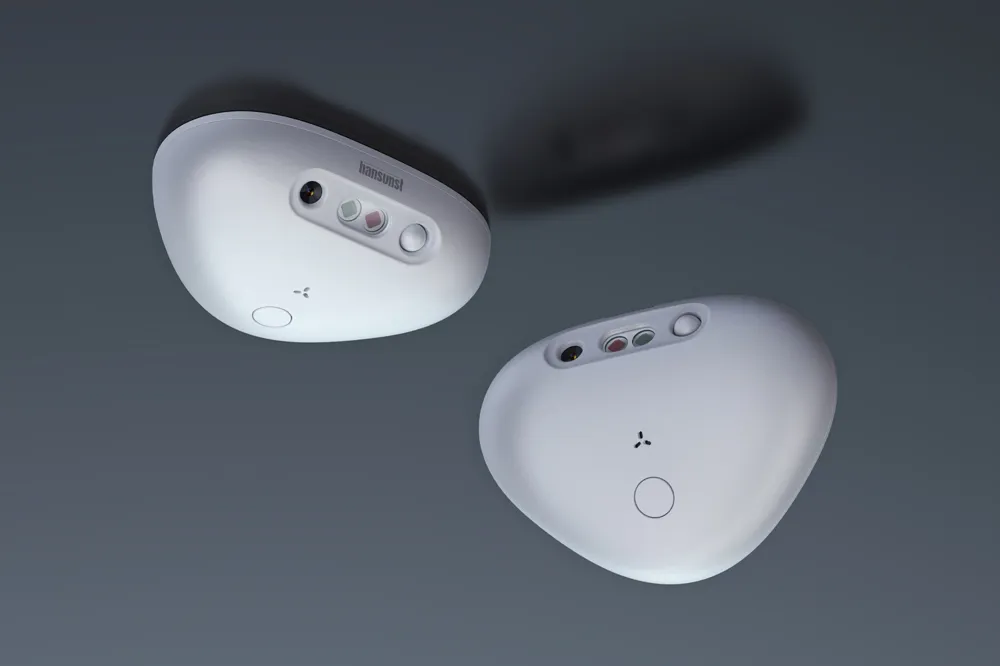
AI 스마트 화재 감지기
HANSUNST
AI Smart Fire Detector (HANSUNST)
Basic Information
Company Name: HANSUNST
Company Website:http://www.hansunst.com/
Korean Company: Global (DB: is_korean_company = false)
Original Link:https://www.ces.tech/ces-innovation-awards/2026/ai-smart-fire-detector/
One-Line Product Definition: AI Smart Fire Detector
Problem Definition
Persistent Fire Threat: Despite the increase in advanced facilities, fires still persist, causing numerous casualties and property damage every year. However, traditional fire alarms only measure smoke density, which means they may not properly detect fires in their early stages or may overreact to small sparks.
Frequent Malfunctions (False Alarms): Existing alarms often go off due to cooking smoke, candles, welding sparks, etc., resulting in frequent **"false alarms."** This leads people to distrust or even turn off the alarms, creating a "crying wolf" problem where the alarm is useless when a fire actually occurs.
Delayed Fire Detection: Existing sensors only operate when smoke reaches a certain density, often detecting fires several minutes after they start. This misses the golden time for initial response, leading to small fires escalating into large ones. In industrial settings, in particular, a delay of even 1-2 minutes can lead to significant damage.
Key Differentiators
Recognition of Human-Fire Interaction: The AI Smart Fire Detector takes a unique approach by understanding even the **"relationship between fire and humans."** In other words, it determines whether a fire is **human-initiated (candle, gas stove)** or an uncontrolled fire by assessing the presence of people and the characteristics of the flames. For example, it recognizes that a flame from someone cooking in the kitchen is not dangerous and does not trigger an alarm, but immediately alarms if a flame appears when no one is present. This is a context-aware algorithm not found in existing detectors.
Multi-Sensor Fusion & ML: It is equipped with a camera (flame video), smoke sensor, and heat sensor, which are integrated and analyzed by a machine learning model. Accuracy is greatly improved by not relying on a single sensor. This ML model learns from hundreds of thousands of fire/non-fire data points to identify real fires with over 99% accuracy based on complex features such as flame flicker frequency, smoke particle patterns, and temperature rise rate. As a result, it has virtually eliminated false alarms from candles or cigarette smoke and improved the detection of actual fires to within seconds.
Edge Computing Implementation: Because all analysis is processed in real-time on the device itself rather than in the cloud, it operates even when the internet is down and has a very fast response time of within seconds. In addition, for human privacy, the video only uses local flame patterns and is not stored.
Two-Way Notification and Interlocking: It does not simply end with a siren, but interlocks with the building's existing fire alarm panel to immediately notify central control and push alarms to the user's smartphone app. This allows users to determine whether there is a fire even from outside and take initial action (such as calling 119), and has the scalability to enable automatic initial extinguishing when connected to an interlocked IoT fire extinguisher.
Key Adopters
B2B (Building Managers, Industrial Facilities): Major customers include large buildings, factories, and logistics centers. Hotels, hospitals, schools, etc. that have had trouble with frequent false alarms will also try to replace them with highly reliable detectors. In particular, **precision manufacturing plants (clean rooms)** can incur enormous losses if production is interrupted by false alarms, so they are likely to consider investing in such smart detectors.
B2C (General Households): It can be sold as a home smart detector through the IoT smart home market. The target audience is residents of fire-prone wooden houses, families with children/elderly, and consumers tired of false alarms. It can be easily managed with an app after installation, so smart home early adopters will be interested.
Local Governments/Public Sector: Local governments can install it in fire-prone areas (traditional markets, old residential areas) through distribution projects. In addition, fire authorities may adopt the sensor as part of building an integrated urban fire monitoring network.
Scalability
Application Across Domestic and International Residential/Industrial Sectors: The market for fire detectors is huge, as they are mandatory installation items in all buildings. This product can target the Korean new building standard after obtaining domestic type approval, and can further enter the global market by obtaining overseas certifications such as the US NFPA standard. It can be especially useful in areas with many wildfires, such as California.
Detection of Other Disasters: The technology can be developed and expanded into a comprehensive hazard sensor platform combined with gas leak detection and earthquake detection. In fact, HANSUNST is expanding the AI model to CCTV-based complex disaster detection, and hinted at this possibility at CES (e.g., similar to products like Argus-D).
Regulatory Aspects: It must meet government standards in each country, such as fire safety certification, which is both a barrier to entry and an opportunity to target the government procurement market upon obtaining certification. In addition, although personal information issues have been avoided by not storing video, continuous promotion is needed to reduce resistance to AI cameras.
Judges' Evaluation
Practical Advancement of Smart Homes: NAR Realtor (National Association of Realtors Magazine) cited this product as an example of "the next wave of smart home technology," saying that "AI has further enhanced home safety." The ability to distinguish between real vs. harmless fires, which existing alarms could not do, is an evaluation that this is a true innovation in smart home safety.
Technological Completeness: As a result of demonstrating with candles and torches at the CES booth, it remained silent to candles in front of people, but sounded an alarm in 2 seconds to torch flames, receiving applause from visitors. Fire experts at the scene expressed confidence, calling it a **"new era of intelligent fire detection,"** and HANSUNST revealed that it was preparing to pass the UL test soon, showing that it was accelerating commercialization. However, some experts mentioned the need to accumulate additional data on the possibility of AI false positives, for example, the probability of unusual lighting or images being mistaken.
Market Expectations: Interior design media such as LookboxLiving predicted that AI fire detectors will be rapidly adopted if they gain customer trust, saying that "smart homes are now contributing to life protection beyond mere convenience." In particular, there is a great deal of interest from fire authorities, and it is known that pilot installation discussions are underway with some local governments in Korea. However, because the price will be higher than that of general alarms (estimated 2-3 times), some believe that the initial market entry will begin with premium/industrial applications, and popularization will be achieved by reducing prices through economies of scale.
Analyst Insights
⚠️ Impressive Technology but Market Uncertainty: AI fire detection is a groundbreaking improvement directly related to human life, but conservative safety standards, price barriers, and user education remain challenges. Although technical excellence has been proven, it remains to be seen how quickly the traditional fire protection industry will adopt it.
The award list data is based on the official CES 2026 website, and detailed analysis content is produced by USLab.ai. For content modification requests or inquiries, please contact [email protected]. Free to use with source attribution (USLab.ai) (CC BY)