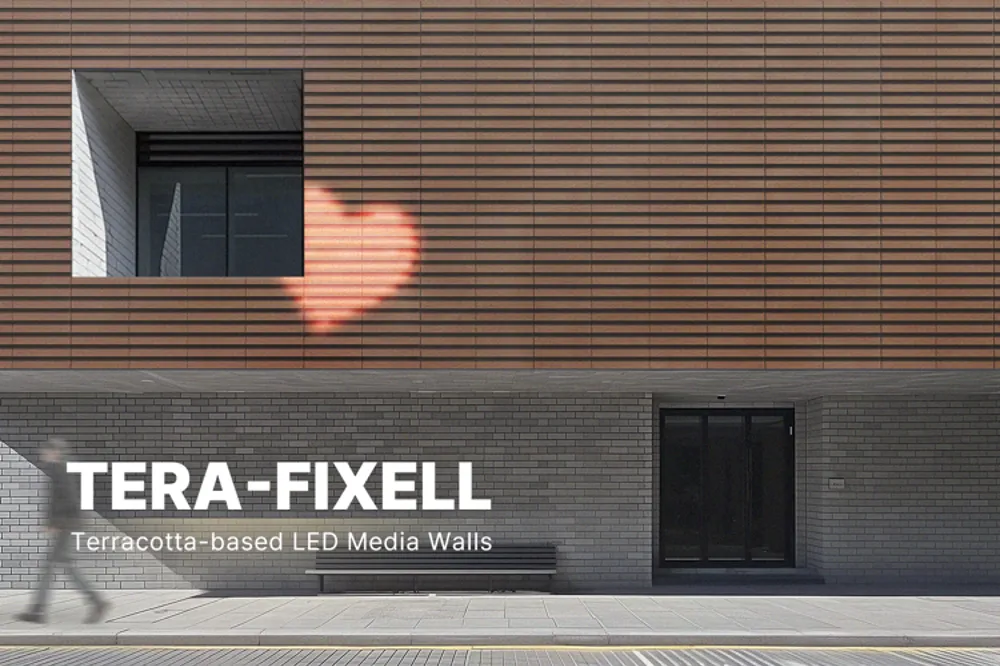
An architectural-integrated large display technology that embeds LED pixels in terracotta, an exterior building material, allowing it to appear as a natural wall surface normally but transform into a digital screen when needed.
Best of InnovationkoConstruction & Industrial TechLED 디스플레이테라코타건축 기술클라우드 제어디지털 사이니지빛 공해 감소
테라 픽셀
84
0
Hanyang University / IMCL
One-Line Product Definition
Problem Definition
Background Problem: Installing digital signage on building exteriors can be unsightly when turned off, displaying a black screen, and cause light pollution when turned on. It has been difficult to install existing LED displays on historical buildings or buildings where aesthetic design is important, creating a conflict between digital promotion and maintaining architectural beauty.
Limitations of Existing Methods: Current building media facades mainly attach LED panels to the exterior, but when the screen is turned off, the black glass or lattice structure is exposed, appearing detached from the building material. Temporary measures are sometimes used to cover this with separate panels or printed materials. In addition, existing LEDs are very bright, causing glare and nighttime light pollution in surrounding living spaces, and can be dazzling up close without the addition of a diffusion film.
Key Differentiators
Fusion of Natural Materials and Digital Technology: Terra Pixel embeds LED elements within terracotta, a traditional architectural finishing material, making the building's exterior appear like a natural terracotta finish when the screen is off. This achieves a complete integration of the digital display with the surrounding architecture, innovating by not detracting from the aesthetics and revealing the video only when needed.
Soft Light Diffusion and Low Light Pollution: The LED light is diffused softly as it passes through the terracotta, creating a smooth screen effect and achieving uniform video without additional optical diffusion films. At this time, the terracotta material acts as a natural filter, reducing unnecessary glare and mitigating light pollution. It enables a comfortable display even at night, without being excessively bright or shining direct light like existing panels.
Cloud-Based Multi-Wall Control: Terra Pixel panels installed on multiple building walls can be centrally managed through a cloud platform, allowing content input, schedule management, and system monitoring from a single dashboard. This makes operation convenient even in large-scale architectural projects and enables remotely synchronized productions. The core differentiator of this technology is realizing a digital screen that looks like a part of the overall architecture.
Key Adopters
Parties Responsible for Actual Costs: Architectural designers/design firms, real estate developers, and local governments/public institutions will be the main adopters. For example, developers building hotels, resorts, or landmark buildings will make purchasing decisions to apply this technology to the building facade. In addition, local governments (B2G) promoting smart city projects may adopt it for the media facades of public buildings.
B2C/B2B/B2G: B2B and B2G. Due to the nature of the architectural material, it is sold in the form of corporate and public orders, rather than individual consumer purchases (a method of contracting as part of large real estate projects).
Scalability
Environmental/National Restrictions: As it belongs to the exterior materials of buildings, there are restrictions that require compliance with the building codes/safety standards of each country. However, since the basic material is terracotta (clay), it is easy to meet building standards in terms of fire resistance and durability, and there are no separate radio wave/communication issues, so national restrictions are not significant. However, market response may vary depending on architectural culture and aesthetic preferences.
Industry/Market Scalability: Initially, it will enter mainly premium construction projects, but as the technology matures and the unit price decreases, it can become common in commercial buildings, transportation hubs (airports, train stations), and public spaces such as museums. In addition to terracotta, it is also possible to expand to various finishing-integrated displays by applying it to other building materials (e.g., concrete or stone). If it is packaged as part of a smart city solution in the future, the market could grow even further.
Judges' Evaluation
CES Award Context: Winning the Innovation Award in the Construction & Industrial Tech category is an unusual case of university research achievements being recognized on the international stage. The judging panel assessed that the eco-friendly and creative display solution would bring a new wave to the construction field. In particular, they seemed to highly value the fact that it delivers environmental information and achieves digitalization while maintaining the urban landscape without additional power waste.
Technological Completeness: The technology is known to have been developed jointly by Professor Noh Young-tae's team at Hanyang University and an architectural materials company, and pilot installations have been completed. In other words, it has passed the stage of verifying on-site applicability beyond laboratory ideas. However, large-scale production systems and long-term weather resistance tests may be required for commercial mass production.
Market Expectations: Architects and media art industries are receiving it as a very interesting solution."Technology that breathes life into buildings"With evaluations such as this, love calls are expected from projects that want to harmonize the preservation of historical buildings and the display of digital information. In addition, Busan, which is promoting a smart city in Korea, is paying attention to the Innovation Award-winning company, so the possibility of a pilot project is being discussed.
Overestimation/Underestimation Factors: Some architectural engineers question "how high the light transmission efficiency through terracotta will be and how much resolution will be achieved." In other words, there may be limitations for advertising purposes that require the same clarity and brightness as existing LED displays. However, this may be an inappropriate comparison, as the original intention differs in that this technology aims for naturalness instead of excessive brightness. As it is currently a technology tailored to specific premium demands, there is little concern about overestimation, and there is also a view that the potential market is large compared to the commercialization capabilities of the development team, so it has been underestimated.
Analyst Insights
📌 Solution Limited to a Specific Niche: It is a technology that shines in special projects that value architectural aesthetics, and is expected to be used mainly for landmark buildings rather than being adopted for all buildings in general. Although innovative, the target market is narrow, so it is expected to form a steady niche demand.
The award list data is based on the official CES 2026 website, and detailed analysis content is produced by USLab.ai. For content modification requests or inquiries, please contact [email protected]. Free to use with source attribution (USLab.ai) (CC BY)
댓글 (0)
댓글을 불러오는 중...