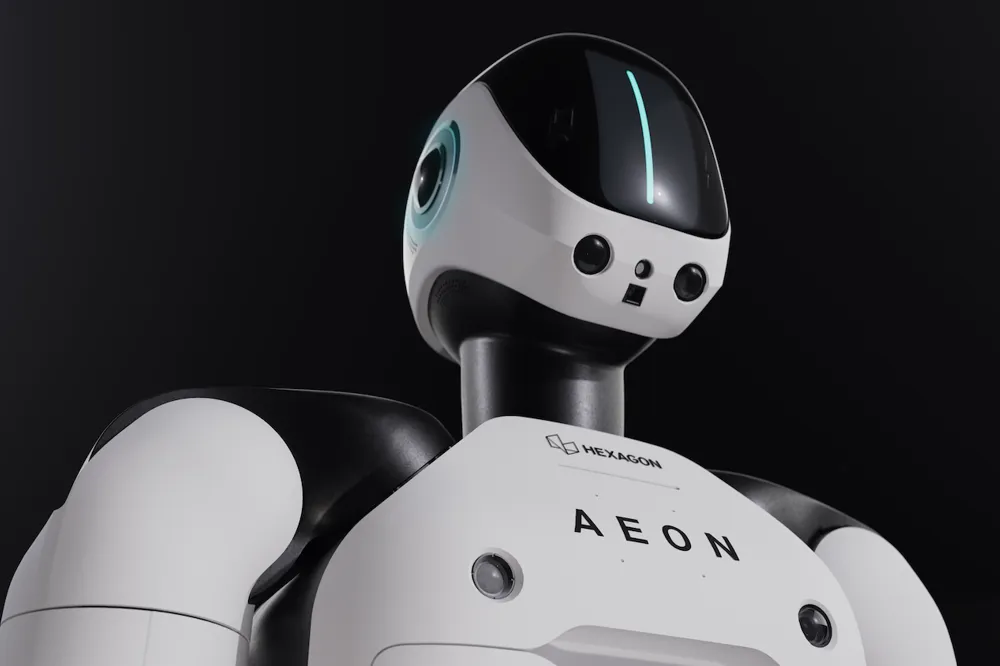
AEON
Hexagon
AEON (Industrial Humanoid Robot, Hexagon)
Basic Information
Company Name: Hexagon
Company Website: (Not in DB)
Korean Company: Global (DB: is_korean_company = false)
Original Link:https://www.ces.tech/ces-innovation-awards/2026/aeon/
One-Line Product Definition: AEON
Problem Definition
Labor Shortage and Aging Population: The manufacturing and logistics industries are facing a chronic labor shortage due to the decline in the young working population and the aging of the workforce. In particular, automation is essential in processes where it is difficult to find people due to dangerous or 3D (dirty, dangerous, difficult) jobs, but existing robot arms can only perform limited tasks and lack flexibility.
Limitations of Existing Humanoids: Although humanoid robot research has been ongoing for a long time, most remain exaggerated concepts with few actual industrial applications. Existing humanoids have often failed to become practical due to problems such as unstable walking, insufficient work precision, and resistance from on-site workers. Companies have been wanting humanoids that can actually be used.
Key Differentiators
Field-Friendly Design: AEON is designed with wheel-based mobility instead of bipedal walking, allowing it to efficiently navigate the flat floors of industrial sites. This allows it to move and work for long periods of time without balance issues. In addition, the appearance and motion design reflect psychological principles to ensure that human workers perceive it as a "collaborator" without resistance. This is a strategy to be accepted as a member of the team, rather than just a machine, which differentiates it from existing robots.
Multi-Skill & Intelligence: AEON has **high agility** and **spatial intelligence**, enabling it to perform various tasks on a single platform, including manipulation (precision assembly), machine tending (machine loading/unloading), facility inspection, digital twin generation (3D scanning), remote operation, and worker assistance. The fact that one AEON model can cover roles that previously required multiple robots with just software upgrades is an innovation in versatility.
Core Hardware Innovation: It is equipped with a highly articulated hand to enable delicate manipulation with both hands, and performs high-level task control with an NVIDIA Isaac-based AI stack. The battery self-swap function allows it to replace its own batteries when discharged, enabling 24-hour operation. In terms of sensors, Hexagon's precision LiDAR, camera, IMU, and other sensor fusion technologies enable it to perceive the environment with mm-level precision. All of this is integrated to a level that can be used directly in real factory environments.
Physical AI Implementation: It is equipped with the ability to judge and adaptively learn (Physical AI) according to the situation, rather than simply repeating motions. For example, it can change its route in real time if an obstacle occurs during work, adjust force appropriately when collaborating with people, and recognize human gestures. This shows that the humanoid has evolved to the stage of "thinking while working."
Key Adopters
B2B (Large Manufacturing Companies): Large-scale factory operators in the automotive, electronics assembly, and logistics centers are early customers. In particular, companies with many repetitive processes and a shortage of three-shift workers will employ AEON as a collaborative robot colleague that operates without shutdowns. Example: Can assist with parts supply and quality inspection on automotive manufacturing lines.
Manufacturing Service Companies: Companies that provide smart factory solutions using robots can purchase/rent AEON and deploy it for factory automation consulting. In this case, manufacturers can use it in the form of RaaS (Robot-as-a-Service) without purchasing it directly.
Public Sector: Government agencies (such as the Nuclear Safety Commission) that deploy robots to dangerous sites such as nuclear accident response and chemical plant inspections can introduce them for special purposes. There is potential demand for measuring disaster sites and performing rescue operations instead of people.
Scalability
Dissemination Throughout Industry: Initially, it will be introduced in large corporate factories in high-wage countries, but as prices fall and reliability is proven, it can spread to small and medium-sized manufacturers, construction, and medical assistance. Demand is expected to be particularly high in the aging markets of Japan and Europe. Hexagon has already partnered with MS to expand its robot solutions.
Entry into the Service Sector: Although it starts as an industrial robot, it can be expanded into various fields that require human-like robots, such as medical rehabilitation robots, logistics transport, and service reception. AEON's modular hand and mobile platform can be used for other purposes by replacing software, leaving room for it to evolve into a general-purpose humanoid platform.
Regulatory Factors: Like general industrial collaborative robots, it must obtain **safety certification (ISO 10218, etc.)**, and in particular, collision safety and emergency stop functions will be strictly verified because it works closely with people. In addition, there is a possibility of union opposition to some job replacements, but social acceptance is relatively high because the aspect of supplementing labor shortages is emphasized.
Judges' Evaluation
"A Watershed Moment for Humanoid Practicalization": TrendHunter praised AEON for **"changing the perception that existing humanoids are unrealistic"** and for focusing on responding to the labor crisis. The CES judges also commented that the design, which takes psychological acceptance into account, and the versatile utilization ability *
Technological Completeness: AEON demonstrated a factory operation demo based on NVIDIA technology at CES, and officials commented that **"unlike other demonstrations, it looked like a scene from a real factory."** A robotics industry report analyzed that Hexagon's total collection of sensor and software technologies makes it more stable than existing startup humanoids. However, battery life and maintenance costs need further verification.
Market Expectations: The manufacturing industry is cautiously optimistic about the emergence of AEON. Interesting Engineering noted that it has already performed quality inspection and scanning tasks in actual factory tests in collaboration with NVIDIA, and reported that the plan to launch commercially in early 2026 is realistic. Meanwhile, comparisons with competing humanoids such as Tesla Optimus are also a hot topic, and many believe that AEON is ahead in evaluations by focusing on immediately applicable practicality. However, some predict that the initial market formation will be gradual due to high prices and psychological resistance to replacing people.
Analyst Insights
⚠️ Impressive Technology but Market Uncertainty: AEON has advanced the practicalization of humanoid robots by one step, but short-term popularization is uncertain due to high prices and the slow pace of acceptance in conservative industrial sites. However, it is clear that this technology has very high potential as a key alternative to solving labor shortages in the long term.
The award list data is based on the official CES 2026 website, and detailed analysis content is produced by USLab.ai. For content modification requests or inquiries, please contact [email protected]. Free to use with source attribution (USLab.ai) (CC BY)