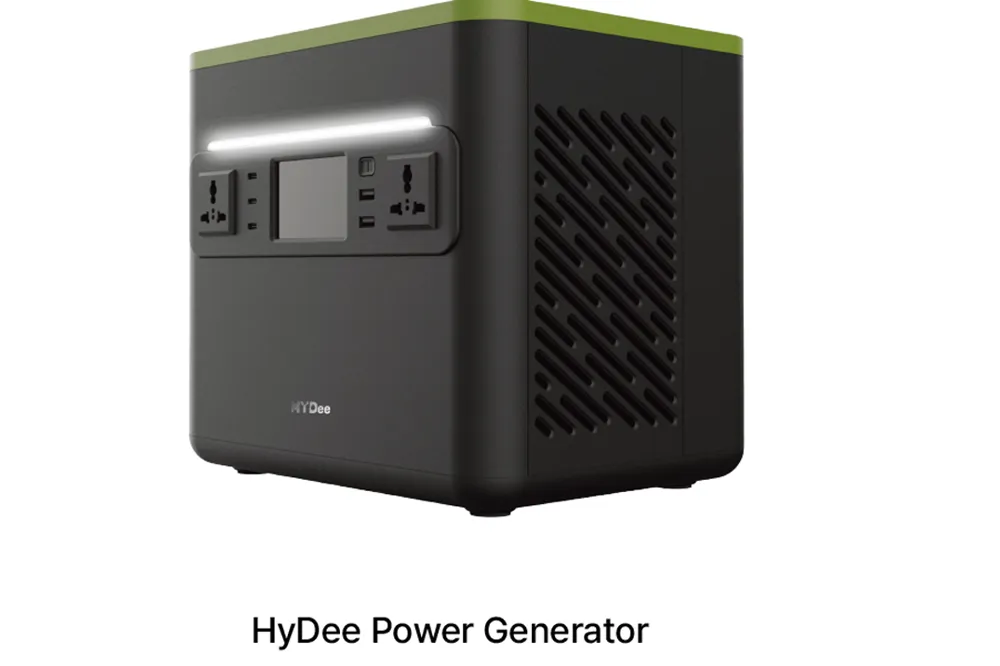
Hydrogen backpack generator that operates without charging – A backpack-type eco-friendly power supply device that continuously supplies power with a hydrogen fuel cell for mobility, drones, etc. that travel more than 200km per day.
HonoreekoSustainability & Energy Transition친환경 기술Vehicle Tech첨단 모빌리티에너지 효율지속가능한 기술탄소 배출 감소
HYDEE
28
0
Hi Lab
One-Line Product Definition
Problem Definition
Mobile devices such as logistics drones, delivery robots, and remote field equipment, when powered by lithium batteries, experience business interruptions due to short driving ranges of up to 40km and charging downtimes of over 3 hours. In business environments where hundreds of kilometers of travel are required daily, the battery issue has led to the deployment of multiple devices or reduced operational efficiency. Furthermore, in situations where access to the power grid is difficult, such as unexpected disaster sites, there has been a lack of portable power sources that can be used for extended periods. In short, the charging delays and short durations of existing batteries are obstacles in industrial settings.
Key Differentiators
By mounting a hydrogen fuel cell stack in a compact, backpack-sized form factor, continuous power generation is possible with only hydrogen fuel replenishment, without the need for charging. This allows for continuous operation without the need to charge every few hours like batteries, and supports much longer driving or operation with a single fueling compared to existing batteries. It also has a higher energy density than lithium-ion batteries and stable output without performance degradation even in cold environments. With IP55-rated waterproof and dustproof design and portability to be carried as a backpack, it can be used in rough terrain or disaster sites. As an eco-friendly power generation with no carbon emissions, it is evaluated to contribute to sustainability goals by increasing operational efficiency without increasing the number of vehicles.
Key Adopters
Initially, logistics and transportation companies (e.g., delivery drone operators, warehouse automation robot teams) that are acutely aware of battery limitations are expected to show interest. In addition, fire and disaster relief agencies can adopt it for powering equipment in areas where power supply is difficult, or it can be used as a power source for communication equipment in the military and security sectors. The purchase type will mainly be B2B/B2G contracts on a project basis, with a focus on corporate and public demand rather than general consumers.
Scalability
It will be primarily distributed in areas with established hydrogen infrastructure, which is currently advantageous for hydrogen economy-promoting countries such as Korea. Although it is still close to the initial R&D stage in terms of technological maturity, requiring solutions for mass production costs and safety regulations (hydrogen storage containers, etc.), it has the potential to be expanded to auxiliary power sources for passenger cars or construction machinery in the future. Ultimately, there is room for expansion into all mobility fields that feel the limitations of batteries, but the establishment of a hydrogen supply chain must be accompanied. From a regulatory perspective, obtaining safety certification for hydrogen fuel operation is key to entering each market.
Judges' Evaluation
It was recognized for its technological potential by winning the CES 2026 Innovation Award in the Sustainability category. Experts who encountered it on-site praised the significance of the concept, saying it is a *"solution that addresses the fundamental limitations of batteries"*, and showed surprise at the miniaturization of hydrogen fuel cells. However, there are question marks about output, supply costs, and hydrogen charging infrastructure as it is still in the prototype stage, and there is a cautious view that additional verification is needed before commercialization. Market expectations are high for the technology concept itself, but with the condition that actual product completeness and economic feasibility must be secured. Overall, it is summarized as *"an impressive but long way to go R&D innovation"*.
Analyst Insights
⚠️ Impressive technology but market uncertainty (notable as a battery alternative, but many challenges to solve, such as hydrogen infrastructure, making short-term commercial viability uncertain)
The award list data is based on the official CES 2026 website, and detailed analysis content is produced by USLab.ai. For content modification requests or inquiries, please contact [email protected]. Free to use with source attribution (USLab.ai) (CC BY)
댓글 (0)
댓글을 불러오는 중...