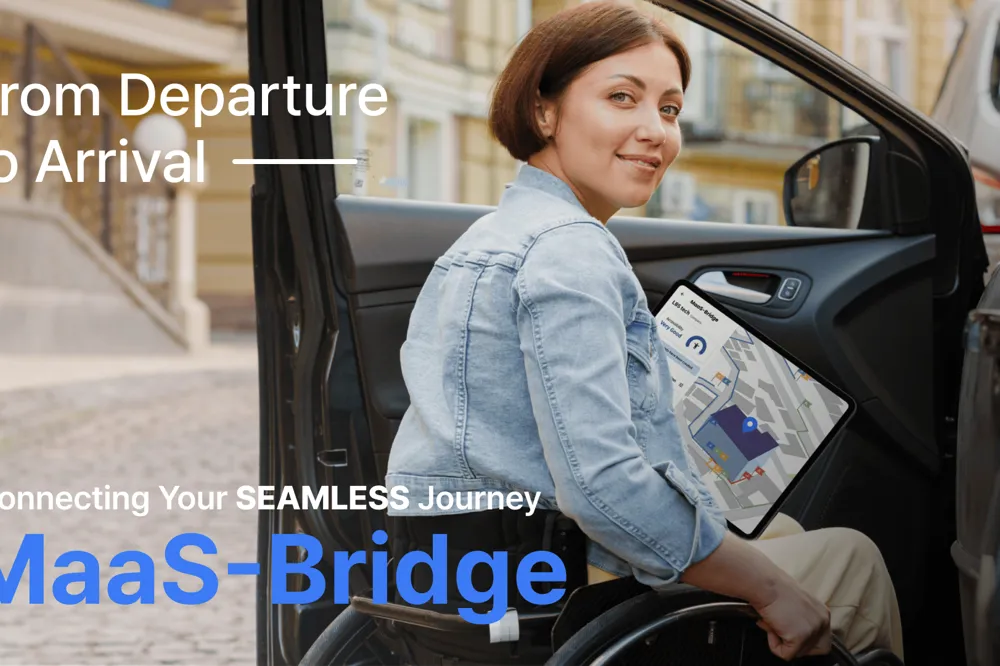
An AI-based mobility connection point design system that allows all mobility-impaired individuals to use it with confidence in the era of autonomous driving. It optimizes vehicle boarding/alighting points to enable barrier-free first/last mile mobility for everyone.
HonoreeTravel & TourismAI 기반 설계MaaS접근성모빌리티 서비스보행자 안전교통 최적화
MaaS-Bridge: 접근 가능한 MaaS(Mobility-as-a-Service) 연결성
2
0
LBS tech
One-Line Product Definition
Problem Definition
Although the commercialization of autonomous buses and robotaxis is approaching, the current transportation system is not friendly to the disabled or elderly. Existing navigation systems only provide routes based on non-disabled adults, so wheelchair users or visually impaired people face barriers to accessing their destinations after getting off the vehicle. For example, wheelchair users need routes without steps, and visually impaired people need tactile paving or voice guidance, but vehicle-hailing services do not consider these needs. In addition, the pick-up/drop-off points of vehicles do not consider traffic flow or pedestrian environment, which can cause congestion or safety risks. The demand to solve the disconnection between transportation and pedestrian routes for transportation for all was the background.
Key Differentiators
MaaS-Bridge uses AI to analyze road traffic flow, pedestrian infrastructure near the destination, and user profiles in a multi-dimensional way topropose the optimal pick-up/drop-off points (Mobility Point).For example, it sets a location with ramps and wide sidewalks for wheelchair users, and a location with tactile maps or safety sign facilities for visually impaired people as the vehicle stopping location. It also considers traffic volume and vehicle accessibility to select operable and safe locations.
This system differs from existing MaaS (Mobility as a Service) platforms in that it extends to pedestrian connections. The route algorithm also uses customized route data for each disability type (sidewalk width, slope, road surface condition, level difference, etc.) as well as general routes to provide the optimal route for each individual. As a result, the key differentiation is the implementation of a "first-mile-last-mile" solution that enables door-to-door movement from the vehicle to the final destination entrance.
Key Adopters
It is expected to be used in the B2G and B2B areas. Local governments and public transportation agencies (B2G)Local governments and public transportation agencies (B2G)can adopt it as a smart city solution, andRobotaxi operating companies (B2B)or mobility platform companies (ride-sharing services, etc.) can also integrate this technology to improve service quality. In addition, large-scale facility management entities such as airports and theme parks can adopt it to support the mobility of people with disabilities.
Ultimately, the service beneficiaries areindividuals with mobility impairments (B2C),but the product/service is provided by the government or companies. LBS Tech is conducting city-level pilots in connection with Incheon Smart City in Korea and plans to expand to overseas cities in the future.
Scalability
Environmental/regulatory constraints are relatively low. Since this solution is software/data-based, it can be applied once access to map data and traffic data of each city is secured. In terms of regulations, it is highly likely to receive government support as it is in line with the policy goal of promoting mobility convenience for the transportation vulnerable.
In terms of industrial scalability, the potential market is global as it can become an essential infrastructure as autonomous driving becomes commercialized. In particular, interest is expected to be high in areas where ADA compliance is important, such as the United States and Europe, and in aging societies such as Japan. In addition, it can be expanded into additional services such as providing barrier-free travel courses in connection with the tourism industry. However, initial data construction costs and coverage of various scenarios are challenges, so it may be difficult to apply to all cities in the short term, but it has considerable growth potential as a smart city standard solution.
Judges' Evaluation
Winning the CES Best of Innovation Award has greatly recognized the inclusive innovation of this technology. The judges praised MaaS-Bridge fortechnically implementing "the right to mobility for all,"and evaluated it as future-oriented in that it is a solution that solves problems that were overlooked in the autonomous driving trend. In terms of technical completeness, it has already been verified in overseas pilot projects such as the UK (projects in London Barking&Dagenham, Birmingham, etc.), so it was considered highly feasible.
In terms of market expectations, there were many positive opinions that it is a practical solution that can be accepted by both government agencies and industry, so the prospects for commercialization are bright. As for concerns about overestimation, there were criticisms about the versatility of data construction (different pedestrian environments for each country), but the consensus is that it is worthwhile in terms of the clarity of innovation goals and social value.
Analyst Insights
The value and publicness of the technology are high, and market application will grow gradually, centered on local governments. MaaS-Bridge is evaluated as a technology that solves social problems by providing an essential link in the era of autonomous driving mobility. Although there is no clear direct revenue model, steady commercialization is expected through government or public institution adoption. When starting in Korea and entering overseas markets, cooperation with local partners (map companies, etc.) is necessary, but global scalability is sufficient. The marketability is not explosive in the short term, but rather a form that will continue to spread as part of the smart city infrastructure. Technically, AI analysis and data processing capabilities are key, and LBS Tech has built a barrier to entry by possessing expertise in pedestrian environment data that it has accumulated over many years. In summary, it is a public innovation technology that will grow steadily even if it is not a commercial blockbuster, and it is expected to achieve meaningful success in line with the ESG trend.
The award list data is based on the official CES 2026 website, and detailed analysis content is produced by USLab.ai. For content modification requests or inquiries, please contact contact@uslab.ai. Free to use with source attribution (USLab.ai) (CC BY)
댓글 (0)
댓글을 불러오는 중...