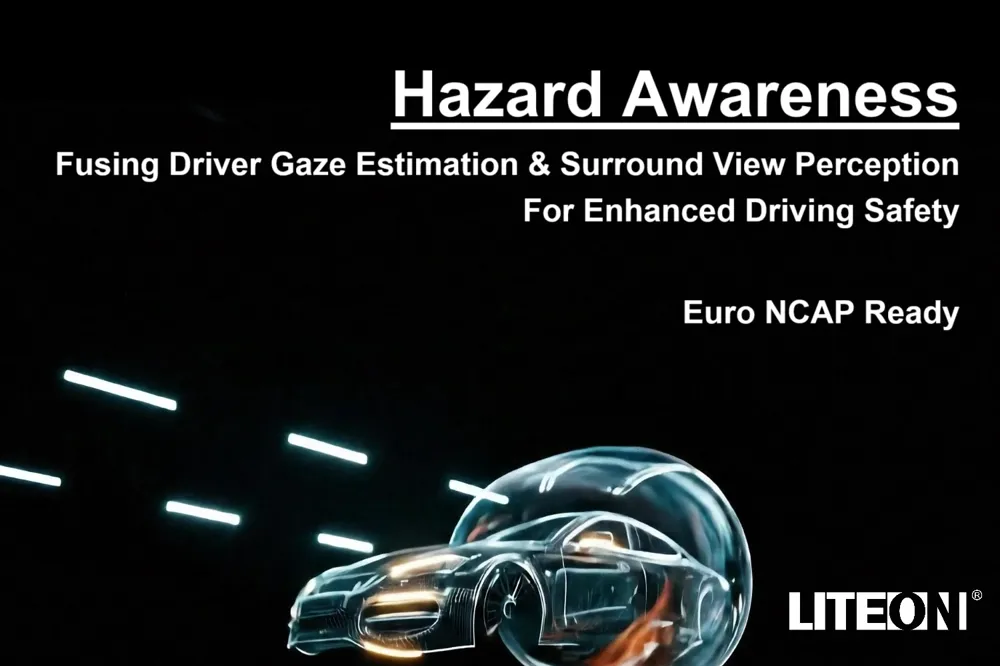
Integrated in-vehicle hazard awareness software that fuses driver monitoring camera and external sensor data in real-time to determine driver awareness, serving as an ADAS assistance system.
HonoreeVehicle Tech & Advanced MobilityAI자율 주행커넥티드 차량스마트 미러뇌 스캐너모빌리티 솔루션
해저드 어웨어니스
1
0
LITEON
One-Line Product Definition
Problem Definition
Current vehicleAdvanced Driver Assistance Systems (ADAS)detect pedestrians and vehicles usingexternal vehicle sensors (camera/radar)and separately monitor driver drowsiness or attention with an interior camera, but these operate independently.
As a result, the system only warns of the presence of a hazard but does not know if the driver sees it and is responding, leading to unnecessary alarms or overlooked risks.
For example, ADAS may overreact to obstacles already recognized by the driver, or the system may only issue a simple warning even if the driver misses a road hazard while distracted. This human-vehicle perception mismatch is a limitation of current technology.
Key Differentiators
LITEON's Hazard Awareness combines external vehicle object recognition and driver gaze tracking into a single AI model. It analyzes the driver's gaze and attention in real-time to estimate what the driver is looking at while simultaneously detecting hazards around the vehicle, such as pedestrians and bicycles.
By cross-referencing these two data sets, the system can determine"whether a hazard exists but is already recognized by the driver."This enables intelligent cooperative driving, such as warning only of hazards not seen by the driver or proactively intervening when the driver is unaware of a risk.
Compared to existing ADAS, it reduces false alarms and performs only necessary interventions, upgrading the vehicle from manual assistance to an intelligent co-pilot. In addition, it can be applied to existing hardware through software updates, enabling economical upgrades.
Key Benefits
Automotive OEMs and Tier 1 suppliers (B2B) are the primary customers. Car manufacturers can integrate this software into their vehicle infotainment/ADAS systems, and Tier 1 suppliers can include the functionality in camera modules and supply them to car manufacturers.Automotive OEMs and Tier 1 suppliers (B2B) are the primary customers. Car manufacturers can integrate this software into their vehicle infotainment/ADAS systems, and Tier 1 suppliers can include the functionality in camera modules and supply them to car manufacturers.
In the downstream industry, insurance companies (B2B)may be interested in it for accident prevention, andpublic transportation safety agencies (B2G)can influence the adoption of relevant technical standards. Since the end consumer encounters it as a car option, it can be seen as a B2B2C model.
Scalability
With movements in safety assessments such as Europe's Euro NCAP requiring driver monitoring and hazard awareness linkage, this technology has the potential to become a global safety standard in the future. As a software solution, it allows simultaneous collaboration with multiple car makers and can be expanded as an essential module for driver-vehicle collaboration in autonomous driving Level 3+ vehicles.
The concept can be applied to other modes of transportation such as aviation and mobility (autonomous shuttles). While driver privacy issues should be noted, the safety benefits are expected to lower regulatory hurdles.
Overall, it has the potential to spread throughout the vehicle safety industry and can be applied to existing vehicles via OTA updates to target the aftermarket.
Judges' Evaluation
Winning the Innovation Award in the Vehicle Tech & Advanced Mobility category, it was recognized for presenting an inevitable direction for ADAS development. Automotive media outlets areassessing it as "the first commercial solution to actively utilize driver monitoring data"and expressing expectations for its accident prevention effects.
There are also observations that OEMs are highly interested in responding to future safety regulations in Europe and elsewhere. However, given that LITEON is not an existing ADAS powerhouse, major OEM partnerships are critical for market adoption.
While the CES on-site evaluation was positive, some view it as a"proof-of-concept stage"since it has not yet been installed in an actual vehicle. In summary, the technical concept and necessity are well-received, but commercialization is just beginning.
Analyst Insights
⚠️ Impressive technology but market uncertainty – While it represents the next generation of vehicle safety, success depends on the automotive industry's adoption and timing.
The award list data is based on the official CES 2026 website, and detailed analysis content is produced by USLab.ai. For content modification requests or inquiries, please contact contact@uslab.ai. Free to use with source attribution (USLab.ai) (CC BY)
댓글 (0)
댓글을 불러오는 중...