An AI smart cane for the visually impaired. It incorporates multiple sensors and AI to detect changes in road elevation, surface texture, and obstacles in real-time, providing safe route guidance through vibration and Braille feedback.
HonoreekoAccessibility & LongevityAI인공지능스마트 지팡이음성 인식장애인 보조 기술지능형 내비게이션
NaviCane
6
0
MightyIrony/Hanseo University
One-Line Product Definition
Problem Definition
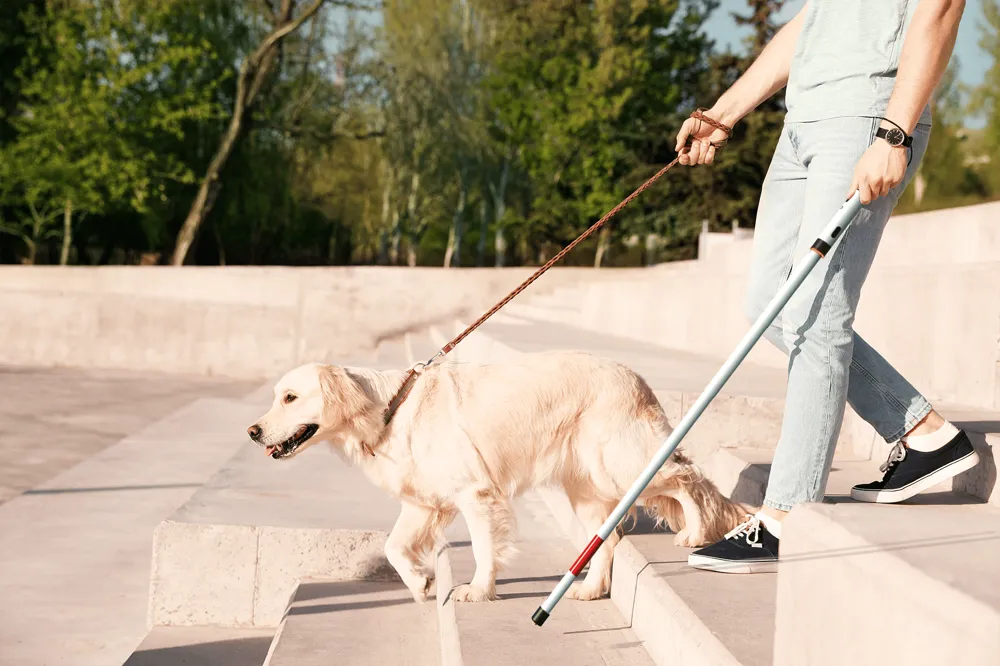
Existing white canes require users to directly explore the ground or ahead, and they are unable to detect obstacles above waist height, posing a risk. Additionally, it is difficult to anticipate road conditions such as stairs, bumps, or puddles, often leading to accidents.
Visually impaired individuals rely on audible traffic signals or apps for traffic signals, but face issues such as low GPS accuracy and the burden of wearing earphones. Existing smart canes only provide basic warnings of obstacles ahead using ultrasonic sensors, lacking detailed terrain information or directional guidance.
These inconveniences limit the independent mobility of the visually impaired. Guide dogs cost tens of thousands of dollars to train and are only available to a limited number of people. NaviCane was developed to solve the problem of safe and independent mobility for the visually impaired.
Key Differentiators
NaviCane is like "a small guide dog with a Braille display."It overcomes the limitations of existing canes through sensor fusion and AI. Equipped with ToF (Time-of-Flight) sensors, IMU (Inertial Measurement Unit), pressure sensors, and vibration motors, it detects not only obstacles at foot level but also those at waist height, road slope, and surface material. Deep learning based on TensorFlow Lite predicts slippery surfaces or hidden potholes.
This information is conveyed to the user through dual vibration motors and a Braille dial UI, allowing them to intuitively understand direction and danger even in noisy environments without voice guidance. It also provides location-based route guidance using GPS and BLE, and has an SOS emergency call button for immediate assistance in case of danger.
Compared to competing products, such as some overseas smart canes that only detect obstacles ahead with one or two ultrasonic sensors, NaviCane is a comprehensive solution with multi-sensor + AI prediction + Braille output, offering unparalleled precision and ease of use. The modular lightweight design minimizes the weight of the cane, maintaining usability similar to a regular white cane.
Key Adopters
Individual visually impaired users (B2C)are likely to purchase directly or receive it through government or local government assistive device programs. For example, NaviCane could be a next-generation alternative for those receiving white canes with national subsidies.
Also,Organizations for the disabled or welfare organizations (B2B)may purchase in bulk to improve the mobility of their members. Educational institutions (such as schools for the blind) can also adopt it for outdoor mobility training for students, andthe public sector (B2G)can distribute smart canes as part of policies to support the transportation disadvantaged.
As the NaviCane development team is a collaboration between university research and a startup, it is currently in the pilot supply stage. However, once commercialized, it will attract the attention of individual buyers in the global assistive device market for the visually impaired (especially the demand to replace expensive guide dogs).
Scalability
With 200 million visually impaired people worldwide as a potential customer base, the international market can be easily entered once the language barrier is resolved. Sensor technology and AI are universal and not significantly restricted by specific national regulations (however, certification burden is low as it is not a medical device).
In addition, NaviCane's core real-time risk prediction and tactile interface can be applied to other areas such as safety canes for construction site workers and smartwatches for the visually impaired (vibration guidance). Ex) Braille UI technology can be used as a Braille output accessory for smartphone navigation.
It can also be modified into indoor guide sticks for the elderly with low vision, expanding into a range of elderly-friendly products. The modular lightweight design facilitates the creation of subsequent models or customization.
On the other hand, there is a limitation in that precise indoor guidance is difficult due to GPS dependency, but this can be supplemented by linking with indoor beacons, which can be applied to other industries (such as indoor autonomous robots).
Judges' Evaluation
Selected as an Innovation Award honoree at CES 2026,it was evaluated as "significantly improving the independence of the visually impaired through a creative combination of AI and tactile feedback."The judges particularly praised the sophisticated environmental analysis and non-voice interface compared to existing smart canes.
Market experts also noted *"the reproduction of the core functions of a guide dog with technology"*, mentioning NaviCane as a groundbreaking innovation in visual impairment mobility assistance, along with .lumen's glasses. However, it is still in the prototype stage with a lack of real-world usage data, and there are aspects to verify in real-life applications such as durability and battery life.
There is also a cautious view that the potential has been confirmed through the CES exhibition, but commercialization and market reaction are uncertain. Overall,the evaluation is that "the idea and implementation are excellent, but there is still a long way to go before market adoption."is the evaluation.
Analyst Insights
🧪 R&D and concept verification stage (The technology concept and prototype are innovative, but mass production and popularization verification have not yet been carried out, so it is an early-stage solution whose future potential needs to be observed.)
The award list data is based on the official CES 2026 website, and detailed analysis content is produced by USLab.ai. For content modification requests or inquiries, please contact contact@uslab.ai. Free to use with source attribution (USLab.ai) (CC BY)
댓글 (0)
댓글을 불러오는 중...