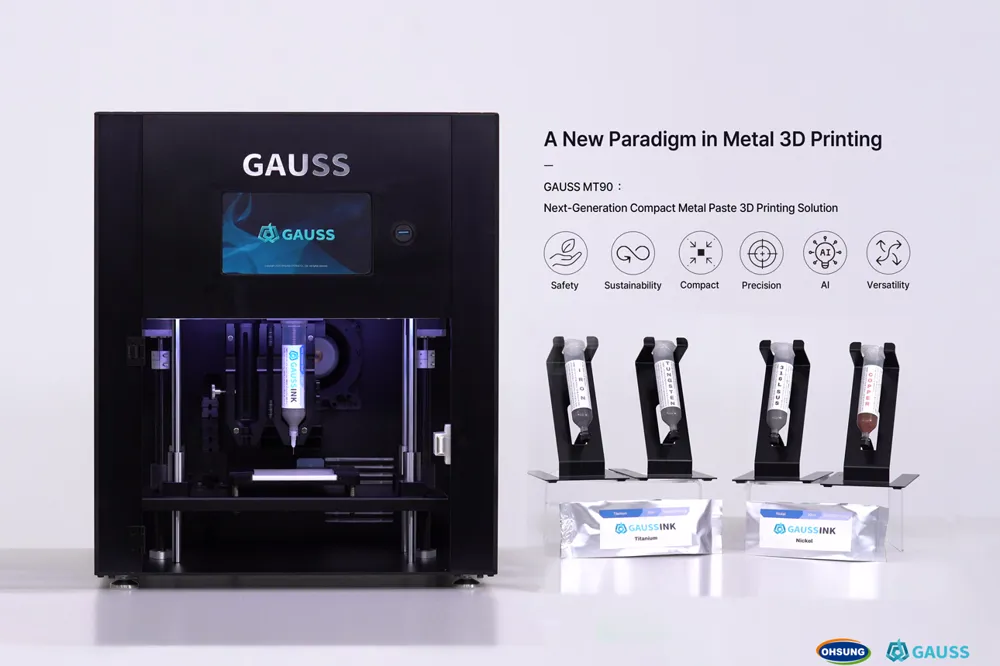
Ohsung System Co., Ltd.'s Gauss MT90 is a safe metal paste-based 3D printing solution that enhances the accessibility of metal 3D printing with its ease of use and automation features.
HonoreeRobotics3D 프린팅금속 페이스트소형화정밀 제조시제품 제작
Gauss MT90 : 차세대 소형 금속 페이스트 3D 프린팅 솔루션
1
0
Ohsung System Co., Ltd.
One-Line Product Definition
Problem Definition
Existing metal 3D printers use fine metal powder and high-powered lasers, posing significant safety concerns such as dust explosion risks and high-temperature processing during operation. Furthermore, the equipment is expensive, costing hundreds of millions of Korean won, and requires specialized personnel and facilities (such as inert gas chambers), creating high barriers to entry.
This has made it difficult for universities, research institutes, and small to medium-sized manufacturing sites to utilize metal 3D printing, and the technology tends to be used mainly by large corporations. Meanwhile, the demand for customized metal parts in industries such as aerospace and healthcare is increasing, but its application is limited due to the risks and costs of existing processes.
Key Differentiators
The biggest differentiator of the Gauss MT90 is that it eliminates the risk of metal powder scattering and explosion by directly depositing high-viscosity metal paste. Since it prints at near room temperature conditions without high-temperature lasers or arc welding, there is almost no risk of fire or burns, and it can be operated in a normal ventilation environment.
Also,Automatic process optimization function (Quick Start mode)greatly enhances user convenience by allowing even beginners to complete printing preparation within minutes. AI camera-based viscosity control and precise extrusion algorithms ensure that the shape of the printed material remains stable even before sintering, resulting in high reliability for repeated printing. In addition, it is equipped with an automatic printing bed replacement system, enabling continuous printing and integration with automated lines, which dramatically improves workflow efficiency compared to existing manual operations.
Key Adopters
University, research institution, and corporate R&D centers (B2B/B2G)can utilize it for educational and research purposes. For example, it is considered suitable for students and researchers in university mechanical engineering departments or national defense research institutes to safely manufacture metal parts.
In addition, in the defense field, it can be used for rapid MRO (Maintenance, Repair, and Operations) purposes, such as producing spare parts on-site or printing discontinued parts within the unit. Manufacturers can also introduce the Gauss MT90 for small-scale customized parts production or prototype manufacturing, enabling in-house metal printing without large equipment. Currently, inquiries for introduction are increasing from many research institutions both domestically and internationally.
Scalability
The Gauss MT90 has a modular design that can accommodate future expansion of printing size or diversification of materials, providing a foundation for integration into smart manufacturing lines. For example, it is expected that real-time quality control will be possible by collecting and analyzing process data in the future and linking it with smart factories.
In terms of regulations, unlike large metal printers, it does not use explosive materials, so there are no special permit restrictions, and CE and domestic safety certifications have already been secured. However, the challenge is how to secure price competitiveness compared to competitors in the global market (e.g., Markforged, Desktop Metal, etc.). Also, after printing,sintering process (kiln firing)is required separately, so packaging it into a total solution package and providing service support will be key to future business expansion.
Judges' Evaluation
It has been praised as "a technology that will accelerate the popularization of metal 3D printing." It is reported that the CES Innovation Award was successfully won because the design that simultaneously improved safety and accessibility was noted in the judging. In particular, it was mentioned that "the consideration of industrial scalability beyond simple research purposes" was highly evaluated, and the wide range of applications from education to national defense was also well-received.
In terms of technical completeness, numerous prototypes have already been verified, and the possibility of actual use is being proven as various institutions have shown interest since the product was announced. However, there is a cautious view that "the market ripple effect compared to innovation remains to be seen" as it has to overcome the conservatism of traditional manufacturing and the market dominance of existing metal printer powerhouses.
Analyst Insights
⚠️ Impressive technology but market uncertain (safe and innovative, but commercialization trends need to be monitored within existing industry practices and competitive landscape).
The award list data is based on the official CES 2026 website, and detailed analysis content is produced by USLab.ai. For content modification requests or inquiries, please contact contact@uslab.ai. Free to use with source attribution (USLab.ai) (CC BY)
댓글 (0)
댓글을 불러오는 중...