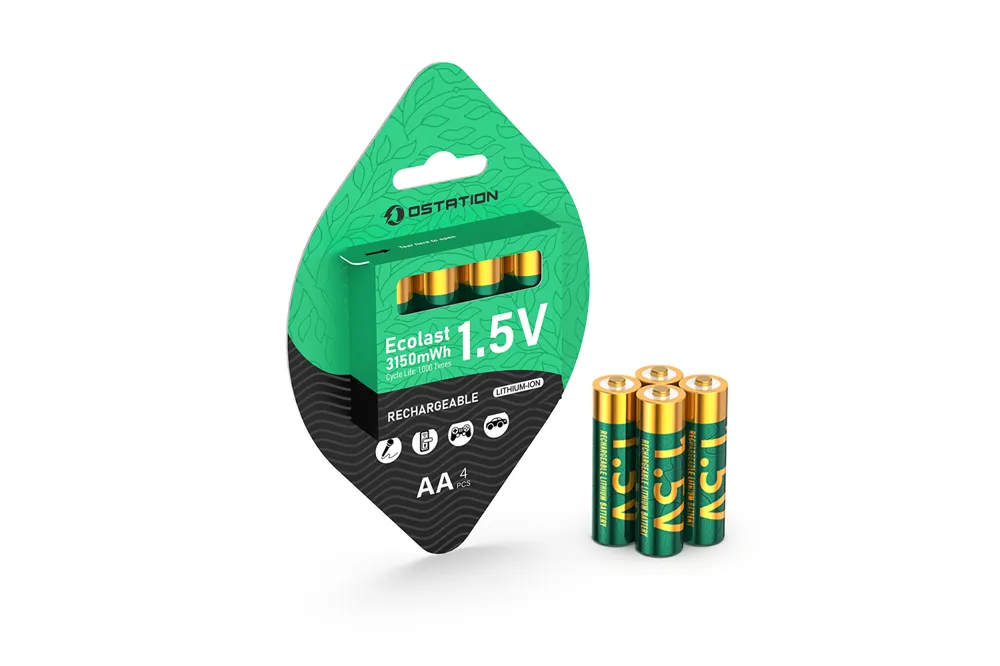
AA size 1.5V rechargeable lithium-ion battery. It has a smart BMS chip embedded in each cell to manage temperature and charging status. It always operates with a stable 1.5V output like a regular alkaline battery, but is an eco-friendly battery that can be recharged more than 1000 times.
HonoreeSustainability & Energy Transition충전식 배터리리튬 이온배터리 관리 시스템(BMS)에너지 효율친환경 기술지속 가능한 에너지
Ecolast AA 1.5V 충전식 리튬 이온 배터리 (배터리 관리 시스템 포함)
1
0
Olight Group Co.,Ltd
One-Line Product Definition
Problem Definition
Environmental burden of disposable batteries: Billions of 1.5V alkaline batteries such as AA are consumed worldwide annually, and disposal after use causes heavy metal contamination and resource waste problems. Rechargeable nickel-metal hydride (Ni-MH) batteries are an alternative, but they have a voltage of 1.2V, which causes driving problems (such as reduced brightness) in some devices, and they tend to be unpopular with general consumers due to self-discharge. As a result, many consumers still choose disposable batteries for convenience, and the problem of disposing of used batteries continues.
Performance limitations of existing rechargeable batteries: Ni-MH rechargeable batteries have a poorer user experience than alkaline batteries due to the memory effect, high self-discharge rate, and low cut-off voltage. Some manufacturers have created 1.5V lithium rechargeable batteries, but they typically add an external circuit to step down the 3.7V cell to 1.5V, which causes issues such as safety (overcharge risk) and output current limitations. In addition, it was difficult to predict when the battery would expire because the battery status was unknown, and charging was complicated without a dedicated charger. In short, the lack of convenience and reliability of rechargeable batteries was a factor preventing the replacement of disposable batteries.
Key Differentiators
World's first AA battery with built-in BMS: Ecolast AA has a battery management system (BMS) IC embedded inside the AA cell, so each battery performs its own status monitoring and protection functions. It measures battery temperature, charge cycle, remaining capacity, etc. in real time to prevent overheating and overcharging, and adjusts the output current as needed to ensure safety. This is the first AA battery that can be digitally managed, and it is unique in that it operates smartly like a smartphone battery.
Always constant 1.5V output: Although the cell voltage is 3.7V lithium, the built-in circuit maintains 1.5V until the end. Alkaline batteries drop from 1.5V to 1.0V as they discharge, and Ni-MH batteries have 1.2V from the beginning, which can cause malfunction or performance degradation depending on the device. Ecolast stably supplies the same 1.5V as alkaline, so brightness/performance remains constant even when the battery level is low. For example, a flashlight does not suddenly dim, and toys run powerfully until the end. This improved user experience is a major factor in consumers switching to rechargeable batteries.
2100mAh high capacity & high load support: General Ni-MH AA is about 2000mAh@1.2V (energy 2.4Wh), but Ecolast is2100mAh@1.5V (3.15Wh)which is about 30% larger. And it is stable even in devices with instantaneous high power (camera flash, etc.). This is thanks to the high energy density and low internal resistance of the internal lithium, and the design to minimize resistance, such as additional gold plating on the anode, makes it excellent in high-discharge devices (digital cameras, motor toys, etc.). Consumers can get rid of the perception that "rechargeable batteries are weak."
No leakage & ultra-low/high temperature operation: Alkaline batteries cause device corrosion due to electrolyte leakage when left unattended, but Ecolast has no leakage due to dual-layer encapsulation, and performance is largely maintained even in -20℃ winter due to the characteristics of lithium batteries. It also operates without ignition in hot environments (+60℃) due to the safety circuit. This reliability and environmental adaptability is a particularly welcome improvement for safety-critical applications (digital door locks, outdoor sensors, etc.).
Smart charging and management ecosystem: Olight has introduced the Ostation smart charging hub together, and when Ecolast is plugged into this charger, each battery ID, charging cycle, temperature, etc. is displayed on the app. Users can check the *
Key Adopters
General consumers (B2C): Households that use a lot of batteries, such as remote controls, toys, and wireless mice, are the main target. In particular, IT device enthusiasts have already used Eneloop, etc., and this product has better performance and is smarter, so there is a great demand for replacement. In addition, high battery consumption users such as photographers and gamers are likely to switch from alkaline to this product. Because the price is not high, it can cover a wide range of consumers.
Corporate/institutional procurement (B2B): If companies that use large quantities of AA batteries, such as broadcasting stations and logistics warehouses, introduce this product, it will greatly reduce waste and save costs. In particular, public institutions such as the military and police use a large amount of AA batteries in work equipment (night vision equipment, etc.), and switching these to rechargeable batteries can contribute to budget savings and environmental goals (government's carbon neutrality). Olight is also selling B2B packages (e.g., large packs and charging stations) to target corporate demand.
Equipment manufacturer OEM: Manufacturers of battery-included products such as smart door locks and sensor lights can provide or recommend Ecolast as a bundled battery. This is because it can increase added value in the form of "dedicated smart battery included." According to Olight's announcement, discussions are also underway with companies in the smart home field.
Scalability
Portfolio expansion such as AAA: It can be easily expanded to standards such as AAA and 9V in addition to AA. Olight has already announced the development of AAA size. This makes it possible to create a lineup that replaces all 1.5V primary batteries, increasing the market size to hundreds of millions of cells.
Global popularization: Olight has a global distribution network and is already selling in North America, the EU, etc. In particular, European consumers with high environmental awareness are expected to respond favorably. In addition, EU battery regulations are being strengthened, and there is a movement to phase out disposable batteries in the future, so it is possible that such products will be virtually mandatory.
Challenges: From a user education perspective, some consumers avoid rechargeable batteries due to past bad experiences with Ni-MH rechargeable batteries. To dispel this, marketing should emphasize"OK for any device with 1.5V"and make them aware of the convenience. In addition, although the unit price increases due to the BMS chip, the price barrier has been lowered by setting the initial set of 4 at a relatively low price of $13.99.
Safety and regulations: Safety is increased with the built-in BMS, but existing restrictions such as air transportation regulations apply because it is a lithium battery. However, this is not a major issue because existing primary batteries are also regulated for mass transportation.
Olight ecosystem effect: Olight has many product lines such as flashlights, so it is creating an ecosystem with Ecolast + Ostation charger + its own lights to create a lock-in effect. If this brand lock-in strategy is effective, sales will increase and barriers to entry for competitors will increase.
Judges' Evaluation
CES Innovation Award and media introduction: Ecolast AA was selected as a CES 2026 Sustainability & Energy Transition Honoree, recognizing both its eco-friendliness and technological innovation. TrendHunter, etc. reported this and introduced it as the *"world's first smart AA battery with built-in BMS"*, and evaluated it as a *"game changer that will replace disposable batteries."* CleanTheSky, an eco-friendly media outlet, also reported this news and said"Digital innovation has occurred in everyday batteries."He said.
User evaluation: According to feedback received from the pilot launch at the end of 2025, users expressed satisfaction, saying that it is "as convenient as alkaline batteries" and *"no problem even with high-performance devices."* In particular, there are reviews that the recharge time is shorter and the output is more stable than Ni-MH when shooting camera flashes. However, there is an opinion that *"the voltage drops sharply after discharge, making it difficult to predict the end point,"* which is a double-edged sword of the 1.5V maintenance feature (it always goes brightly and then suddenly turns off near the end). However, it is believed that this will be resolved soon because the BMS chip can notify the remaining amount via the app.
Environmental expectations: Environmental experts evaluate that *"if switching to rechargeable batteries becomes this easy, it will greatly contribute to reducing household waste batteries."* In particular, parents who use a lot of batteries for their children's toys are welcoming the change, saying, *"Now I can reduce the guilt of using and throwing away batteries."*
Marketability evaluation: Most media and critics say"It's finally here."They are confident in the demand because it is a product that has been needed for several years. In fact, there were 1.5V lithium AAs in the past (products from some Chinese companies), but Olight products are said to be superior in terms of completeness, such as built-in BMS. Olight's brand reliability is also high, and it is expected to be a *"key item that will increase the penetration rate of rechargeable batteries."*
Only concern: There is concern that the life of the rechargeable battery may be shortened due to the built-in chip. Although the BMS itself consumes power, it is very insignificant, and test results show that the life is sufficient with a guarantee of 1000 or more charges, so it does not appear to be a major problem.
Analyst Insights
🔥 High marketability / Business connection possible: This product breaks down both technical and user psychological barriers and almost perfectly replaces disposable batteries. The price is also reasonably set, so it is highly likely to be adopted by the mass market, and the eco-friendly trend may create demand from governments and companies. It has high marketability as a killer product that will lead the popularization of rechargeable batteries.
The award list data is based on the official CES 2026 website, and detailed analysis content is produced by USLab.ai. For content modification requests or inquiries, please contact contact@uslab.ai. Free to use with source attribution (USLab.ai) (CC BY)
댓글 (0)
댓글을 불러오는 중...