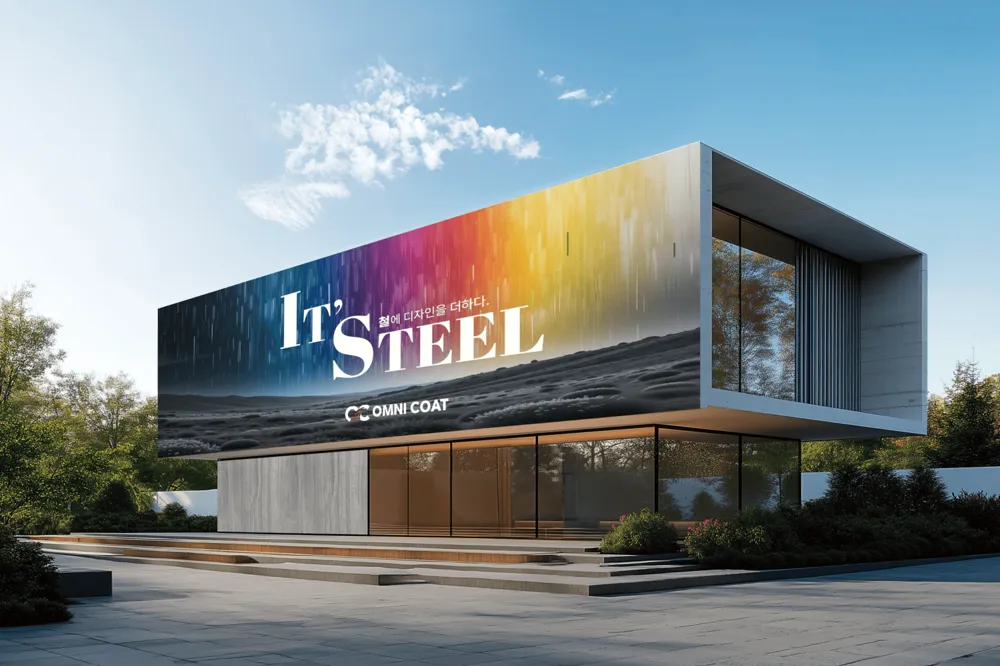
The world's first dry toner digital printing system for metal, which directly prints and fixes full-color patterns on steel plates without ink or film, providing an eco-friendly coating technology for steel surfaces.
HonoreekoConstruction & Industrial Tech디지털 프린팅건식 토너강판 인쇄친환경 제조고속 생산맞춤형 디자인
SteelChroma Toner
9
0
OMNICOAT
One-Line Product Definition
Problem Definition
Traditionally, to create color steel plates used for building materials or appliance exteriors,wet coating (paint)or film adhesion processes have been used. However, these methods have environmental issues such as solvent (VOC) emissions and wastewater generation. Changing colors or patterns requires altering the coating equipment, making flexible production difficult.
Attempts have been made to use wet digital printing such as inkjet on metal, but commercialization has been limited due to poor ink adhesion and durability, and slow process speeds. Additionally, the shortage of skilled coating personnel and the increasing demand for custom designs have exposed the limitations of existing methods.
In short,there has been an industrial need to "apply digital printing, common on paper or fabric, to metal as well."However, due to the characteristics of metal such as thermal conductivity and hardness, the problem of commercialization has persisted.
Key Differentiators
SteelChroma Toner combines a dry toner developed specifically for metal with a fuser system to print color images directly onto steel plates and melt and fix the toner with high heat. It is a completely new method in that it is the world's first implementation of commercial dry metal printing, and it is a 0% solvent process compared to inkjet or wet coating, so there are no VOC emissions or wastewater.
Toner particles adhere strongly to the metal surface, providing excellent corrosion resistance and scratch resistance, and can be dried immediately after curing for use in high-speed coil production. From a design perspective, desired patterns such as wood grain and marble texture can be printed immediately by simply changing the digital file, enabling various appearances without changing the raw materials.
In addition, small-quantity customization is possible without separate printing plates/screens, which has revolutionized production flexibility. The proprietary materials and processes, protected by 11 patent applications (5 registered), are also a differentiator that makes it difficult for competitors to imitate.
In short, it is a metal printing technology with eco-friendliness, high speed, and flexible production, which can replace existing coating methods.
Key Adopters
The main customers are industries that produce or utilize color steel plates. For example, steel plate manufacturers for building materials can produce steel plates with various patterns by introducing this toner system into their processes. Also, home appliance manufacturers can replace existing coating lines to create their own designed steel plates.
OMNICOAT itself will generate revenue in a B2B format by selling or licensing toner supply and printing equipment. Therefore, the cost payers are companies such as steelmakers, building material companies, and home appliance companies, and ultimately, construction companies or consumers will encounter products made with this technology. (※ This technology has a strong industrial material aspect, so general consumers do not purchase it directly.)
Scalability
The technology itself is applicable to the global metal processing market in principle, as passing industry standards/certifications is more critical than specific national regulations. Currently, it is focused on printing steel plates, but future research is expanding to applications in other metals such as aluminum, PCB substrate mask printing, and battery electrode coating.
Also, scaling up the printing width or speed can integrate it into mass production lines, and modularizing the printing system can increase on-site installation flexibility. OMNICOAT is already building a dry/wet integrated production plant in Pohang, which is scheduled to be operational in 2025, and is promoting technology verification and scale expansion simultaneously.
However, the adoption cycle may be long for replacing existing processes in the conservative steel industry, and initial equipment investment costs should also be considered. Nevertheless, the demand for eco-friendly digital coating technology is expected to grow globally due to ESG pressure and customized production trends, so the potential for expansion to the global market is high without being tied to a specific region.
Judges' Evaluation
The judges highly praised the material engineering innovation and integrated process implementation of this product. It was recognized as a breakthrough in technical challenges in that *"digital color printing on paper was applied to metal for the first time,"* and received reactions from steel industry officials that it *"could be a game-changer."
In particular, the CES review evaluated it as excellent in four aspects: materials engineering, process integration, eco-friendliness, and scalability, and saw that it had the potential to open up a completely new market. Regarding the completeness of the technology, it is known that the prototype already showed high adhesion to actual steel plates, so it is evaluated as a *"solution close to the production stage."
Market expectations are also quite high, and OMNICOAT is accelerating its global expansion by seeking partnerships in North America and Europe based on this award. However, economic feasibility verification compared to traditional coating and conservative industry practices are cited as obstacles, but it is regarded as an innovation that should be noted rather than underestimated.
Analyst Insights
🔥 High marketability / Business connection possible (Technology to support the eco-friendly and digital transformation of the large steel and home appliance industries, with high potential for business success due to the significant ripple effect upon commercialization)
The award list data is based on the official CES 2026 website, and detailed analysis content is produced by USLab.ai. For content modification requests or inquiries, please contact contact@uslab.ai. Free to use with source attribution (USLab.ai) (CC BY)
댓글 (0)
댓글을 불러오는 중...