AI-powered obstacle-climbing mobility platform capable of driving both indoors and outdoors – a next-generation electric platform that autonomously overcomes stairs and obstacles
HonoreekoVehicle Tech & Advanced MobilityAI모빌리티 플랫폼계단 등반액추에이터지형 분석경로 최적화
Ascender: AI 기반, 액추에이터 강화 계단 등반 모빌리티 플랫폼
10
0
Safeway Inc.
One-Line Product Definition
Problem Definition
Sidewalk curbs and stairs in urban environments pose significant limitations for wheeled vehicles such as wheelchairs and delivery robots. Existing vehicles with high-speed driving capabilities cannot overcome curbs, while robots specialized in stair climbing are expensive and slow due to complex multi-axis wheels or tracks.
In other words, there is a technical trade-off between "high performance on flat ground vs. obstacle overcoming," making it difficult to satisfy both functions simultaneously. As a result, outdoor service robots or electric wheelchairs are stopped by sidewalk curbs and stairs, requiring human assistance or limiting travel routes.
Key Differentiators
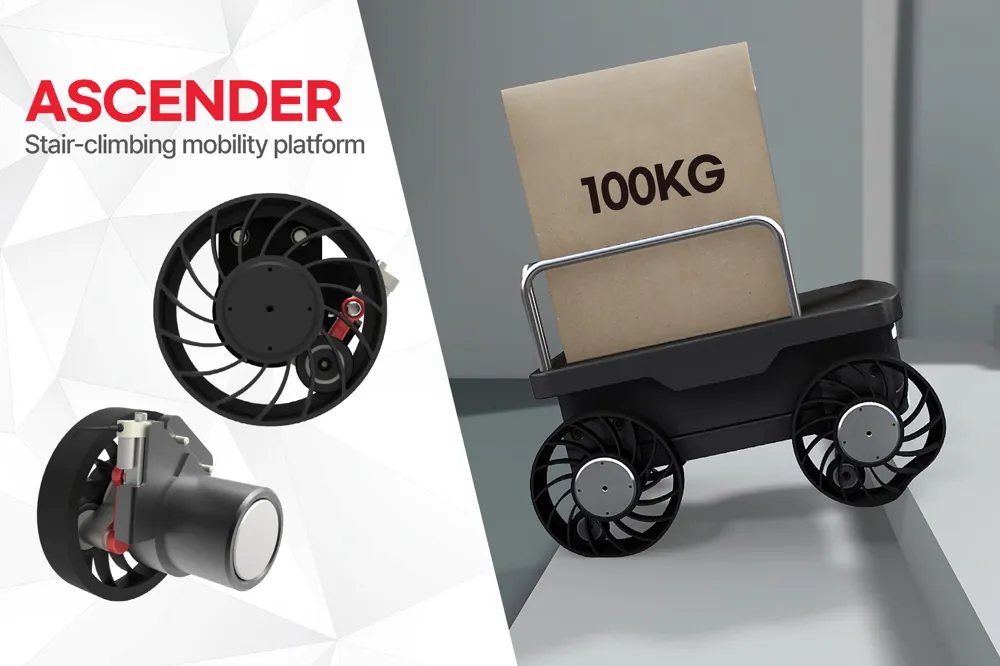
Ascender solves this problem with its patented elastic wheel technology. It maintains a circular shape like a normal wheel on flat surfaces, but when it encounters a curb or stairs, it elastically deforms to create additional contact area and torque, allowing it to climb naturally.
To achieve this, it employs a special elastic wheel with internal support rollers. It can also automatically optimize by detecting the angle of inclination with AI sensors and actuators when needed. This method can climb up to 130% of the wheel's diameter without using complex multi-joint legs or tracks, resulting in a simple structure and maintaining a driving speed of around 21km/h.
In summary, it is the first wheel platform to simultaneously achieve high-speed driving on flat ground and obstacle climbing capabilities, making it innovative in terms of driving efficiency and stability compared to similar products. Installing the Ascender module on existing electric wheelchairs or robots provides the differentiated performance of automatically overcoming curbs without separate devices.
Key Benefits
This technology is likely to be adopted as a module by outdoor service robot companies, electric wheelchair manufacturers, logistics robots, etc.Mobility companies (B2B)In fact, Safeway is collaborating with the Korea Expressway Corporation to apply it to traffic light inspection robots and is conducting a joint development PoC for Ascender wheelchairs with global electric wheelchair company WHILL.
It is also being tested in collaboration with Stanford University for application in indoor service robots. Therefore, the purchasing entities are companies such as robot developers and medical device manufacturers, and it will indirectly enter the B2G (local government infrastructure robots) or B2C (complete electric wheelchairs) market as a finished product.
Currently, commercialization is being carried out in the form of B2B licensing/joint development, and the end consumers will be individuals using robots/wheelchairs incorporating the technology.
Scalability
The Ascender platform is designed as a universal electric platform and can be widely applied to various wheeled mobility solutions such as delivery and patrol robots, electric strollers, and military robots. It can be used in markets worldwide without being tied to specific national regulations, but may require tuning depending on local terrain conditions (e.g., stair specifications).
Since it can be attached to existing products in module form, it can also target the retrofit market. If the unit price is lowered through mass production in the future, it has the potential to become a universal solution for improving mobility rights without improving urban infrastructure. Currently, it is also receiving support from the public sector (SBA Seoul Center) such as the Seoul Metropolitan Government, so initial diffusion is expected to start in the public and urban sectors and then expand to the private sector.
The technology itself is widely scalable, but Safeway's status as a small and medium-sized enterprise makes securing a global distribution network a future challenge.
Judges' Evaluation
At CES, Ascender was"introduced as a new standard for mobility accessibility"and received favorable reviews. It was recognized for its technological completeness in solving existing robotics challenges with its unique elastic wheel approach, and its market launch potential is also highly rated as it is already undergoing domestic demonstration with support from the Seoul Metropolitan Government.
In particular, it is also positive in terms of social impact as it can innovate the mobility limitations of wheelchair users. However, there are also realistic concerns that product stability and cost structure must be verified as it is still in the pre-mass production stage.
Overall, thanks to the CES Innovation Award and various partnership news,there is an expectation that "it will have a significant impact upon commercialization,"but there are also cautious views on how quickly a startup can enter the market on its own without a large company.
Analyst Insights
🔥 High marketability, high potential for commercialization with related companies
The award list data is based on the official CES 2026 website, and detailed analysis content is produced by USLab.ai. For content modification requests or inquiries, please contact contact@uslab.ai. Free to use with source attribution (USLab.ai) (CC BY)
댓글 (0)
댓글을 불러오는 중...