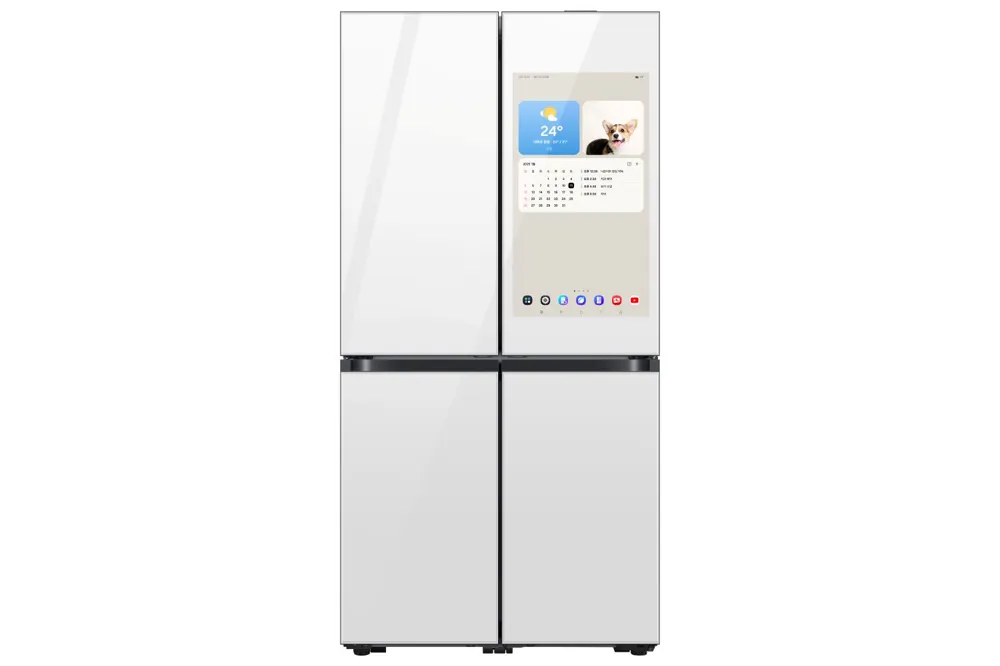
A smart refrigerator equipped with AI vision technology that recognizes internal food ingredients, suggests gene-based personalized diets, and automatically orders missing ingredients, making it a next-generation Family Hub refrigerator.
HonoreeSmart HomeAI 비전AI 에이전트스마트 냉장고개인 맞춤형 헬스케어식단 관리온라인 쇼핑
Family Hub™ with AI Vision Inside Powered by AI Agent
0
0
Samsung Electronics America
One-Line Product Definition
Problem Definition
Although smart refrigerators have emerged, their utilization has been low due to the inconvenience of manually inputting internal ingredients and their simple memo functions.
The lack of connection to personalized diet management based on individual health conditions has resulted in the absence of true healthcare appliances.
Key Differentiators
The latest Family Hub refrigerator has a camera + AI Vision inside to automatically recognize food in the refrigerator [74]. This information is linked to Dr. Twin AI, a gene-based health program, to recommend diets optimized for each family member's health condition [75].
For example, if one family member needs a low-sodium diet and another needs iron supplementation, the refrigerator suggests personalized recipes that can be made with the ingredients in the refrigerator. In addition, missing ingredients can be ordered online with one click from the refrigerator screen, leading to food ingredient management.
This is differentiated from existing smart refrigerators, which have been limited to show-off features, by substantially improving health promotion and convenience.
Key Adopters
Individual consumers (B2C) in households interested in health management are the target. It is especially useful for middle-aged families with diverse family member health conditions.
For B2B, healthcare institutions (patient diet management) or fitness centers can consider it as an additional service.
Scalability
Samsung Electronics' Family Hub platform is constantly evolving globally, so this AI feature is likely to be applied to models worldwide.
It can be expanded to medical services (nutritionist consultation) or smart kitchen device interworking in the future. However, the use of genetic information requires consideration of regulations such as individual consent.
Judges' Evaluation
It was evaluated as a "full-fledged convergence of home appliances and healthcare" [74]. Actual demonstrations at CES garnered attention, and it was praised as playing the role of a family doctor at home.
On the other hand, some skeptical views exist regarding actual accuracy and effectiveness, and there is an opinion that it should be monitored to see if it is an exaggeration.
Analyst Insights
⚠️ Impressive technology but market uncertain (concept is excellent, but it is unknown whether consumers will pay a premium for this level of functionality, and continuous usability needs to be verified)
The award list data is based on the official CES 2026 website, and detailed analysis content is produced by USLab.ai. For content modification requests or inquiries, please contact contact@uslab.ai. Free to use with source attribution (USLab.ai) (CC BY)
댓글 (0)
댓글을 불러오는 중...