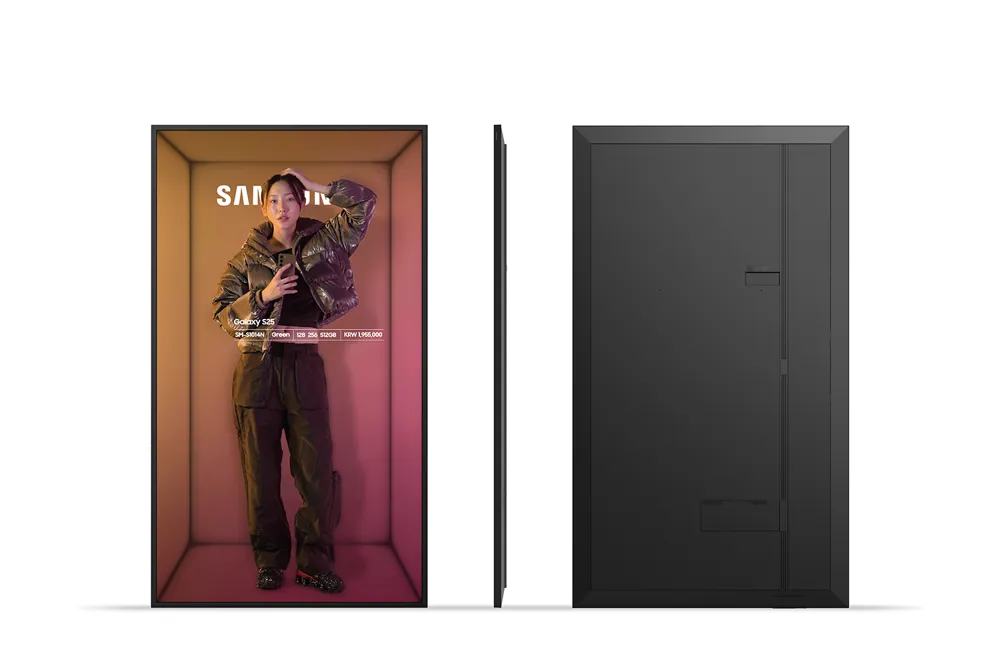
An 85-inch ultra-slim digital signage that displays 3D effects without glasses. As a commercial display, it adds depth to existing 2D content in stores and exhibitions, attracting customers with an immersive visual experience.
Best of InnovationkoEnterprise Tech3D 디스플레이공간 사이니지초박형 디자인베젤리스실감형 콘텐츠디지털 사이니지
삼성 스페이셜 사이니지
10
0
Samsung Electronics America
One-Line Product Definition
Problem Definition
Digital signage has become common in offline stores, but flat 2D screens have limitations in attracting attention.
Attempts have been made to use 3D holograms or stereoscopic displays to attract customers' attention, but existing solutions require special glasses, are thick, and are complicated to install. For example, some glassless 3D billboards are thick box shapes due to complex lens arrays, which limits interior design options and are very expensive. In addition, dedicated 3D content is required, adding to the burden of content creation.
Therefore, there was a need for an easy-to-use 3D digital signage with a thin and stylish form factor that can also utilize existing 2D videos. There was a need for a solution that is easy to install and operate while enhancing the immersive experience for consumers.
Key Differentiators
Samsung Spatial Signage is the world's first ultra-thin glassless 3D signage that embodies a sense of depth in a slim, flat form factor with a thickness of 52mm by embedding Samsung's proprietary 3D Plate technology into a general LCD panel.
Existing glassless 3D solutions were thick, box-shaped structures with multiple layers of LCDs. However, this product saves installation space and has a beautiful design because it creates a spatial depth effect with a single flat panel. The 85-inch large screen has almost no bezel, providing a high sense of immersion, and can be placed close to the wall without a box, harmonizing with high-end store interiors.
Importantly, it transforms existing 2D content to appear three-dimensional, so you can add depth to your current advertising images/videos without creating separate dedicated 3D videos. Integrated with Samsung VXT software, it allows you to remotely manage and synchronize displays in multiple stores, making it easy to update promotions across chain stores.
As a result, this product is Samsung's first commercial 3D display as the world's No. 1 digital signage company, and its core differentiation is that it is optimized for actual use in terms of design, thickness, and content compatibility.
Key Benefits
B2B customers are proactively adopting it. In the retail industry, shopping malls, flagship stores, and luxury brand stores in department stores can adopt it as an immersive display to stop customers in their tracks. In the advertising industry, it is expected to be used for outdoor billboards and exhibition booths. It can also be used as an eye-catching element in the entertainment/exhibition fields such as theme parks, stadiums, and museums.
The decision makers are usuallyCompanies (retail chain headquarters, advertising solution companies)or digital signage installation companies. This is not a product that general B2C consumers will purchase directly,Commercial/public space operators (B2B/B2G)are the customers. In particular, brands that value in-store experiences (e.g., car dealerships, mobile carrier experience stores, etc.) are expected to be interested.
Scalability
Since the commercial display market is global, this product will be sold to companies around the world.
In terms of technology licensing, it may take time for competitors to imitate because it utilizes Samsung's unique 3D Plate technology. The application field can be expanded to various fields other than retail advertising, such as education, medical care (e.g., 3D display in operating rooms), and corporate lobby promotional materials.
However, the glassless 3D effect may have viewing angle or distance limitations, so the effect is greater in environments within the optimal viewing distance. There are no regulations or national restrictions, but it is released in a single 85-inch size, which limits its ability to respond to the small signage area. If size diversification (55″, 110″, etc.) and interactive touch functions are added in the future, it will be able to cover more markets. In addition, supporting content creation tools and ecosystems will help expand customers.
Currently, it is expected that market development will be achieved by actively proposing it from global retailers to stadiums/exhibition halls through Samsung's B2B network.
Judges' Evaluation
It was introduced as the first product to receive the Innovation Award in the Enterprise Technology category at this CES, and has attracted the attention of industry experts. There is a sense of reassurance that the technical completeness has been verified to some extent due to the IFA 2025 demonstration history,“3D viewing without glasses has finally reached the practical stage.”is the evaluation.
In particular, the market is“Commercial 3D displays finally have practical usability.”expectations are being formed.
However, market expectations are cautious. Remembering the failure of consumer 3D TVs (the past boom in glasses 3D TVs quickly faded), there is a point that data is needed on how effective commercial 3D will be. The content effect is cited as an overestimation factor. Although 2D content also looks like 3D, there is an opinion that dedicated 3D content would be more impactful to achieve the optimal effect.
So far, it has drawn positive responses at the CES site with the novelty of "the screen appears to float in the air," but the advertising effectiveness indicators in actual stores must be proven in the future.
In summary,“Very interesting B2B display technology”is a favorable review, but the market is watching adoption conservatively.
Analyst Insights
📌 A solution limited to a specific niche – Useful as a tool to provide a differentiated experience in limited commercial spaces such as luxury retail and exhibitions. However, it is likely to remain in the niche B2B market because popularization in general commercial spaces will be limited due to price and content conditions.
The award list data is based on the official CES 2026 website, and detailed analysis content is produced by USLab.ai. For content modification requests or inquiries, please contact contact@uslab.ai. Free to use with source attribution (USLab.ai) (CC BY)
댓글 (0)
댓글을 불러오는 중...