A privacy-oriented home monitoring system that analyzes data from all devices in the house with local AI to detect security, safety, and health anomalies in real-time and suggests actions to the user.
HonoreekoSmart Home온디바이스 AI엣지 컴퓨팅스마트 홈AI 보안개인 정보 보호지능형 가전
삼성 EdgeAware AI Home
3
0
Samsung Electronics
One-Line Product Definition
Problem Definition
Existing smart home security mainly relies on CCTV cameras or sensors to notify intrusions, but lacks context awareness or comprehensive response to events. For example, it is difficult to know if there is a strange noise in the house unless it is captured by a camera, and individual device notifications are sporadic and can be missed by the user.
In addition, most operate with cloud interlock, raising privacy concerns as personal video/audio data is transmitted to external servers. Meanwhile, various devices such as smart TVs, appliances, and speakers in the home can be potential sensor/information sources, but they have not been integrated and utilized.
In other words, there was a need for a way to monitor the home in a more intelligent and privacy-conscious manner to ensure safety.
Key Differentiators
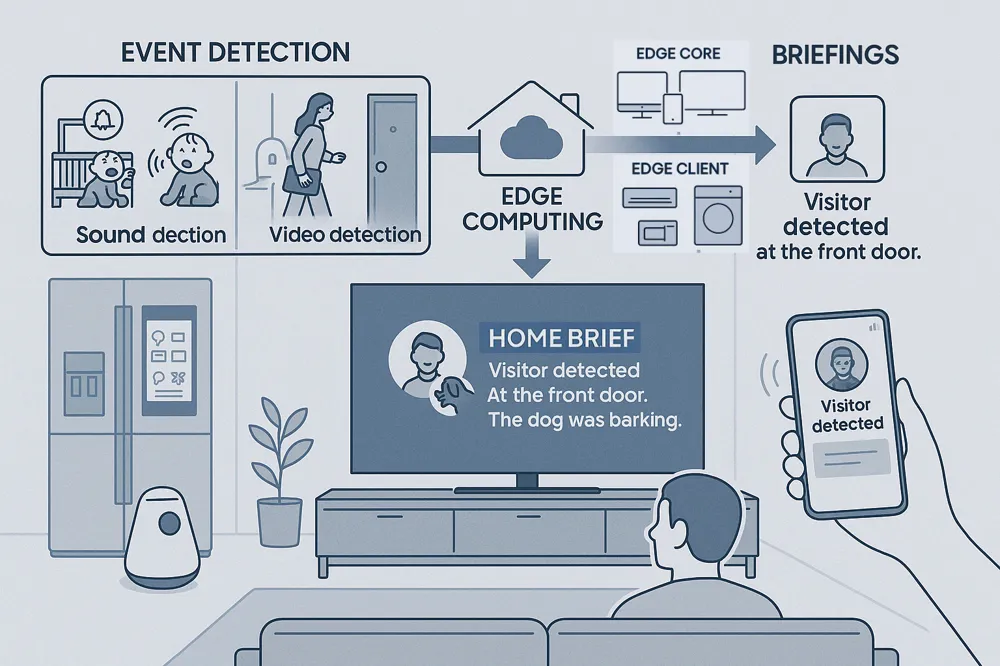
EdgeAware AI Home analyzes the home situation without sending data to the cloud usingedge computing (AI within the device)and is the industry's first fully edge-based home monitoring system. It does not rely solely on cameras, but comprehensively analyzes various sensor data from Samsung and third-party devices (e.g., sound, vibration, and video from TVs, refrigerators, and SmartThings-linked sensors) locally.
It recognizes 12 types of sounds (water flowing, glass breaking, dog barking, etc.) and understands the context of "why that sound occurred" beyond simple notifications. For example, if a "bang" sound is heard, it detects the risk of gas leakage/explosion, or if a continuous cough is heard, it suggests a remote medical app on the TV screen, providing customized responses to the situation.
It also provides an AI search function that allows you to quickly search for specific events such as "the moment the door is knocked" or "the doorbell rings," eliminating the need for people to manually search through vast amounts of home recording data.
The biggest feature is that it maximizes privacy protection by not transmitting personal video/audio data externally. Data is processed in the high-performance processor in the TV or smart appliance, allowing you to protect your home without the risk of cloud hacking.
In summary, it implements smarter and safer home monitoring through multi-sensor fusion + edge AI processing.
Key Target Adopters
General households (B2C) interested in smart home securityare the primary target. It appeals especially to young, tech-oriented consumers who value privacy and want to adopt the latest home security technologies, parents raising children (child safety/cry monitoring), and caregivers for the elderly.
Also, from the perspective of home security service providers (B2B), this technology can be used as a package solution and offered as a subscription service. For example, a security company or telecommunications company cancommercialize edge AI home monitoring services (B2B2C).can do.
Smart apartment complex developers (B2B)can also consider adopting it as a premium option. In B2G, it can be applied to support households in crime-vulnerable areas, but the focus will be on the private housing market for now.
Scalability
Expansion to other industries is possible, for example, by applying it to security systems for small stores or offices. Due to the nature of edge processing, it can be used even in places with poor network infrastructure, making it advantageous for global market expansion.
However, localization is necessary because the events to be detected and the notification system may vary from country to country. (e.g., the United States requires gunshot detection, Japan requires earthquake sound detection, etc.)
The speed of ecosystem expansion depends on how widely 3rd-party device integration is supported. If it is linked with various IoT sensor manufacturers in addition to Samsung devices, it can grow into a de facto standard home AI platform.
In terms of regulations, local data processing instead of the cloud makes it relatively free from personal information regulations such as GDPR, making it easier to form corporate partnerships. In the long term, the concept can be transferred to safety management of private spaces such as automobiles and hotels.
Judges' Evaluation
Expertsevaluate it as an attempt to "evolve the SmartThings ecosystem to the next level."The technical completeness seems to have already been implemented to a considerable level, such as identifying 12 types of sounds, and the cloud-free design has been praised as an innovative approach in the security industry.
It is positive because it meets the trend of emphasizing privacy in the market, but it is uncertain how much the general consumer will understand and accept this concept. As an overestimation criticism, there is the point that "they are ultimately advanced features, but the average person may feel that a camera alarm is sufficient." There are also concerns that the actual setup may be difficult due to the complexity of linking various devices.
However, the on-site reaction at CES 2026 was generally dominated by the evaluation that it was fresh as "next-generation home security using AI." Market verification is in its early stages, so it is currently at the level of raising expectations in terms of concept.
In summary, there are many opinions that "both the concept and technology are impressive, but it remains to be seen whether it will become popular."
Analyst Insights
⚠️ Impressive technology but market uncertainty – The differentiation of privacy-protected AI home monitoring is clear, but it may take time for consumers to understand and accept the new approach. It is attractive to the leading smart home segment, but popularization and business feasibility need to be observed further.
The award list data is based on the official CES 2026 website, and detailed analysis content is produced by USLab.ai. For content modification requests or inquiries, please contact contact@uslab.ai. Free to use with source attribution (USLab.ai) (CC BY)
댓글 (0)
댓글을 불러오는 중...