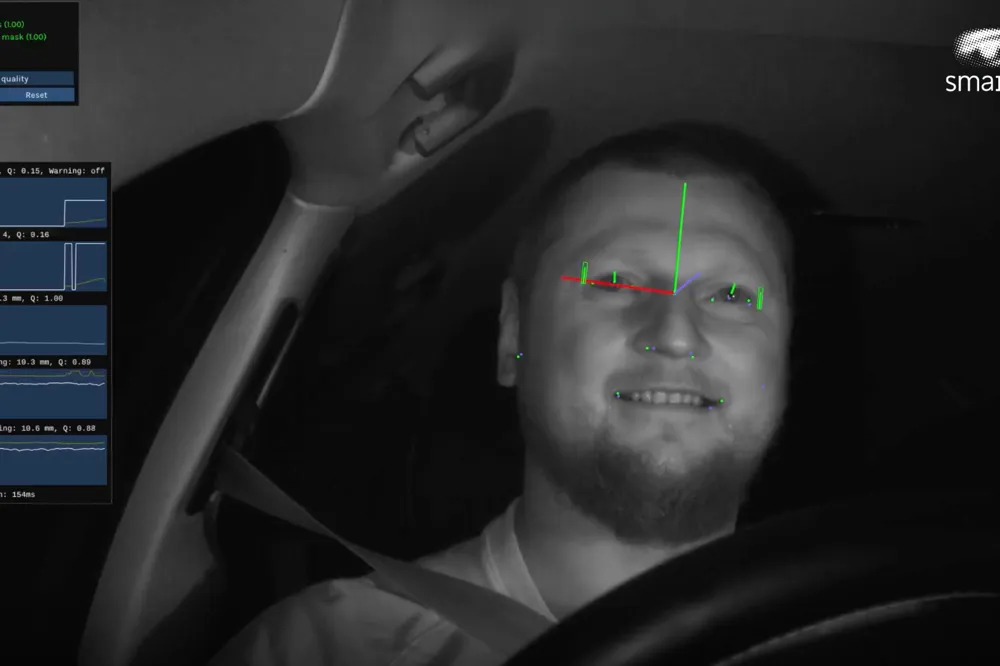
Real-time In-Vehicle Alcohol Detection – The world's first commercialized technology that is integrated into a Driver Monitoring System (DMS) camera and analyzes real-time changes in a driver's eye movements and eyelid behavior to detect signs of cognitive and motor skill impairment due to alcohol.
HonoreeVehicle Tech & Advanced Mobility운전자 모니터링 시스템음주 운전 감지AI 기반 분석행동 패턴 분석생체 신호 분석도로 안전 기술
Real-Time Alcohol Impairment Detection for Driver Monitoring Systems
74
0
Smart Eye AB
One-Line Product Definition
Problem Definition
Drunk driving is a serious problem, causing over 12,000 deaths annually in the United States alone. Previously, vehicles lacked built-in systems to detect driver intoxication, relying mainly on police enforcement, post-incident penalties, or *interlocks* installed in the vehicles of some repeat offenders.
However, these measures are not applied to all drivers in real-time, and ordinary drivers, in particular, are unchecked if they avoid drunk driving enforcement. While Driver Monitoring System (DMS) technology is being introduced in the pre-autonomous driving stage, it only detects drowsiness or inattentiveness and does not identify cognitive impairment due to alcohol.
International regulatory bodies (such as the US NHTSA and European NCAP) are seeking to require alcohol detection features in new vehicles in the future, but technical implementation remains a challenge. Ultimately, a system is needed to immediately recognize unique eye behavior changes caused by alcohol consumption while driving.
Key Differentiators
Smart Eye's real-time alcohol detection feature determines whether a driver is intoxicated using only the vehicle's interior camera, without requiring separate devices. This is based on the principle that a person's eye movements and blinking patterns change subtly under the influence of alcohol.
For example, alcohol can cause abnormally slow blinking, dulled pupil response, and unsteady gaze. The system analyzes DMS camera footage with AI to capture these subtle changes in real-time. By using machine learning to learn combined patterns of eyelid drooping, difficulty in sustained gaze, and subtle eye tremors, the system immediately classifies the driver as "suspected of intoxication" when it detects a clear deviation from the norm.
This feature is integrated into Smart Eye's existing driver monitoring software, allowing implementation with just a software update without the need for additional hardware. It is also tuned to meet the real-vehicle test scenarios required by major global safety certification bodies, and is developed to produce highly reproducible results across various driver demographics (race, age, gender) during real road driving.
In particular, European NCAP will introduce alcohol detection assessment from 2025, and this technology is currently considered the closest to commercial realization. As the description *
In conclusion, this technology can prevent drunk driving accidents by immediately recognizing careless driving patterns caused by alcohol consumption and enabling warnings or vehicle intervention (speed reduction, hazard light activation, etc.).
Key Adopters
Automotive OEMs and Tier-1 suppliers (B2B)are the direct customers of this feature. Since DMS (Driver Monitoring System) has already been mandated for new vehicles in Europe from 2026, premium brands such as Mercedes-Benz, BMW, and Genesis, as well as general brands, are adopting DMS. These car manufacturers purchase software from DMS specialists like Smart Eye and install it in their vehicles.
In particular,Commercial vehicle/truck companies and logistics companies (B2B)are also sensitive to preventing drunk driving and will require DMS with this feature. Ultimately, government regulations are likely to mandate it forall mass-produced vehicles (B2C).Currently, it is a B2B (business-to-vehicle manufacturer) model, but around 2030, consumers are expected to ask, "Does our car have an alcohol detection feature?"
Scalability
Very high. According to US infrastructure law, the application of drunk driving prevention technology to vehicles sold in the US is being promoted between 2027 and 2029, and Europe also has long-term mandatory discussions separate from the NCAP assessment. Due to these regulatory drivers, this feature is likely to become a standard safety feature in new cars worldwide within a few years.
Smart Eye is one of the world's top 1-2 companies in the DMS field and already has partnerships with many OEMs, so it also has channels to supply updates. In terms of technology, it is a software solution, so it can be distributed without regional differences, and only model tuning tailored to various demographics is required.
If expanded, algorithms can be added to detect cognitive impairment due to drugs/fatigue in addition to alcohol,occupations involving machinery operation other than driving (heavy equipment operation, etc.)can also be considered for application. In summary, the regulatory trend and social demand are clear, and it is expected to be expanded to almost all vehicles within a few years.
Judges' Evaluation
It has been recognized on the international stage by winning the CES 2026 Innovation Award in the Vehicle Technology category. Automotive media such as Car and Driver were amazed, saying, *
Regarding the completeness of the technology, Smart Eye has already accumulated various driver data (including drunk state experiments) for several years to develop the model, and there is praise that it is *
Market expectations are very high,"This technology could significantly reduce drunk driving deaths."There is even social expectation attached to it. Rather than being an exaggeration, it is a feature that everyone agrees on the need for, so car manufacturers are expected to announce its installation competitively. Smart Eye, which currently has a technological advantage, is in a favorable position to preempt the market and is recognized as *
Analyst Insights
🔥 High Marketability / Feasible Business Connection – It is a core safety technology that will soon be applied to all vehicles due to regulations and social demand. Smart Eye's solution is realistic and implementation-ready, and is expected to be adopted by most car manufacturers within a few years, contributing to the protection of human lives.
The award list data is based on the official CES 2026 website, and detailed analysis content is produced by USLab.ai. For content modification requests or inquiries, please contact [email protected]. Free to use with source attribution (USLab.ai) (CC BY)
댓글 (0)
댓글을 불러오는 중...