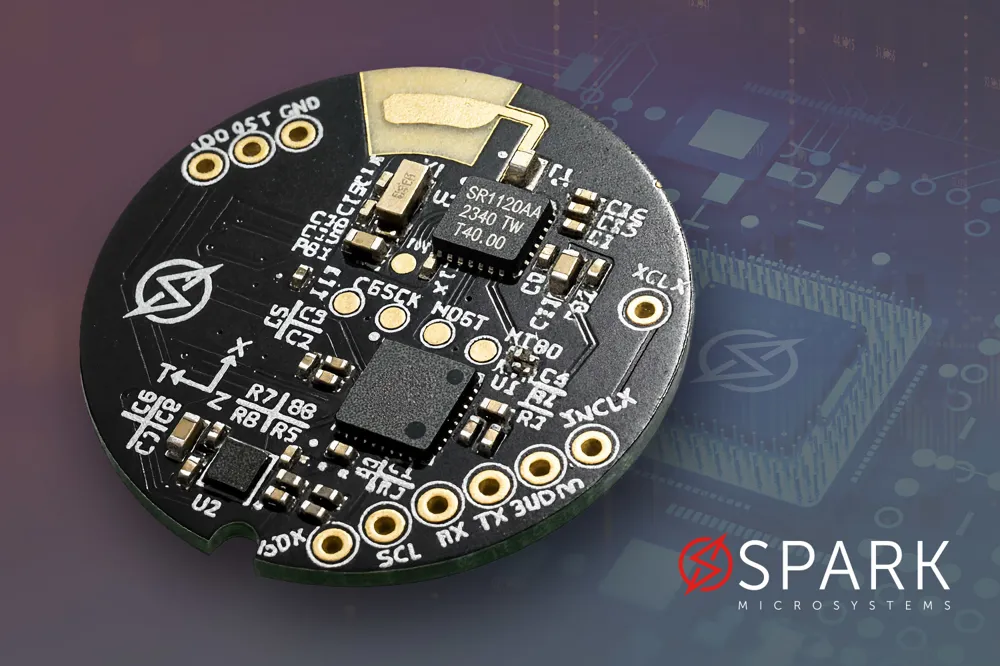
An ultra-wideband wireless chip with 40x the speed and 25x lower power consumption compared to Bluetooth (a LE-UWB transceiver for short-range wireless communication, optimized for next-generation devices requiring low power and low latency).
HonoreeEmbedded TechnologiesLE-UWB초저전력 통신무선 트랜시버저지연IoT근거리 통신
SPARK SR1120 LE-UWB™ 무선 트랜시버
5
0
SPARK Microsystems International Inc.
One-Line Product Definition
Problem Definition
Numerous IoT devices, wearables, and audio devices are wirelessly connected, but existingBluetooth Low Energy (BLE)or Wi-Fi technologies have limitations. BLE is low-power but slow and has long latency, making it unsuitable for high-quality audio or applications requiring real-time response. Wi-Fi, on the other hand, has high bandwidth but consumes a lot of power, burdening battery-powered devices. Also, its congested frequency band is prone to interference, making it difficult to guarantee stable real-time performance.
Moreover, both BLE and Wi-Fi have limited precision ranging capabilities, requiring additional technologies (such as UWB tags) for precise short-range location recognition. In short, next-generation devices such as AR/VR glasses, wireless VR controllers, high-fidelity wireless earphones, and real-time sensor networks require faster, lower-latency, and more power-efficient wireless, but current standards have limitations. Furthermore, ultra-low power wireless is essential for the era of battery-free energy harvesting sensors, which BLE has not yet achieved.
Key Differentiators
The SPARK SR1120 transceiver pioneers a new category calledLow-Energy UWBachieving a qualitative leap compared to existing wireless technologies. Its data rate is 40 times higher than BLE (up to 40.96 Mbps), easily handling lossless audio (24bit/96kHz) streaming or AI glass video data transmission.Communication latencyis below 200µs, up to 60 times lower than BLE, making it suitable for immediate reflection of controller operations or real-time sensing.
Nevertheless, its power efficiency is dramatically better, consuming only 1 nanojoule (nJ) per bit transmitted, saving energy by 25 times compared to BLE and 100 times compared to Wi-Fi. This not only extends battery life but also makes energy harvesting operation (operating on environmental energy without charging) a reality. Also, due to the nature of UWB technology,precise distance measurement (accuracy below several tens of cm)is possible, enabling simultaneous provision of location-based services.
The SR1120 chip uses an impulse radio architecture for high interference resistance and security, and supports multi-antenna (MIMO) to increase transmission reliability. From a competitive standpoint, existing UWB chips (used in smart tags, etc.) focus only on distance measurement and have weak data transmission capabilities, while the SR1120 is the only solution that implements distance measurement and high-speed data transmission at once, and even with ultra-low power consumption. In summary, it has a practical advantage as a next-generation short-range wireless that combines only the advantages of BLE+UWB+Wi-Fi.
Key Adopters
Key adopters: Electronic device manufacturers (B2B)who put communication functions into finished products will purchase this transceiver chip and install it in their products. For example, wireless gaming peripheral companies (requiring ultra-low latency for mice, keyboards, etc.), AR/VR device manufacturers, and audio device manufacturers (high-fidelity, low-latency earphones, speakers) are major customers. In addition, wearable medical device companies (real-time patient monitoring sensors) and industrial IoT sensor network companies can also introduce this chip to improve product performance.
Specifically, for example, Meta/Oculus may adopt SR1120 instead of BLE in VR controllers, or Bose/Sony may apply it to next-generation wireless earphones. A development kit is provided, and a wide range of B2B customers from startups to large corporations are expected. Ultimately, consumers will benefit from products with this chip embedded (B2B2C).
B2C/B2B classification: B2B (supplied to device manufacturers as semiconductor components)
Scalability
Environmental/regulatory restrictions: Wireless chips must obtaincommunication certifications (FCC, CE, etc.)in each country, but the UWB band already has bandwidth regulations, and SPARK would have designed with regulatory compliance in mind. Due to the nature of UWB, the allowable frequency range or output limit must be adjusted for each country, but this part can be technically adjusted. In terms of security, general-purpose compatibility can be obtained by complying with the IEEE 802.15.4z UWB standard, etc.
Industry/market scalability: Market scalability is very large, but the battle with competing standards is a variable. The Bluetooth camp is also improving BLE, and Wi-Fi is also releasing a low-power mode (Wi-Fi HaLow, etc.), so industry alliances and ecosystem construction are necessary for SPARK's LE-UWB to be widely adopted as a standard. Fortunately, leading companies in specific fields such as acoustics and gaming are showing interest, so it can expand its position from niche markets.
For example, judging from the attention paid by professional media such as AudioXpress, the audio industry is responding favorably. SPARK has already released a development kit and is holding a booth at CES to conduct AR glass/audio demos to attract partners. In the Internet of Things sensor sector, ultra-low power consumption is very attractive, so it may be adopted as a replacement for BLE in smart buildings, industrial sensor networks, etc.
Ultimately,"connecting everything without a single wire"In the future vision of , SPARK's technology can contribute to completely eliminating cables. For example, an ecosystem where all PC peripherals are wireless, VR headsets are wireless (cable removal), and even batteries are removed from sensors (energy harvesting). If SPARK cooperates with foundries to smoothly mass-produce, it can enter various industries at the same time, so explosive growth is expected. The key is whether large companies (Qualcomm, etc.) will compete with similar technologies, but SPARK's leading position is currently clear.
Judges' Evaluation
The SR1120 chip, which received the CES 2026 Innovation Award in the Embedded Technologies category, has been"re-writing the rules of wireless performance"Audio professional magazine AudioXpress introduced it as"next-generation wireless that surpasses Bluetooth and Wi-Fi"highlighting figures such as 40x speed/25x efficiency/60x lower latency. It also reported that the SPARK chip will break the limitations of modern consumer devices with "connectivity suitable for the AI and AR era."
The industry showed great interest in the LE-UWB™ concept presented by SPARK, and demonstrations of AR glasses, gaming mice, and wireless HiFi audio were held at the CES booth, surprising those involved. The technological completeness is already reliable as an improved version of the previous generation chip (SR1020, etc.), and experts paid attention to the announcement that performance has doubled with this chip. Market expectations are very high, but there are also voices pointing out technology standard competition.
Some communication experts say, "Because BLE is so widespread, it may take time for SPARK to penetrate the market," but also"It will be adopted for special purposes first."The evaluation of SPARK itself is positive as "a small but strong fabless company," and it is analyzed that winning the CES award has raised its reputation and turned on a green light in terms of attracting investment and partnerships. There are almost no criticisms of overestimation, and rather"Innovation has finally arrived in the wireless field"and more attention than expected is being focused on it.
As an example, it became a hot topic on industry social media such as LinkedIn, and in audio enthusiast communities, there was a response saying, "I'm looking forward to a wireless DAC/amplifier with this chip" (community mentions, low reliability). Overall, although public awareness is still low compared to the technical impact, expert evaluations are very high, and there are great expectations for future developments.
Analyst Insights
🔥 High marketability / Possible business connection (A high value-added semiconductor product that is evaluated as the core of next-generation wireless communication and is expected to be widely commercialized through collaboration with various electronic product manufacturers.)
The award list data is based on the official CES 2026 website, and detailed analysis content is produced by USLab.ai. For content modification requests or inquiries, please contact contact@uslab.ai. Free to use with source attribution (USLab.ai) (CC BY)
댓글 (0)
댓글을 불러오는 중...